GS 3: Internal SecurityGS 2: International RelationsGS 3: Environment & EcologyGS 3: EconomyPrelims
‘India-EU FTA can be a game changer’, Pg14
German Ambassador declares India-EU FTA a 'game changer,' promising massive trade, investment, defence collaboration, and skilled worker opportunities.
Practice MCQs
891 Students attempted
Key Highlights:
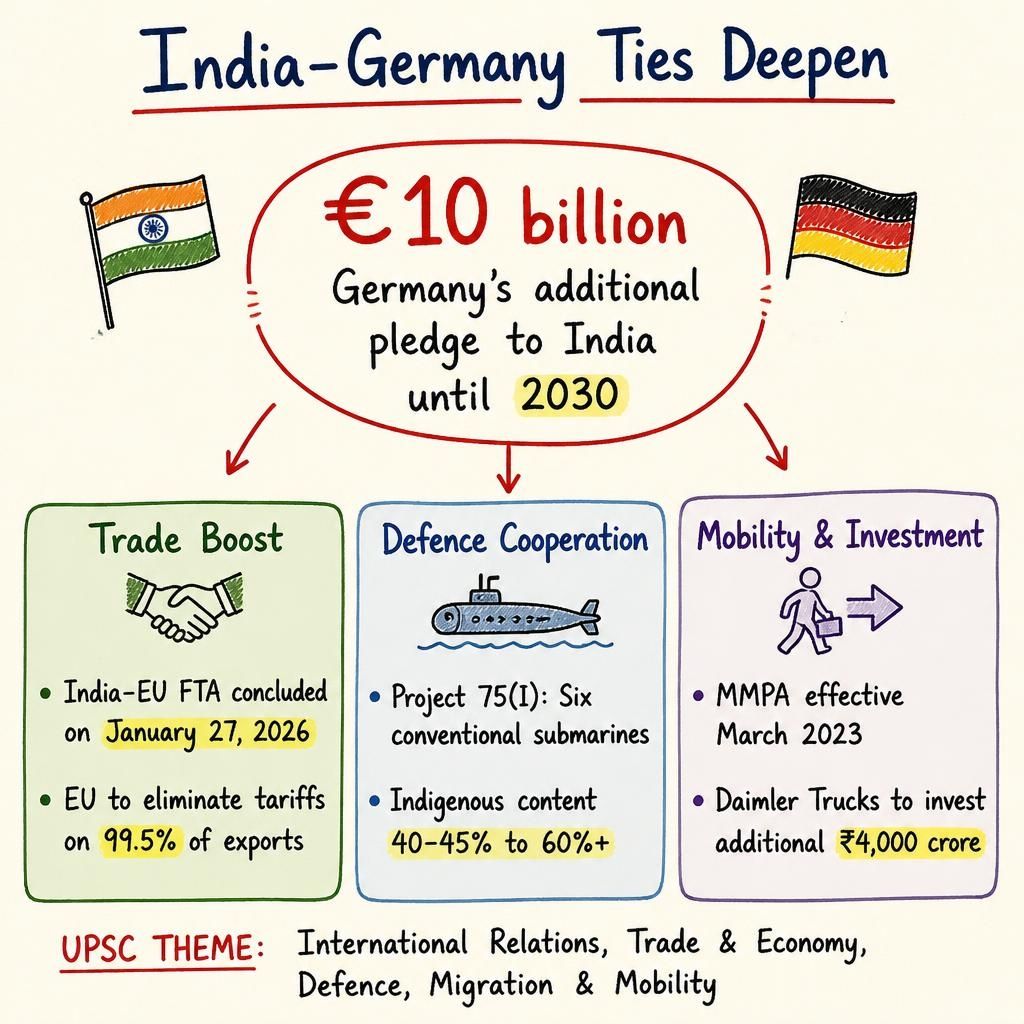
- Negotiations for the India-EU Free Trade Agreement (FTA) concluded on January 27, 2026, aiming to liberalize trade and investment between the two economic blocs.
- Germany has pledged an additional €10 billion in development assistance to India until 2030 under the Green and Sustainable Development Partnership (GSDP), which was launched in May 2022.
- German firm ThyssenKrupp Marine Systems (TKMS) and India's Mazagon Dock Shipbuilders Limited (MDL) are in final negotiations for Project 75(I), a program to indigenously build six conventional submarines.
- The Migration and Mobility Partnership Agreement (MMPA) between India and Germany, signed in December 2022 and effective March 2023, facilitates pathways for Indian students and skilled workers to study and work in Germany.
- German companies are making significant investments in India, particularly in Tamil Nadu, with Daimler Trucks planning an additional ₹4,000 crore investment in its plant.
India-EU FTA.jpg
Detailed Insights:
- The India-EU FTA is envisioned as a "game changer" that will create a free trade zone encompassing approximately 2 billion people and about 25% of the global GDP.
- Under the agreement, the EU will eliminate tariffs on 99.5% of Indian exports by value, while India will offer concessions on 97.5% of EU import value.
- This agreement is expected to significantly boost India's labor-intensive sectors such as textiles, apparel, leather, and footwear by providing duty-free access to the European market.
- The Green and Sustainable Development Partnership (GSDP) focuses on key areas including climate action, energy transition, sustainable urban development, and green mobility.
- The Indo-German Energy Forum (IGEF), established in 2006, has been a crucial platform for bilateral energy cooperation, supporting initiatives in renewable energy expansion and green hydrogen.
- Project 75(I) involves the indigenous construction of six advanced conventional diesel-electric submarines equipped with Air-Independent Propulsion (AIP) technology.
- The project mandates a progressive increase in indigenous content, starting from 40-45% for the first submarine and reaching 60% or more for the sixth.
- TKMS has expressed readiness to establish a production hub in India for the export of submarines to third markets, especially in Southeast Asia and Latin America.
- The Migration and Mobility Partnership Agreement (MMPA) includes provisions for extended residence permits of up to 18 months for Indian students in Germany and allocates 3,000 annual German Job Seeker Visas for Indian professionals.
- The number of Indian students enrolled in German universities has quadrupled to 70,000 over the past nine years, with approximately half choosing to remain in Germany for employment after completing their studies.
Key Concepts Involved:
- Free Trade Agreement (FTA): A treaty between two or more countries to reduce or eliminate trade barriers, such as tariffs and quotas, to promote the exchange of goods and services.
- Air-Independent Propulsion (AIP): A marine propulsion technology that allows non-nuclear submarines to operate without surfacing to access atmospheric oxygen for extended periods, significantly enhancing their stealth and underwater endurance.
- Strategic Partnership: A comprehensive, long-term bilateral relationship between two nations, involving cooperation across diverse sectors like economy, defence, technology, and culture.

SuperKalam is your personal mentor for UPSC preparation, guiding you at every step of the exam journey.
Download the App


STUDY RESOURCES
CONTACT US
ⓒ Snapstack Technologies Private Limited