GS 2: International RelationsPrelimsGS 2: Bilateral, Regional and Global Groupings and AgreementsGS 2: Effect of Policies and Politics of Developed and Developing Countries on India's Interests
After Elections, More Pressure For Peace, Pg13
US and Israeli political shifts, coupled with Iran conflict costs, create a diplomatic opening for Middle East peace, urging a sustainable regional security framework.
Practice MCQs
891 Students attempted
Key Highlights:
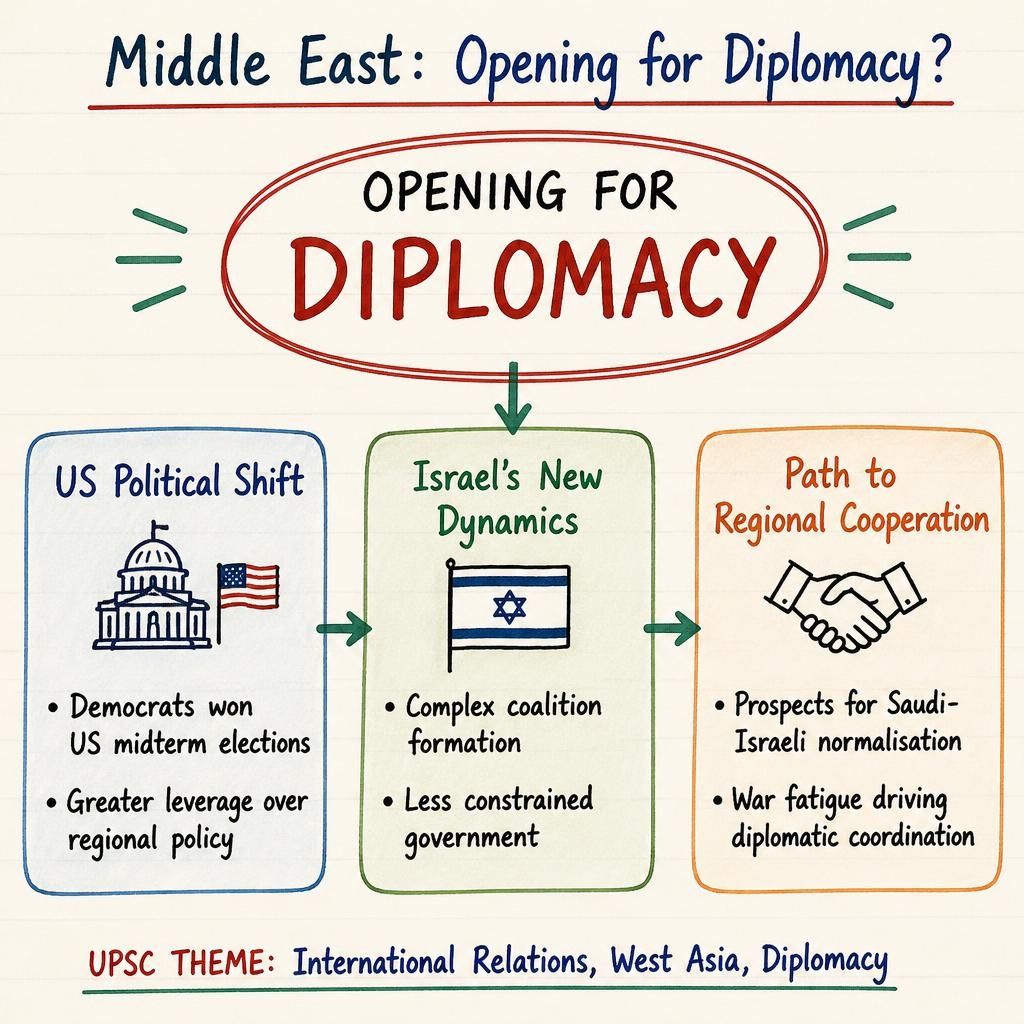
- The evolving political landscape in the US and Israel, coupled with mounting economic and strategic costs of the Iran conflict, may be creating an opening for diplomacy in the Middle East.
- US midterm elections resulted in Democratic victories, altering Washington's political environment and potentially constraining the administration's capacity for open-ended military campaigns.
- Israel's recent elections led to a complex coalition formation, which could reduce a future government's dependence on hardline political constituencies.
- Prospects for Saudi-Israeli normalisation are significant, with Riyadh's insistence on meaningful progress on the Palestinian question remaining a major obstacle.
- Growing war fatigue and shared concerns over maritime security and energy flows are encouraging greater diplomatic coordination and regional agency.
Middle East Diplomacy.jpg
Detailed Insights:
- A Democratic-controlled US Congress will have greater leverage over regional policy through its control over appropriations, oversight, and scrutiny of arms transfers.
- This shift could create stronger incentives for the US administration to explore diplomatic alternatives, potentially offering President Trump an opportunity to establish a foreign policy legacy.
- Diplomacy might involve negotiated understandings with Tehran on its nuclear program, freedom of navigation through the Strait of Hormuz, and non-aggression arrangements involving Gulf states.
- A less constrained Israeli government could have greater room to combine deterrence with diplomatic engagement and rebuild international credibility.
- A stronger commitment to addressing extremist violence and improving humanitarian and political conditions in Palestinian territories is essential for restoring international confidence in Israel.
- The Iran conflict has exposed both the limits of military power and the vulnerabilities of the regional security architecture.
- Converging interests could provide a basis for containing Iranian proxies, stabilizing Gaza, Lebanon, and Syria, and advancing the Abraham Accords.
- Sustainable cooperation will depend on addressing Iran-related security concerns and the Palestinian question, rather than bilateral normalisation alone.
- Existing initiatives, including the US administration’s Gaza transitional framework, offer potential foundations for a broader diplomatic process.
Key Concepts Involved:
- Abraham Accords: A series of normalization agreements between Israel and various Arab nations.
- Strait of Hormuz: A strategically vital waterway connecting the Persian Gulf to the Arabian Sea.
- Coalition Government: A cabinet of a parliamentary government in which several political parties cooperate.
- Gaza transitional framework: A proposed plan by the US administration for the interim governance and reconstruction of Gaza.

SuperKalam is your personal mentor for UPSC preparation, guiding you at every step of the exam journey.
Download the App


STUDY RESOURCES
CONTACT US
ⓒ Snapstack Technologies Private Limited