GS 2: GovernanceGS 2: PolityGS 2: Social JusticePrelimsGS 2: Government policies and interventions for development in various sectors
Work out a plan for capping prices of all drugs: SC to govt., Pg12
Supreme Court directs government to cap prices of all essential medicines and medical devices, questioning exorbitant mark-ups beyond cancer drugs.
Practice MCQs
883 Students attempted
Key Highlights:
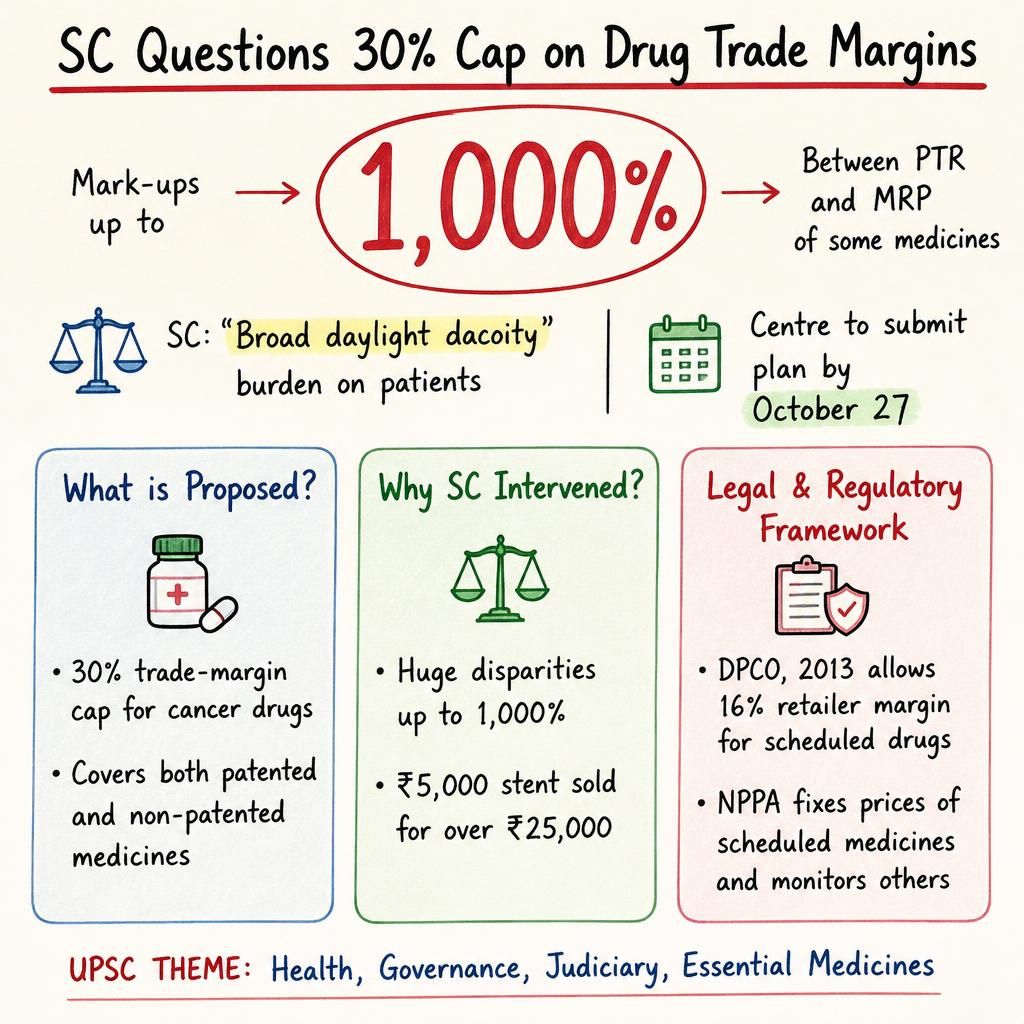
- The Supreme Court questioned the Centre's decision to cap trade margins at 30% only for non-scheduled cancer drugs, urging its extension to all essential medicines and medical products.
- The Court highlighted extreme disparities between the price to retailer (PTR) and maximum retail price (MRP) of certain medicines, with mark-ups reaching up to 1,000%.
- The Centre's proposed 30% trade-margin cap for cancer drugs will cover both patented and non-patented medicines.
- The Supreme Court cited instances of medical devices like cardiac stents, costing ₹5,000, being sold for over ₹25,000.
- The Court has given the Centre until October 27 to formulate a plan for capping prices of all medicines.
Drug Pricing.jpg
Detailed Insights:
- The Supreme Court termed the exorbitant mark-ups as "broad daylight dacoity," emphasizing the financial burden on patients.
- The petitions before the Supreme Court sought stricter enforcement of price controls under the Drugs (Prices Control) Order (DPCO), 2013, to curb disproportionate margins.
- The DPCO, 2013, allows a 16% retailer margin for scheduled medicines, which the Court suggested could be a benchmark for other drugs.
- The National Pharmaceutical Pricing Authority (NPPA) is responsible for fixing ceiling prices of scheduled medicines and monitoring prices of non-scheduled drugs.
- In 2019, the NPPA capped trade margins on 42 non-scheduled anti-cancer drugs, leading to an average 50% price reduction and estimated annual savings of ₹984 crore.
- Non-scheduled drugs are not subject to direct price ceilings, but their MRP cannot be increased by more than 10% annually.
- The National List of Essential Medicines (NLEM) forms the basis for identifying drugs under price control as scheduled formulations.
Key Concepts Involved:
- Drugs (Prices Control) Order (DPCO), 2013: A legal framework under the Essential Commodities Act, 1955, to regulate drug prices in India.
- National Pharmaceutical Pricing Authority (NPPA): A government regulatory agency established in 1997 to fix and revise drug prices and ensure their availability and affordability.
- Scheduled Drugs: Medicines listed in Schedule-I of the DPCO, 2013, whose ceiling prices are fixed by the government.
- Non-Scheduled Drugs: Medicines not listed in Schedule-I of the DPCO, 2013, whose initial prices are market-determined but annual increases are capped.
Previous12/12

SuperKalam is your personal mentor for UPSC preparation, guiding you at every step of the exam journey.
Download the App


STUDY RESOURCES
CONTACT US
ⓒ Snapstack Technologies Private Limited