GS 2: GovernanceGS 1: Indian SocietyGS 2: Social JusticeGS 3: EconomyPrelims
Why does India need a trained workforce for elderly care?, Pg9
India's aging population demands a trained elderly care workforce; NITI Aayog and Budget 2026-27 initiatives aim to professionalize caregiving, addressing social and economic challenges.
Practice MCQs
883 Students attempted
Key Highlights:
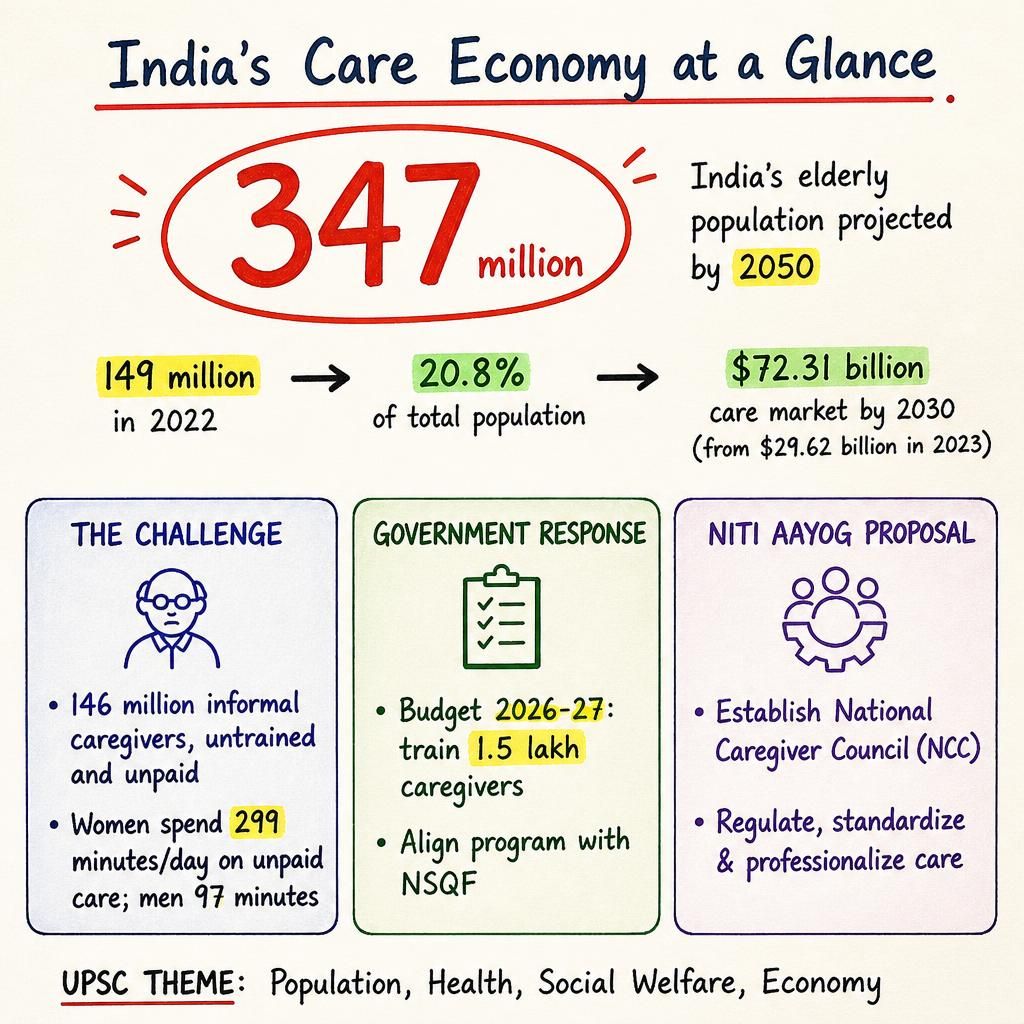
- India's elderly population, estimated at 149 million in 2022, is projected to reach 347 million by 2050, constituting approximately 20.8% of the total population.
- The Budget 2026-27 announced plans to train 1.5 lakh caregivers, aligning the program with the National Skills Qualifications Framework (NSQF).
- A NITI Aayog report, "Reimagining Care: Strategies for Empowering Caregivers in Viksit Bharat@2047," redefines caregiving as an economic activity rather than solely welfare work.
- An estimated 146 million informal caregivers currently operate in India, largely untrained and unpaid.
- Women spend an average of 299 minutes per day on unpaid domestic work and caregiving, significantly more than men's 97 minutes.
Care Economy.jpg
Detailed Insights:
- The growing elderly population and the shift from joint to nuclear families necessitate a formal, trained caregiving system.
- The NITI Aayog report proposes establishing a National Caregiver Council (NCC) to regulate, standardize, and professionalize caregiving services across the country.
- The proposed NCC would set minimum standards, develop comprehensive curricula, and manage a National Caregiver Registry and digital platform.
- Existing initiatives include Kerala's Kudumbashree's K4 Care training programme, which certifies women as geriatric/patient/disability care executives.
- The NHSRC has developed a Training Manual on Elderly Care for ASHA workers, with training delivered through Ayushman Bharat Health and Wellness Centres.
- A national caregiving curriculum must integrate geriatric mental health and behavioral management alongside physical care protocols.
- Formalizing the care economy is seen as a strategic move to unlock economic value and provide dignity to caregivers.
- The Indian care services market, valued at $29.62 billion in 2023, is projected to grow to $72.31 billion by 2030.
Key Concepts Involved:
- National Skills Qualifications Framework (NSQF): A competency-based framework that organizes qualifications according to levels of knowledge, skills, and aptitude.
- Viksit Bharat@2047: The Government of India's vision to transform India into a developed nation by 2047, focusing on economic growth, social development, and global influence.
- NITI Aayog: The primary policy 'Think Tank' of the Government of India, responsible for providing directional and policy inputs.
- Kudumbashree: A poverty eradication and women empowerment program implemented by the State Poverty Eradication Mission of the Government of Kerala.
- ASHA workers: Accredited Social Health Activists, who are community health volunteers working under the National Health Mission.
- Ayushman Bharat Health and Wellness Centres: Initiatives under Ayushman Bharat aimed at delivering comprehensive primary healthcare services closer to communities.

SuperKalam is your personal mentor for UPSC preparation, guiding you at every step of the exam journey.
Download the App


STUDY RESOURCES
CONTACT US
ⓒ Snapstack Technologies Private Limited