GS 2: GovernanceGS 3: Disaster ManagementGS 3: Environment & EcologyPrelimsGS 3: Disaster and Disaster Management
Warming Himalayas demand a rethink on development, Pg6
Warming Himalayas face unprecedented climate-induced disasters, necessitating urgent policy rethink on development and infrastructure projects for regional resilience.
Practice MCQs
883 Students attempted
Key Highlights:
- The Indian Himalayan Region (IHR) faces frequent and severe climate-induced disasters due to unheeded calls for sustainable development.
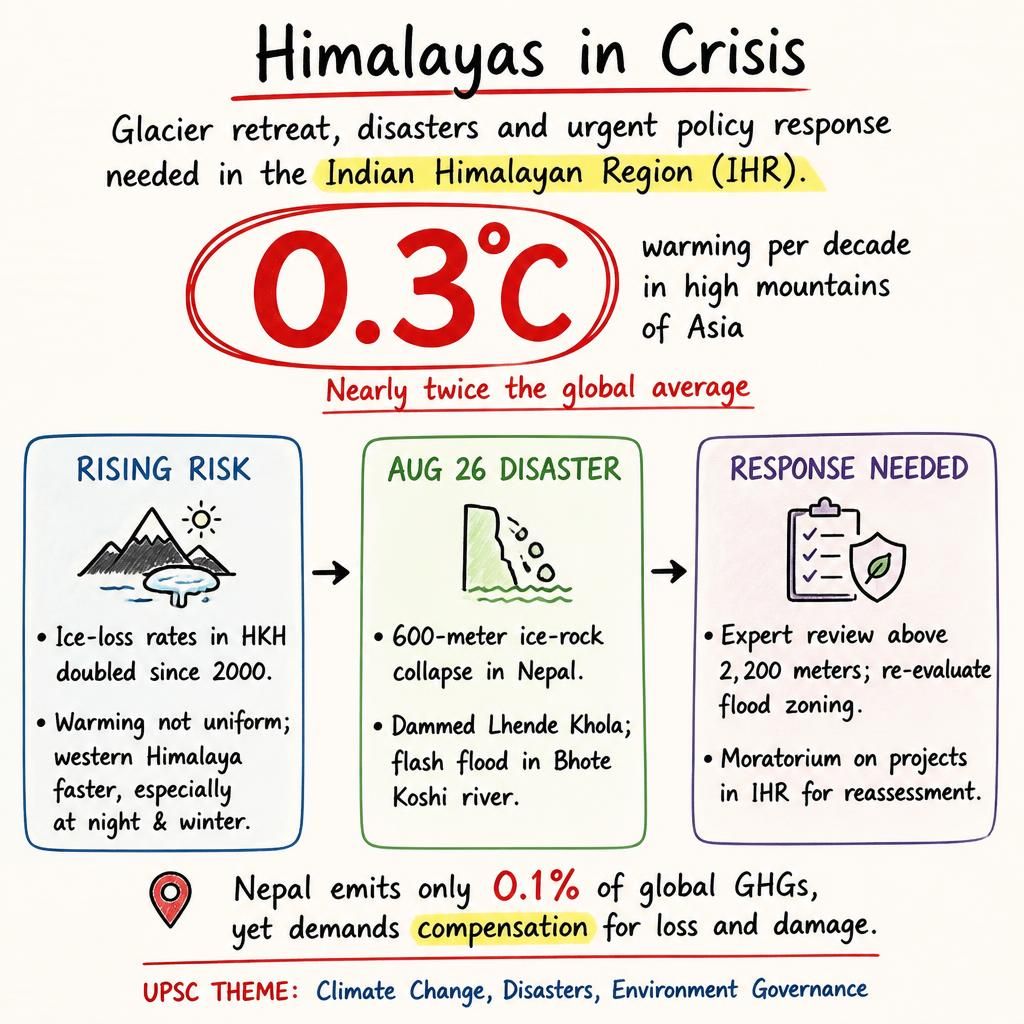
- High mountains of Asia are warming at 0.3°C per decade, nearly twice the global average, leading to glacier retreat and increased disaster risk.
- Reports released on March 21, 2026, by the International Centre for Integrated Mountain Development (ICIMOD) indicate that ice-loss rates across the Hindu Kush Himalaya (HKH) have doubled since 2000.
- A catastrophic event on August 26 saw a 600-meter section of ice and rock collapse from Langtang Himal in Nepal, causing a flash flood.
- Nepal, contributing only 0.1% of global greenhouse gas emissions, is demanding compensation for climate-induced loss and damage.
Himalayas in Crisis.jpg
Detailed Insights:
- The Intergovernmental Panel on Climate Change (IPCC) and the World Meteorological Organization (WMO) have consistently warned about accelerated warming in high mountain regions.
- Warming is not uniform across the 3,500-kilometre Himalayan range, with the western Himalaya experiencing faster warming, especially at night and during winter.
- Rising temperatures alter the balance between snow accumulation and melt, making glaciers more susceptible to melting and increasing their flow speed.
- Permafrost thaw, caused by rising temperatures, destabilizes steep rock walls, triggering avalanches, landslides, and debris flows.
- The August 26 collapse in Nepal, equivalent to a magnitude 5.2 seismic event, dammed the Lhende Khola, a tributary of the Bhote Koshi river, before unleashing a "concrete-like mud and debris" flash flood.
- Mitigation strategies include regional cooperation, real-time data exchange, high-altitude surveillance (satellite, drone), and acoustic/hydrological sensors.
- Continuous monitoring and engineered drainage for glacial lakes are crucial to prevent outburst floods.
- River flood zoning needs to be re-evaluated based on valley slope to appropriately locate infrastructure.
- The Avay Shukla Committee and Ravi Chopra Committee recommended restricting major hydropower projects or subjecting construction above 2,200 meters to expert review.
- The proposed Chenab-Beas river-linking project in Himachal Pradesh requires serious reconsideration due to its location in a fragile ecosystem.
- A moratorium on all development projects in the IHR is suggested until rigorous reassessment for environmental impact, hazard-averseness, and climate resilience.
Scientific/Technical Concepts Involved:
- Glacier Retreat: The process where glaciers melt faster than they accumulate snow, causing them to shrink and recede.
- Permafrost: Ground, including rock or soil, that remains frozen at or below 0°C for at least two consecutive years.
- Supraglacial Lakes: Meltwater pools that form on the surface of glaciers.
- Moulins: Vertical shafts or conduits through which meltwater drains from the surface of a glacier to its base.
- Subglacial/Englacial Water Channels: Water pathways located beneath (subglacial) or within (englacial) a glacier, influencing its movement.

SuperKalam is your personal mentor for UPSC preparation, guiding you at every step of the exam journey.
Download the App


STUDY RESOURCES
CONTACT US
ⓒ Snapstack Technologies Private Limited