GS 2: GovernanceGS 3: Science & TechnologyGS 3: EconomyPrelimsGS 3: Major Crops, Cropping Patterns and Irrigation Systems
Unregulated use of GM: A cautionary tale, Pg8
India faces widespread unregulated cultivation of unapproved HT-Bt GM cotton, driven by farmer demand for cost-saving, bypassing official biosafety regulations.
Practice MCQs
883 Students attempted
Key Highlights:
- Over a quarter of India's cultivated cotton area utilizes unapproved genetically modified (GM) hybrids, incorporating herbicide-tolerant (HT) and advanced Bacillus thuringiensis (Bt) traits.
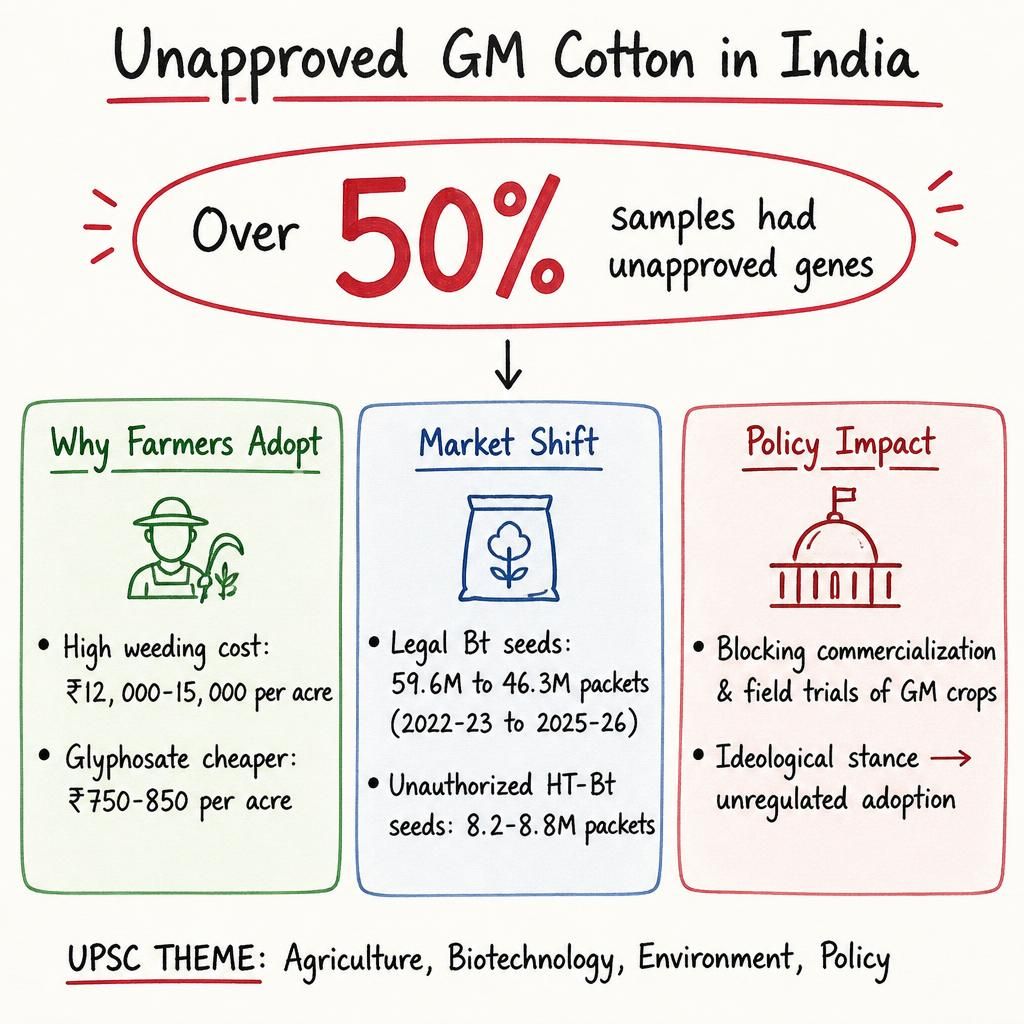
- A study found unapproved HT and next-generation Bt genes in over 50% of samples from farmers' fields across 16 districts in Maharashtra, Telangana, Andhra Pradesh, and Rajasthan.
- Farmers adopt these unapproved varieties due to high manual weeding costs (₹12,000-15,000 per acre) compared to glyphosate application (₹750-850) and the ineffectiveness of approved Bt cotton against pink bollworm.
- Sales of legal Bt cotton seeds decreased from 59.6 million to 46.3 million packets between 2022-23 and 2025-26, while the unauthorized HT-Bt seed market grew to an estimated 8.2-8.8 million packets.
- The government's policy of blocking commercialization and field trials of GM crops, based on ideological positions, is cited as the reason for this widespread unregulated adoption.
GM Cotton.jpg
Detailed Insights:
- The unapproved GM cotton varieties provide tolerance to weed killers like glyphosate and offer protection against a broader range of pests, including the destructive pink bollworm.
- The Vip3A Bt gene, found in unapproved hybrids, is effective against pink bollworm, unlike the Cry1Ac and Cry2Ab genes present in officially approved Bt cotton.
- Farmers obtain these seeds through illegal channels, bypassing India's established biosafety and regulatory approval system.
- This unregulated market negatively impacts the organized seed industry and prevents farmers from accessing advanced GM traits developed by legitimate research-backed companies.
- India, which was once a leading producer and exporter of cotton, has become a net importer due to policies that hinder the development and regulated adoption of advanced GM crops.
- The Genetic Engineering Appraisal Committee (GEAC), under the Ministry of Environment, Forest and Climate Change, is the apex body responsible for approving GM crops and products in India.
- GM crops in India are regulated under the "Rules for the Manufacture, Use/Import/Export and Storage of Hazardous Microorganisms/Genetically Engineered Organisms or Cells, 1989" notified under the Environment (Protection) Act, 1986.
Scientific/Technical Concepts Involved:
- Genetically Modified (GM) Crops: Plants whose genetic material (DNA) has been altered using genetic engineering to introduce new traits.
- Bt Cotton: A GM cotton variety that produces insecticidal proteins from the bacterium Bacillus thuringiensis to protect against bollworms.
- Herbicide-Tolerant (HT) Cotton: A GM cotton variety engineered to withstand specific herbicides like glyphosate, allowing for targeted weed control.
- Pink Bollworm: A major lepidopteran pest of cotton, whose larvae feed inside cotton bolls, causing significant damage to yield and fiber quality.

SuperKalam is your personal mentor for UPSC preparation, guiding you at every step of the exam journey.
Download the App


STUDY RESOURCES
CONTACT US
ⓒ Snapstack Technologies Private Limited