GS 3: Environment & EcologyPrelimsGS 3: Conservation, Pollution and DegradationGS 1: Changes in Critical Geographical Features, Water Bodies, Ice Caps, Flora and Fauna
Contextualising WWF’s Report On Wildlife Population Decline, Pg7
WWF's 2026 Living Planet Index reports a 73% average decline in studied wildlife populations since 1970, clarifying common misinterpretations of the data.
Practice MCQs
883 Students attempted
Key Highlights:
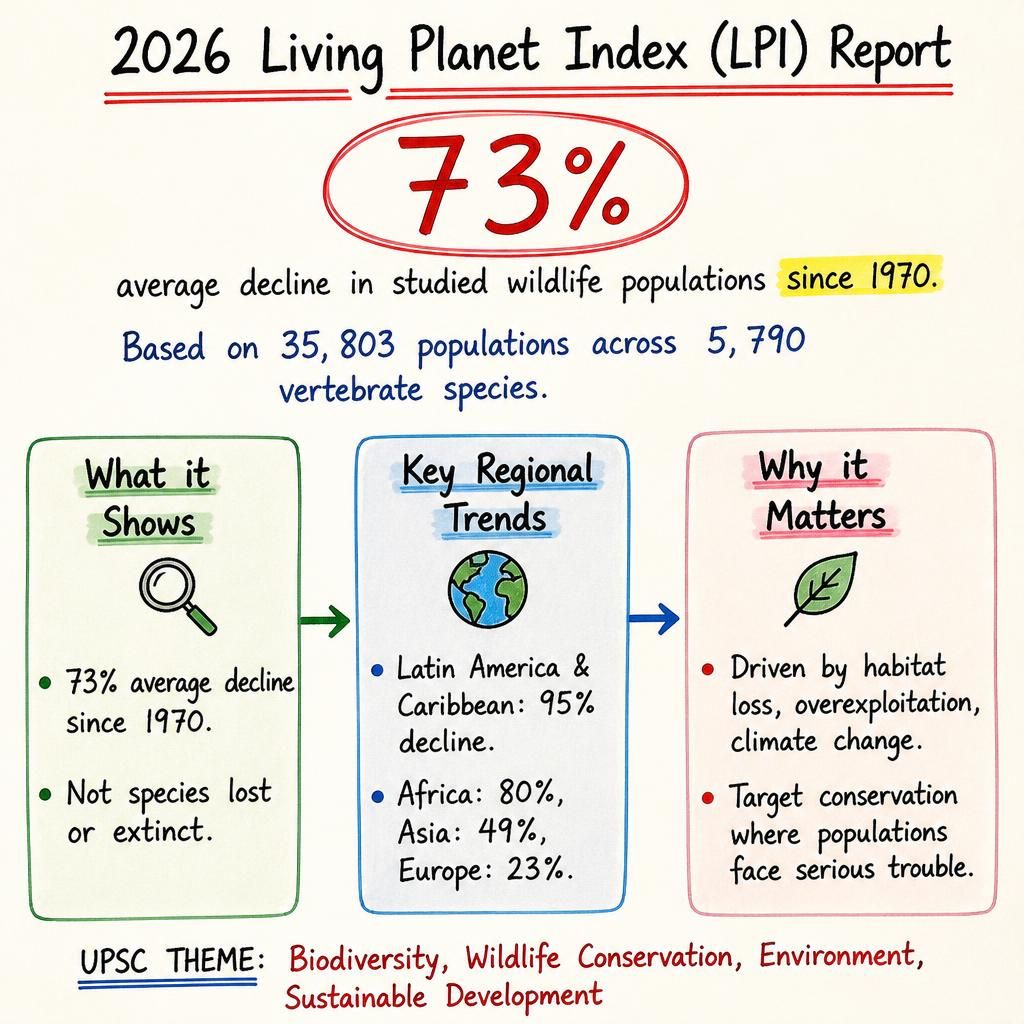
- The 2026 Living Planet Index (LPI) report by the Worldwide Wildlife Fund (WWF) indicates a 73% average decline in studied wildlife populations since 1970.
- This figure is based on monitoring 35,803 populations across 5,790 vertebrate species (mammals, birds, reptiles, amphibians, and fish).
- The report clarifies that the 73% decline represents an average change in population size, not the percentage of species lost, extinct, or declining.
- Approximately half of the studied populations were in decline, while the other half were either increasing or stable.
- Latin America and the Caribbean experienced the most severe regional decline, averaging 95% since 1970.
Living Planet Index.jpg
Detailed Insights:
- The Living Planet Index (LPI) is a measure of the state of the world's biological diversity, tracking population trends of vertebrate species across terrestrial, freshwater, and marine habitats.
- The methodology involves calculating the geometric mean of population changes across thousands of individual populations, with data timelines varying.
- Changes in the LPI figure between different reports (e.g., 69% in 2022 to 73% in 2024/2026) are primarily due to updated data, increased coverage of populations and species, and methodological refinements.
- The 2026 report notably increased data coverage from Africa, improving its representation in the global index.
- Regional declines vary significantly: Africa saw an 80% decline, Asia 49%, and Europe the smallest at 23% since 1970.
- Primary drivers of wildlife decline include habitat loss and degradation, overexploitation, climate change, pollution, invasive species, and disease.
- The report suggests that conservation efforts should be efficiently targeted towards populations in serious trouble, rather than assuming a universal decline across all wildlife.
Key Concepts Involved:
- Living Planet Index (LPI): A metric published biennially by WWF that tracks the average trend in the abundance of monitored vertebrate populations worldwide.
- Worldwide Wildlife Fund (WWF): An international non-governmental organization dedicated to wilderness preservation and reducing human impact on the environment.
- Biodiversity Hotspot: A biogeographic region with a significant reservoir of biodiversity that is under threat from human activities.

SuperKalam is your personal mentor for UPSC preparation, guiding you at every step of the exam journey.
Download the App


STUDY RESOURCES
CONTACT US
ⓒ Snapstack Technologies Private Limited