GS 1: Physical GeographyGS 3: Science & TechnologyGS 3: Environment & EcologyPrelimsGS 3: Conservation, Pollution and Degradation
Rapid Himalayan Erosion Triggers Hidden Source Of CO2: Study, Pg13
New study reveals rapid Himalayan erosion triggers hidden CO2 release from pyrite oxidation, potentially offsetting cooling effects and contributing to long-term climate warming.
Practice MCQs
876 Students attempted
Key Highlights:
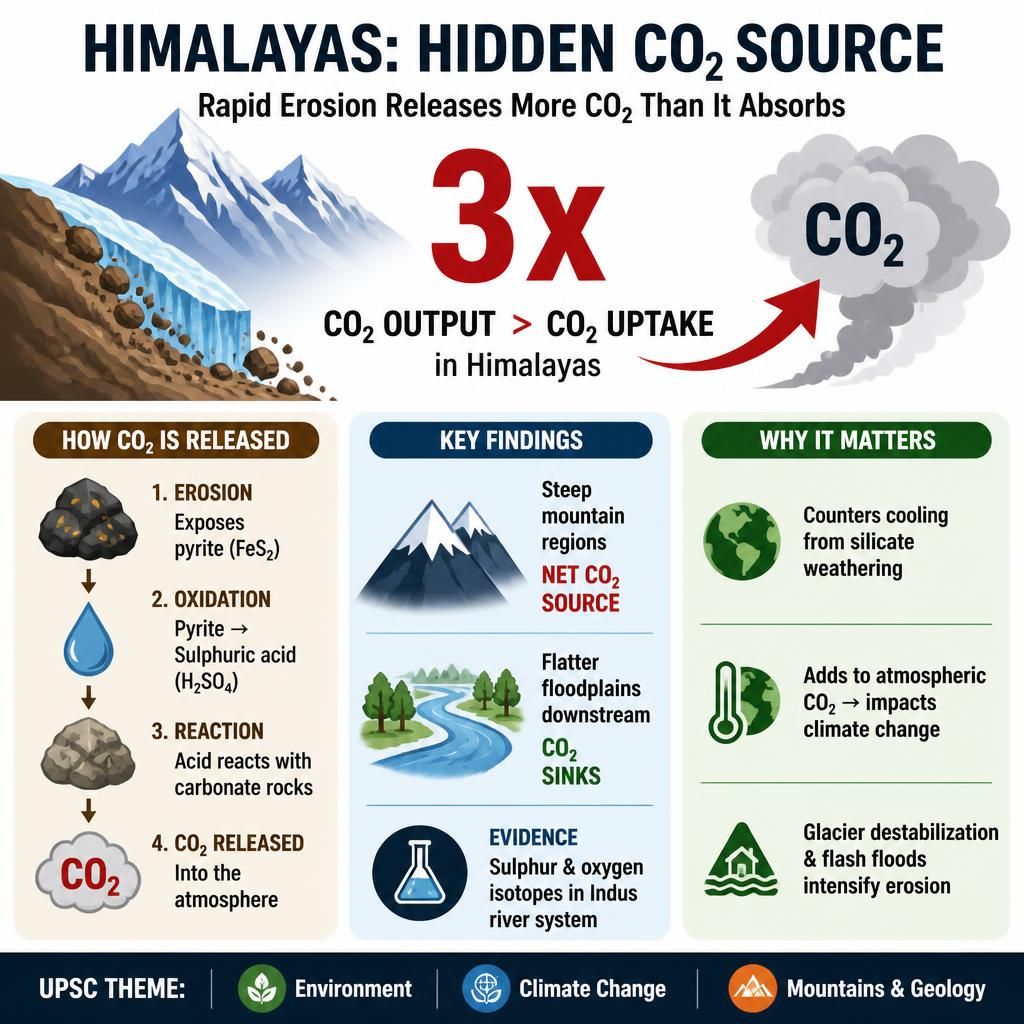
- A recent study indicates that rapid erosion in the Himalayas, particularly due to glacier activity, acts as a significant geological source of carbon dioxide (CO2).
- This CO2 release, primarily from pyrite oxidation, may counteract the cooling effect traditionally associated with silicate weathering.
- Researchers from IISER Pune, Wadia Institute of Himalayan Geology, and IIT-Roorkee published these findings in Chemical Geology.
- The study, focused on the upper Indus basin, estimated CO2 oxidation rates to be three times higher than CO2 uptake by silicate weathering.
- Recent flash floods in Nepal underscore the destabilization of Himalayan glaciers, which contribute to the intensified erosion process.
Himalayas.jpg
Detailed Insights:
- The ongoing collision of the Indian plate with the Eurasian plate drives Himalayan uplift and erosion, exposing diverse minerals.
- Silicate minerals typically react with atmospheric CO2, sequestering carbon into seafloor sediments, a process historically linked to Earth's cooling.
- However, rapid erosion exposes pyrites (also known as fool's gold), whose sulphides oxidize into sulphuric acid upon contact with air and water.
- This sulphuric acid subsequently reacts with carbonate rocks, leading to the release of CO2 into the atmosphere.
- The research utilized the ratio of sulphur and oxygen isotopes in the Indus river system to distinguish between different sulphate origins.
- The study found that while flatter floodplains downstream function as CO2 sinks, the steep mountainous regions are net CO2 sources.
- Glaciers intensify this process by efficiently crushing rocks and exposing pyrites, making erosion a "double-edged sword" for the carbon cycle.
- These findings suggest a long-term impact on the global carbon cycle and a potential contribution to climate warming over geological timescales.
Scientific/Technical Concepts Involved:
- Silicate Weathering: A natural geological process where silicate minerals react with atmospheric CO2, removing it from the atmosphere.
- Pyrite Oxidation: A chemical reaction where sulphide minerals like pyrite react with oxygen and water, producing sulphuric acid and releasing CO2 when reacting with carbonates.
- Carbon Cycle: The natural biogeochemical cycle involving the exchange of carbon among Earth's atmosphere, oceans, soil, and living things.
- Isotopes: Atoms of the same element with differing numbers of neutrons, used as tracers in scientific studies to identify origins or processes.

SuperKalam is your personal mentor for UPSC preparation, guiding you at every step of the exam journey.
Download the App


STUDY RESOURCES
CONTACT US
ⓒ Snapstack Technologies Private Limited