GS 2: International RelationsGS 3: Environment & EcologyGS 3: EconomyPrelimsGS 3: Infrastructure: Energy, Ports, Roads, Airports, Railways etc.
'Fossil Fuels Will Still Play an Important Role': Declaration Opposes Carbon Border Tax, Pg9
BRICS Declaration acknowledges fossil fuels' role in energy mix, opposes EU's carbon border tax, and calls for developed nations' climate finance.
Practice MCQs
876 Students attempted
Key Highlights:
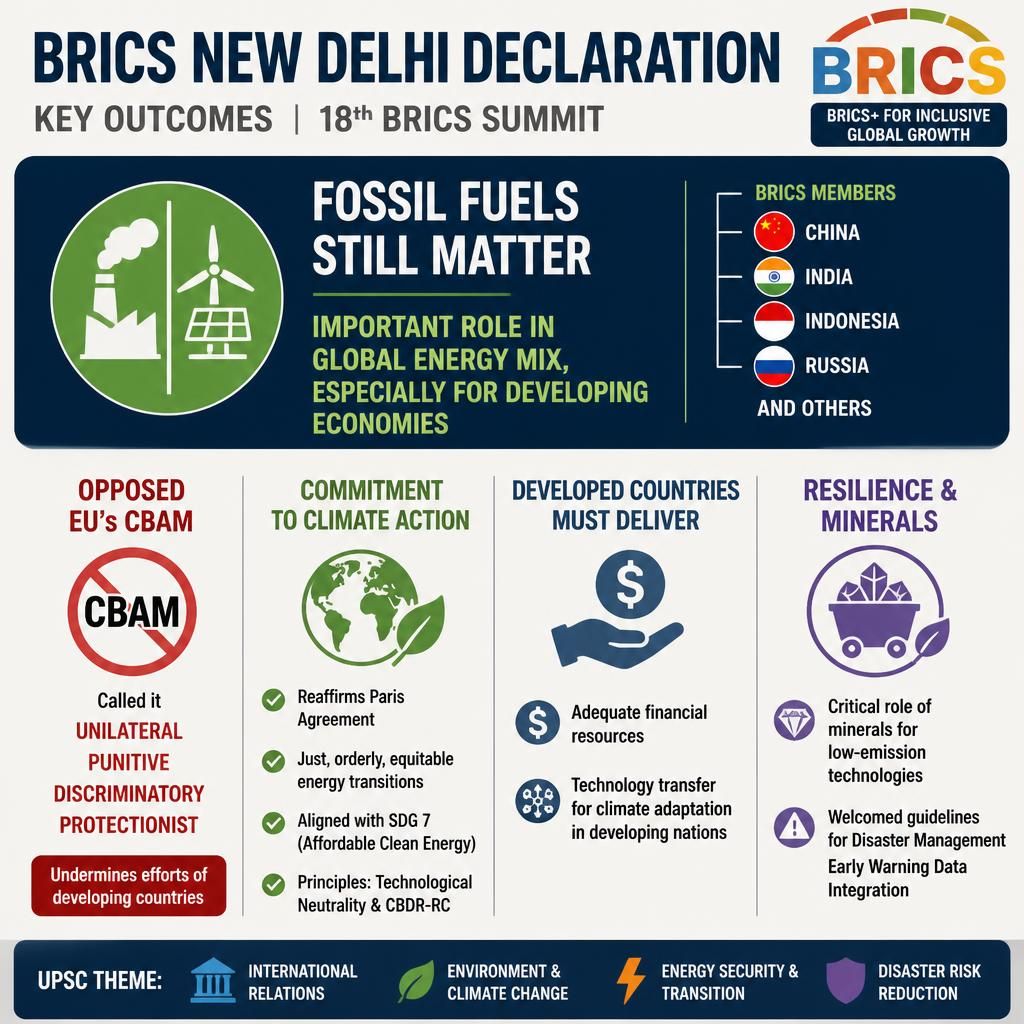
- The New Delhi Declaration, adopted at the 18th BRICS Summit, acknowledged the continued important role of fossil fuels in the global energy mix, especially for developing economies.
- BRICS nations collectively opposed the European Union's Carbon Border Adjustment Mechanism (CBAM), labeling it as unilateral, punitive, discriminatory, and protectionist.
- The declaration reaffirmed BRICS' commitment to the Paris Agreement and called for developed countries to provide adequate financial resources and technology transfer for climate adaptation in developing nations.
- It emphasized the importance of nationally determined just transitions to cleaner fuels and energy use, aligning with climate goals and Sustainable Development Goal 7 (SDG7).
- BRICS members China, India, Indonesia, and Russia are among the world's leading coal consumers, despite significant advancements in renewable energy expansion.
- The declaration recognized the critical role of minerals for low-emission energy technologies and supply chain resilience.
Fossil Fuel Still Matters.jpg
Detailed Insights:
- The declaration underscored energy security as a fundamental basis for social and economic development, particularly for emerging markets.
- It advocated for just, orderly, equitable, and inclusive energy transitions while reducing greenhouse gas emissions.
- The principles of technological neutrality and Common But Differentiated Responsibilities and Respective Capabilities (CBDR-RC) were highlighted in climate action.
- BRICS criticized the EU's CBAM for undermining efforts by developing countries to address climate change and build resilience.
- The declaration welcomed guidelines for Disaster Management Early Warning Data Integration, acknowledging increasing disaster risks, especially for the Global South.
- The stance on fossil fuels reflects the energy demands of rapidly growing economies within the BRICS bloc.
Key Concepts Involved:
- Carbon Border Adjustment Mechanism (CBAM): An EU import levy on carbon-intensive goods designed to prevent carbon leakage and ensure fair carbon pricing.
- Just Transition: A framework ensuring that the shift to a low-carbon economy is equitable, socially inclusive, and economically viable, protecting workers and communities.
- Nationally Determined Contributions (NDCs): Climate action plans submitted by countries under the Paris Agreement, outlining their efforts to reduce emissions and adapt to climate change.
- Common But Differentiated Responsibilities and Respective Capabilities (CBDR-RC): A principle recognizing that all states share responsibility for climate change but have different capacities and historical contributions, requiring differentiated actions.
- Sustainable Development Goal 7 (SDG7): A UN goal aiming to ensure access to affordable, reliable, sustainable, and modern energy for all by 2030.

SuperKalam is your personal mentor for UPSC preparation, guiding you at every step of the exam journey.
Download the App


STUDY RESOURCES
CONTACT US
ⓒ Snapstack Technologies Private Limited