GS 3: Science & TechnologyPrelimsGS 3: Indigenization of Technology and New Technology DevelopmentGS 3: Space Technology
ISRO successfully carries out tests of Gaganyaan systems, Pg14
ISRO successfully conducts three critical Gaganyaan crew module tests, including uprighting and umbilical separation, advancing India's human spaceflight mission.
Practice MCQs
862 Students attempted
Key Highlights:
- The Indian Space Research Organisation (ISRO) successfully conducted three major qualification tests for the Gaganyaan crew module systems.
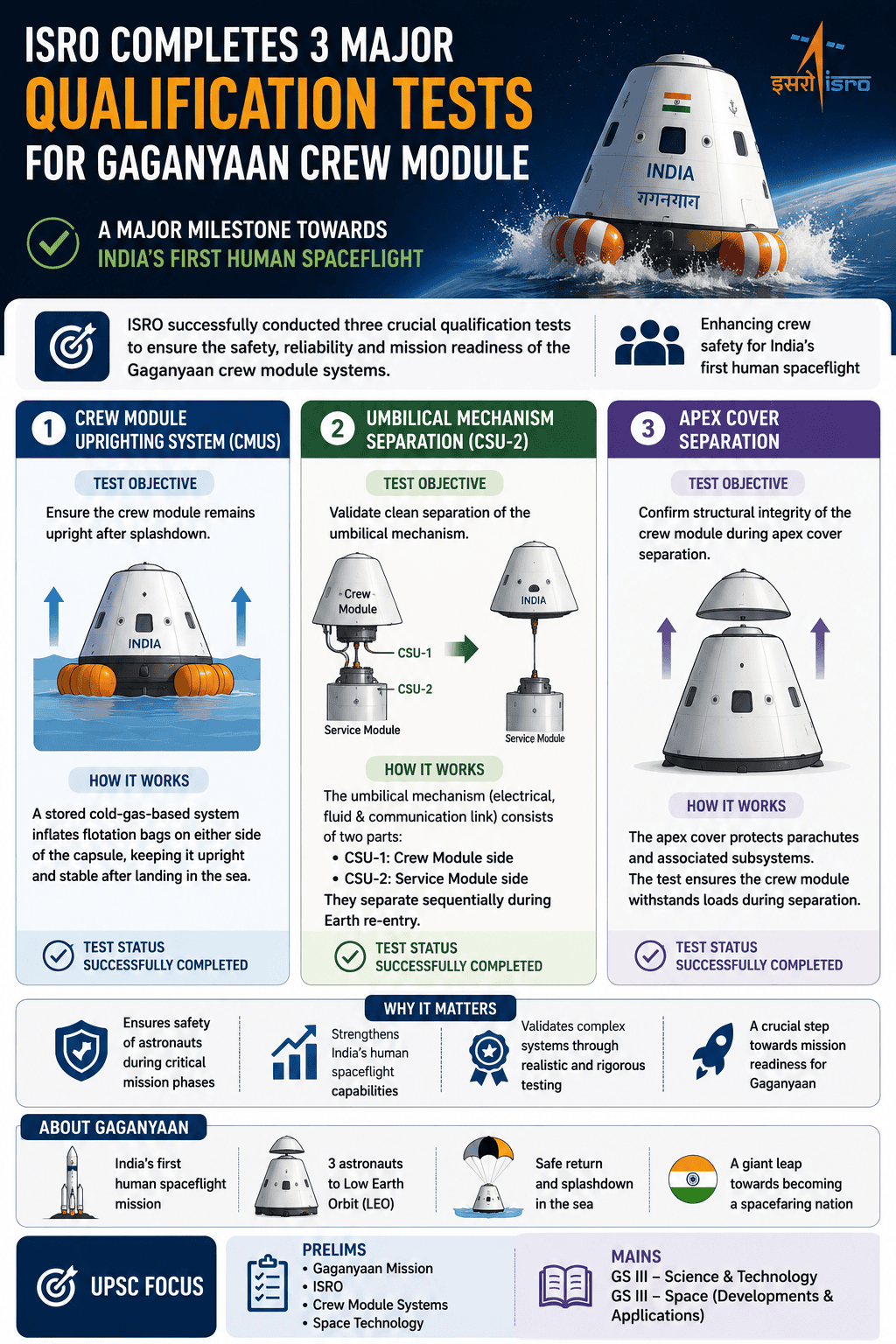
- These tests focused on ensuring the crew module's upright position after splashdown, the separation of the umbilical mechanism, and the structural integrity during apex cover separation.
- The successful completion of these trials marks a significant step towards India's first human spaceflight mission, enhancing crew safety.
ISRO.png
Detailed Insights:
- The first test involved the Crew Module Uprighting System (CMUS), which uses a stored cold-gas-based system to inflate flotation and ensure the capsule remains upright after landing in the sea.
- The second test validated the clean separation of the umbilical mechanism, specifically CSU-2, which links the crew module and service module for electrical, fluid, and communication during flight.
- The umbilical mechanism consists of two parts, CSU-1 on the crew module side and CSU-2 on the service module side, separating sequentially during Earth re-entry.
- The third test confirmed the structural integrity of the crew module during the separation of the apex cover, which protects parachutes and associated subsystems before deployment.
- During the apex cover separation test, the crew module was subjected to loads approximately 1.75 times higher than expected during flight, with measured strain and deformation remaining within design limits.
- The Gaganyaan mission aims to send a crew of three members to an orbit of 400 km for a three-day mission, returning them safely to Earth by landing in Indian sea waters.
Scientific/Technical Concepts Involved:
- Gaganyaan Mission: India's first human spaceflight program by ISRO to demonstrate indigenous human spaceflight capability to low Earth orbit.
- Crew Module: The habitable part of the spacecraft designed to carry astronauts, providing an Earth-like environment and equipped for re-entry.
- Service Module: Supports the crew module in orbit by providing essential services like propulsion, power, and thermal control.
- Apex Cover: A protective cover for the parachutes and associated deceleration systems, jettisoned before parachute deployment during re-entry.

SuperKalam is your personal mentor for UPSC preparation, guiding you at every step of the exam journey.
Download the App


STUDY RESOURCES
CONTACT US
ⓒ Snapstack Technologies Private Limited