GS 2: GovernanceGS 1: Indian SocietyGS 3: EconomyPrelimsGS 3: Changes in Industrial Policy and Effects on Industrial Growth
GCC is office success story. Now, focus on factory, Pg8
India's booming Global Capability Centers generate $100 billion, employing 2.3 million, yet the nation urgently needs manufacturing growth to absorb its less-skilled workforce.
Practice MCQs
862 Students attempted
Key Highlights:
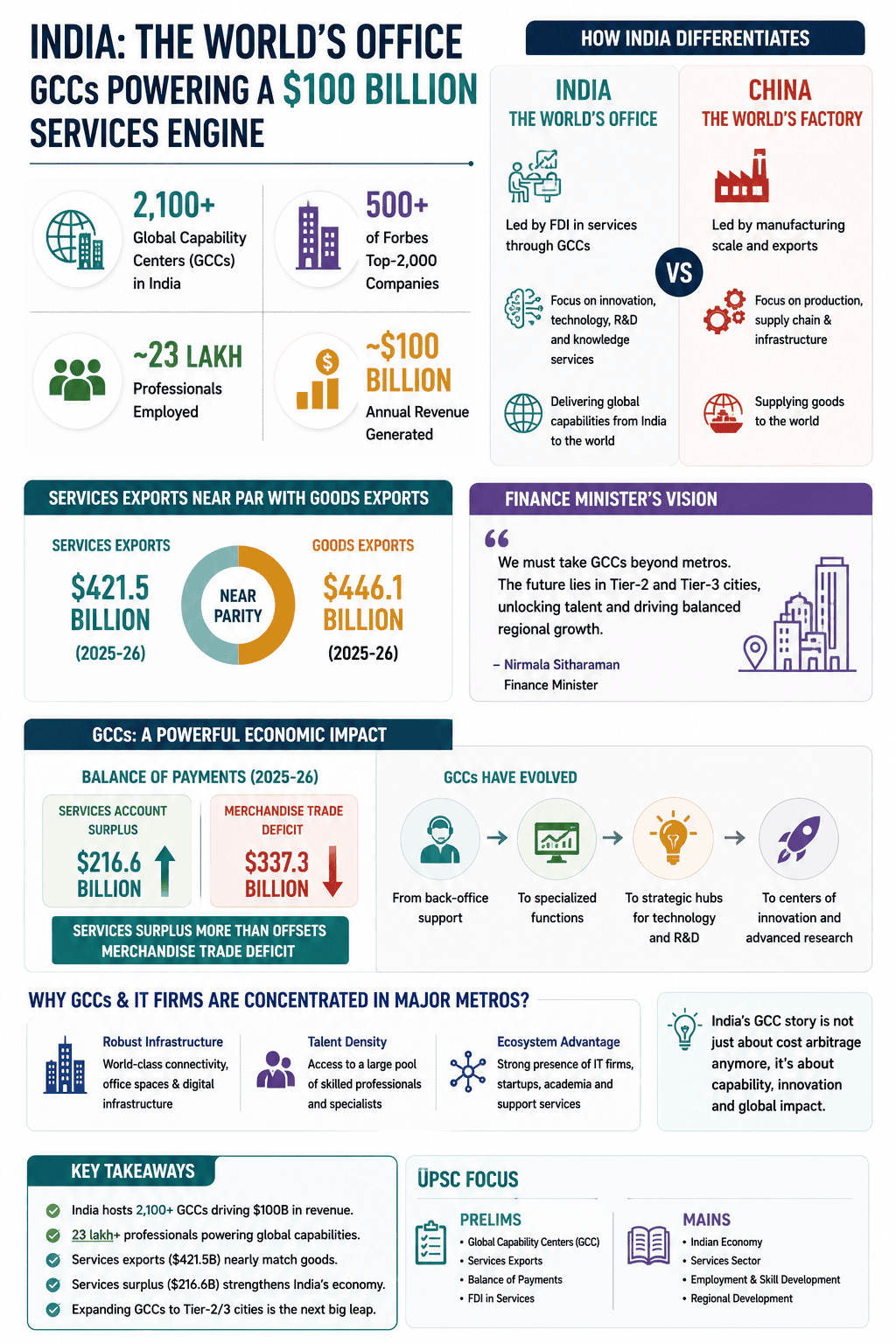
- India hosts over 2,100 Global Capability Centers (GCCs) from more than 500 Forbes top-2,000 companies.
- These GCCs employ approximately 23 lakh professionals and generate nearly $100 billion in annual revenue.
- India has become "the world's office" due to significant Foreign Direct Investment (FDI) in services, contrasting with China's manufacturing-led "world's factory" model.
- In 2025-26, India's services exports were $421.5 billion, nearly matching goods exports of $446.1 billion.
- Finance Minister Nirmala Sitharaman advocates for expanding GCCs into Tier-2 and Tier-3 cities.
GCC.png
Detailed Insights:
- Global Capability Centers (GCCs) have evolved beyond basic back-office functions to strategic hubs for technology, R&D, and advanced research.
- India's Balance of Payments shows a substantial services account surplus of $216.6 billion, offsetting a merchandise trade deficit of $337.3 billion.
- The concentration of GCCs and IT firms in major metros like Bengaluru and Delhi-NCR is due to robust infrastructure and talent density.
- Replicating the ecosystem for GCCs in smaller cities is challenging, unlike manufacturing clusters that can thrive with lower land and labor costs.
- India needs to develop its manufacturing sector, including textiles and agro-processing, to absorb its less-skilled workforce.
- The current economic structure highlights India's comparative advantage in services rather than in goods manufacturing.
Key Concepts Involved:
- Global Capability Centers (GCCs): Offshore units of multinational corporations providing strategic functions like R&D, IT, and business process support.
- Foreign Direct Investment (FDI): Investment made by a firm or individual in one country into business interests located in another country.
- Balance of Payments: A statement summarizing all economic transactions between residents of a country and the rest of the world over a specific period.
- Merchandise Trade Deficit: Occurs when a country's imports of goods exceed its exports of goods.
- Services Account Surplus: Occurs when a country's exports of services exceed its imports of services.

SuperKalam is your personal mentor for UPSC preparation, guiding you at every step of the exam journey.
Download the App


STUDY RESOURCES
CONTACT US
ⓒ Snapstack Technologies Private Limited