GS 2: GovernanceGS 3: Science & TechnologyGS 3: Environment & EcologyPrelimsGS 3: Conservation, Pollution and Degradation
Eärendil-1: bright or blight?, Pg2
US FCC approves controversial Eärendil-1 satellite for nighttime Earth illumination, sparking fears of skyglow and optical astronomy interference.
Practice MCQs
862 Students attempted
Key Highlights:
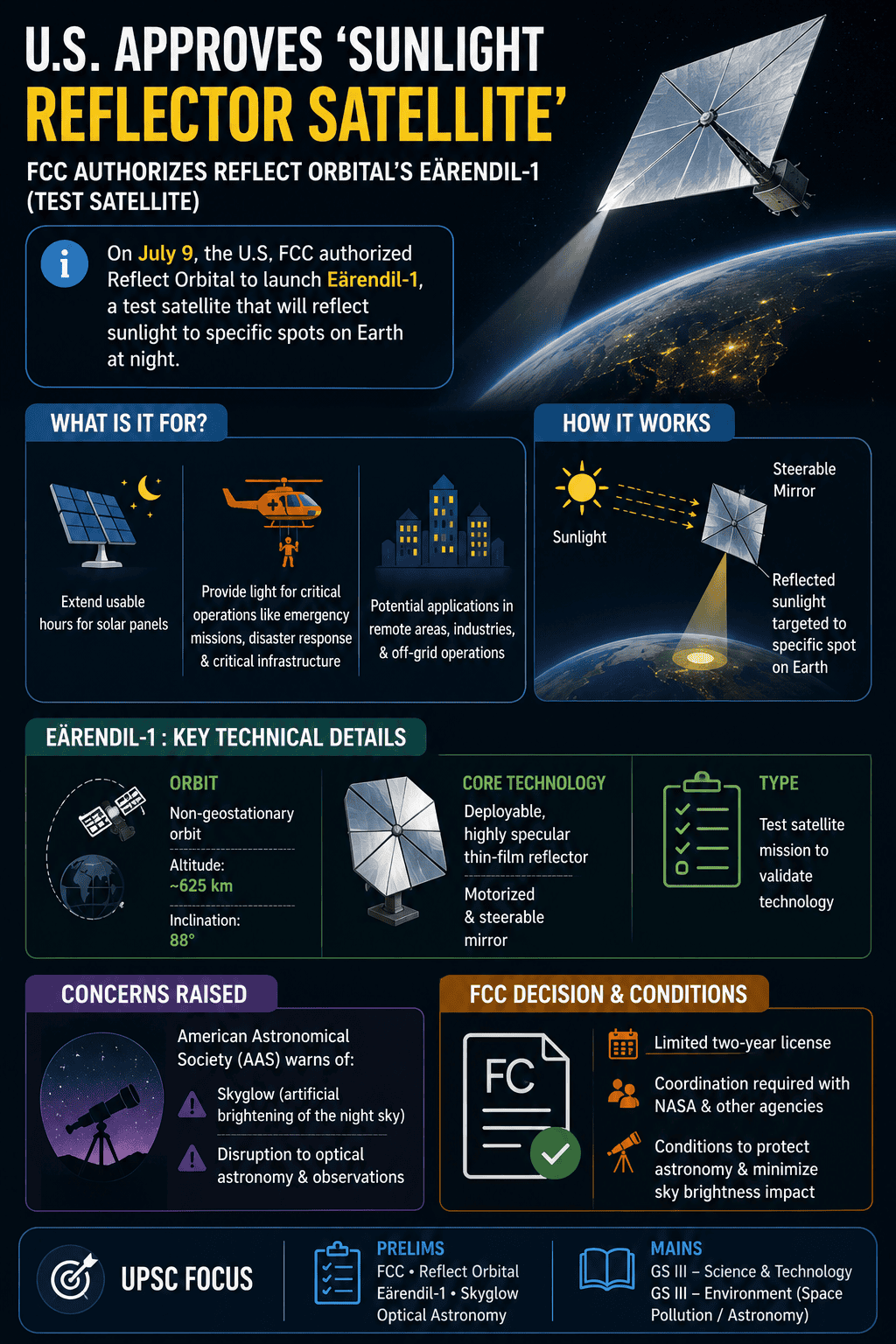
- On July 9, the U.S. Federal Communications Commission (FCC) authorized Reflect Orbital to launch Eärendil-1, a test satellite.
- The satellite is designed to deploy a large, steerable mirror to reflect sunlight towards specific spots on Earth at night.
- Reflect Orbital aims to extend usable hours for solar panels and provide light for critical operations like emergency missions.
- The American Astronomical Society (AAS) raised concerns about potential skyglow and disruption to optical astronomy.
- The FCC granted a limited two-year license, imposing conditions for coordination with NASA and other agencies to protect astronomy.
Earendil.png
Detailed Insights:
- Eärendil-1 will operate in a non-geostationary orbit at an altitude of approximately 625 km with an 88° inclination.
- The satellite's core technology is a "deployable, highly specular thin-film reflector" that is motorized and steerable.
- The FCC ruled that while it regulates radiofrequency interference and orbital debris, the visual impact of reflected sunlight is outside its statutory authority.
- Conditions for approval include coordinating with the U.S. National Science Foundation and the National Telecommunications and Information Administration.
- The satellite must also adhere to specific duty cycles and conjunction angles to prevent interference with other space missions.
Key Concepts Involved:
- Non-geostationary orbit: An orbit where a satellite does not remain fixed relative to a point on Earth's surface.
- Skyglow: Artificial brightening of the night sky due to light pollution, impacting astronomical observations.
- Orbital debris: Non-functional, human-made objects in orbit around Earth, posing collision risks.
- Radiofrequency interference: Unwanted signals that disrupt the reception of desired radio communications.

SuperKalam is your personal mentor for UPSC preparation, guiding you at every step of the exam journey.
Download the App


STUDY RESOURCES
CONTACT US
ⓒ Snapstack Technologies Private Limited