GS 2: GovernanceGS 2: PolityPrelimsGS 2: Important Aspects of Governance, Transparency and AccountabilityGS 2: Constitutional Bodies
The need to preserve the shine of Indian elections, Pg9
Intense protests and allegations challenge the Election Commission's credibility, raising concerns about the integrity and future of India's democratic electoral system.
Practice MCQs
876 Students attempted
Key Highlights:
- The credibility of Indian elections, managed by the Election Commission of India (ECI), is facing challenges due to intense protests and allegations.
- The Special Intensive Revision (SIR) of electoral rolls has generated significant litigation and agitation, raising questions about its management.
- India's elections, involving approximately 98 crore electors in 2024, are globally recognized for their scale and logistical complexity.
- There is a growing concern over chronic allegations of partisan conduct by the poll body and aggressive grievance bordering on rejection of electoral results.
- New threats include digital disinformation, deep fakes, and the increasing influence of money power, including institutional cash transfers.
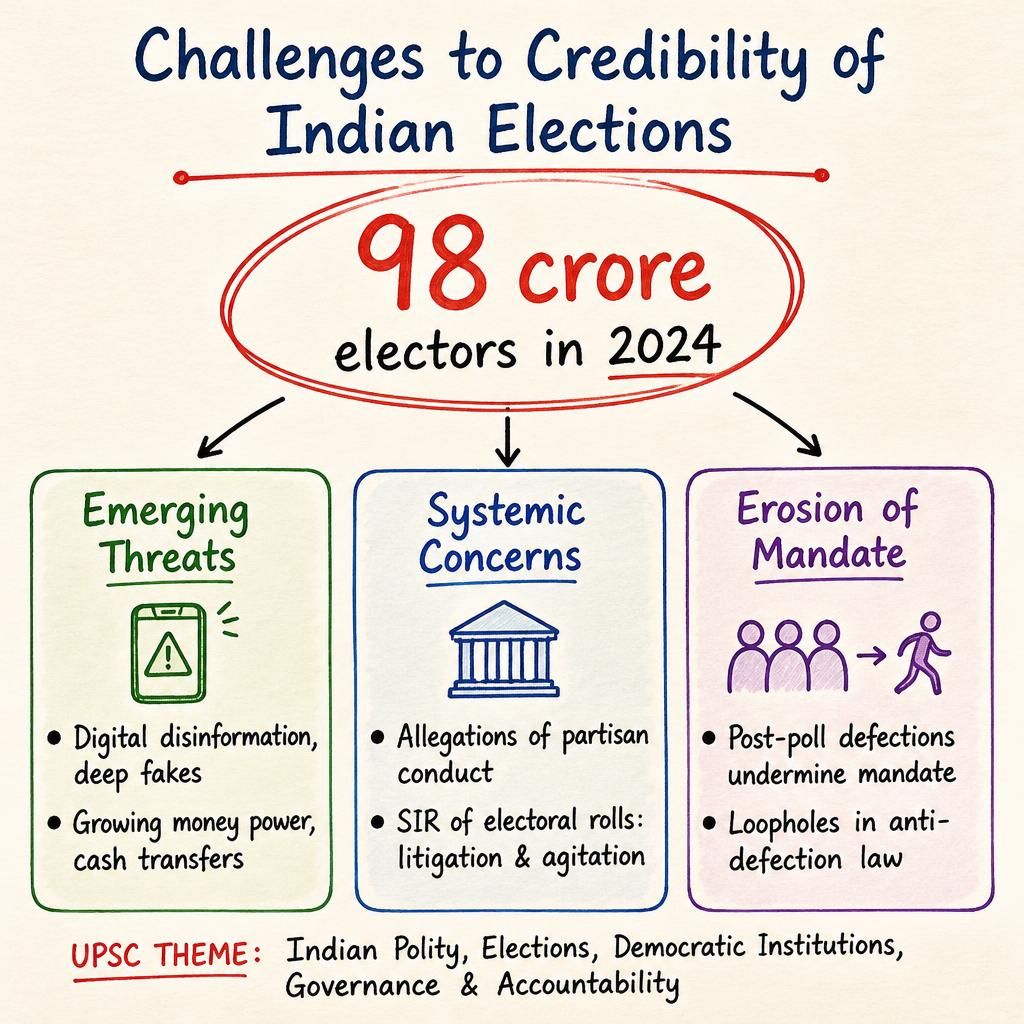
Indian Elections.jpg
Detailed Insights:
- India's democratic elections have historically been a significant soft power, providing stability and a pathway to development since independence.
- The ECI has been instrumental in conducting massive electoral exercises, leading to the establishment of the India International Institute of Democracy and Election Management (IIIDEM) for training election managers globally.
- Modern challenges to electoral integrity include the potential manipulation of voter databases through undue enfranchisement or disenfranchisement.
- The influence of money power has expanded beyond localized distribution to large-scale institutional cash transfers, impacting electoral integrity and public finance.
- Post-poll defections, facilitated by exceptions in the Tenth Schedule of the anti-defection law, undermine the people's mandate and voter choice.
- The appointment process of Election Commissioners and the enforcement of the Model Code of Conduct have also become zones of contention, leading to distrust.
- Restoring trust in the electoral system requires collective, apolitical efforts from all stakeholders, including political parties, to address structural and legal loopholes.
Key Concepts Involved:
- Election Commission of India (ECI): A constitutional body established under Article 324 to conduct free and fair elections to Parliament, state legislatures, and the offices of President and Vice-President.
- Special Intensive Revision (SIR): An exercise undertaken by the ECI to verify and revise electoral rolls to ensure accuracy, completeness, and freedom from errors.
- India International Institute of Democracy and Election Management (IIIDEM): Established by the ECI in June 2011 as a global center for electoral training, research, and capacity building.
- Anti-defection law / Tenth Schedule: Added to the Constitution by the 52nd Amendment in 1985, it provides for the disqualification of Members of Parliament and State Legislatures on grounds of defection.
- Model Code of Conduct: A set of guidelines issued by the ECI to regulate the conduct of political parties, candidates, ministers, and governments during elections to ensure a free and fair process.

SuperKalam is your personal mentor for UPSC preparation, guiding you at every step of the exam journey.
Download the App


STUDY RESOURCES
CONTACT US
ⓒ Snapstack Technologies Private Limited