GS 3: EconomyPrelimsGS 3: Indian Economy, Planning, Mobilization of Resources, Growth, Development and EmploymentGS 2: Statutory, Regulatory and Quasi Judicial BodiesGS 2: Effect of Policies and Politics of Developed and Developing Countries on India's Interests
RBI hopes to shore up weakening rupee by using Chinese playbook, Pg15
RBI introduces Foreign Exchange Risk Reserve, borrowing from China, to curb rupee's fall by making hedging more expensive for importers.
Practice MCQs
876 Students attempted
Key Highlights:
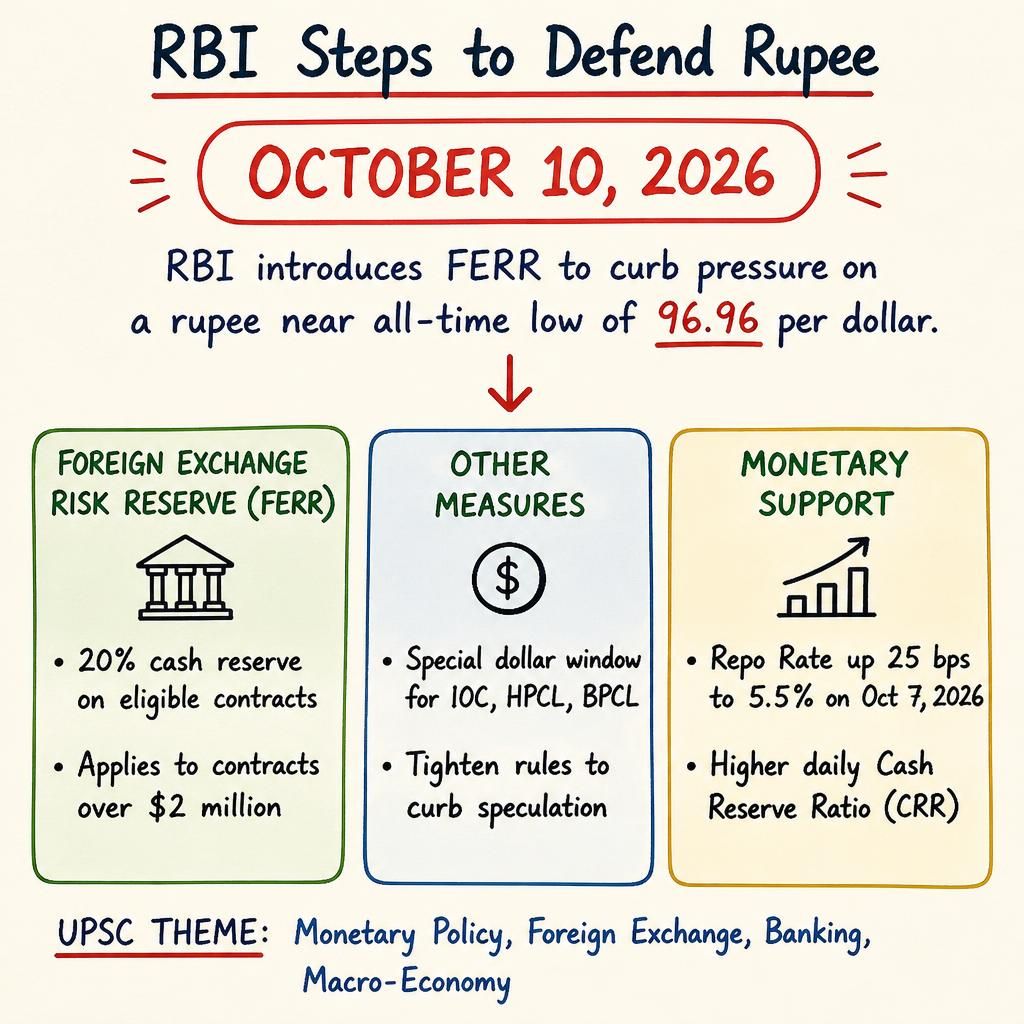
- The Reserve Bank of India (RBI) introduced a Foreign Exchange Risk Reserve (FERR) on October 10, 2026, requiring banks to set aside 20% of forex derivative contracts exceeding $2 million involving the rupee.
- This measure, inspired by China's playbook, aims to make hedging against rupee depreciation more expensive and curb speculative demand.
- The rupee recently neared its all-time low of 96.96 per dollar, having depreciated almost 7% in 2026.
- Other steps include a special dollar window for state-owned oil marketing companies and tightening rules for foreign exchange derivative transactions.
- The RBI also hiked the Repo Rate by 25 basis points to 5.5% on October 7, 2026, and increased the daily Cash Reserve Ratio (CRR) maintenance requirement.
RBI and Rupee.jpg
Detailed Insights:
- The FERR mandates that banks maintain a cash reserve with the RBI for eligible rupee-linked foreign exchange derivative contracts, thereby increasing the cost of protecting against future rupee weakness.
- This move is a reversal of China's strategy, which had reduced its FERR when the Yuan was strengthening, effectively removing disincentives to bet against its currency.
- The special dollar window for Indian Oil Corporation (IOC), Hindustan Petroleum (HPCL), and Bharat Petroleum (BPCL) aims to reduce their demand for dollars in the open market, easing pressure on the rupee.
- Restrictions on rebooking cancelled rupee-linked derivative contracts and lowering the threshold for unhedged derivative transactions from $100 million to $5 million are intended to curb speculation.
- The RBI's actions are seen as providing "breathing room" for the rupee, but its medium-term trajectory will depend on global factors and Balance of Payments dynamics.
- The current measures are compared to the strong interventions seen during the 2013 Taper Tantrum, highlighting the severity of the pressure on the Indian currency.
Key Concepts Involved:
- Foreign Exchange Risk Reserve (FERR): A reserve that banks must set aside for certain foreign exchange derivative contracts, making hedging more expensive.
- Hedging: A financial strategy used to offset potential losses from adverse price movements, such as currency fluctuations.
- Trade Deficit: Occurs when a country's imports exceed its exports, leading to a net outflow of foreign currency and pressure on the domestic currency.
- Balance of Payments (BoP): A record of all economic transactions between a country and the rest of the world over a specific period.
- Repo Rate: The interest rate at which the central bank lends money to commercial banks, influencing liquidity and credit in the economy.
- Taper Tantrum: The 2013 market reaction to the US Federal Reserve's announcement to reduce its Quantitative Easing program, leading to capital outflows from emerging markets.

SuperKalam is your personal mentor for UPSC preparation, guiding you at every step of the exam journey.
Download the App


STUDY RESOURCES
CONTACT US
ⓒ Snapstack Technologies Private Limited