GS 2: International RelationsGS 3: EconomyPrelimsGS 2: Bilateral, Regional and Global Groupings and AgreementsGS 2: Effect of Policies and Politics of Developed and Developing Countries on India's Interests
BRICS Finance Ministers, Bank Heads Flag ‘Unilateral Imposition’ of Tariffs, Pg9
BRICS Finance Ministers and Central Bank Governors condemn unilateral tariffs, advocate local currency trade, and push for reform of multilateral lending institutions.
Practice MCQs
869 Students attempted
Key Highlights:
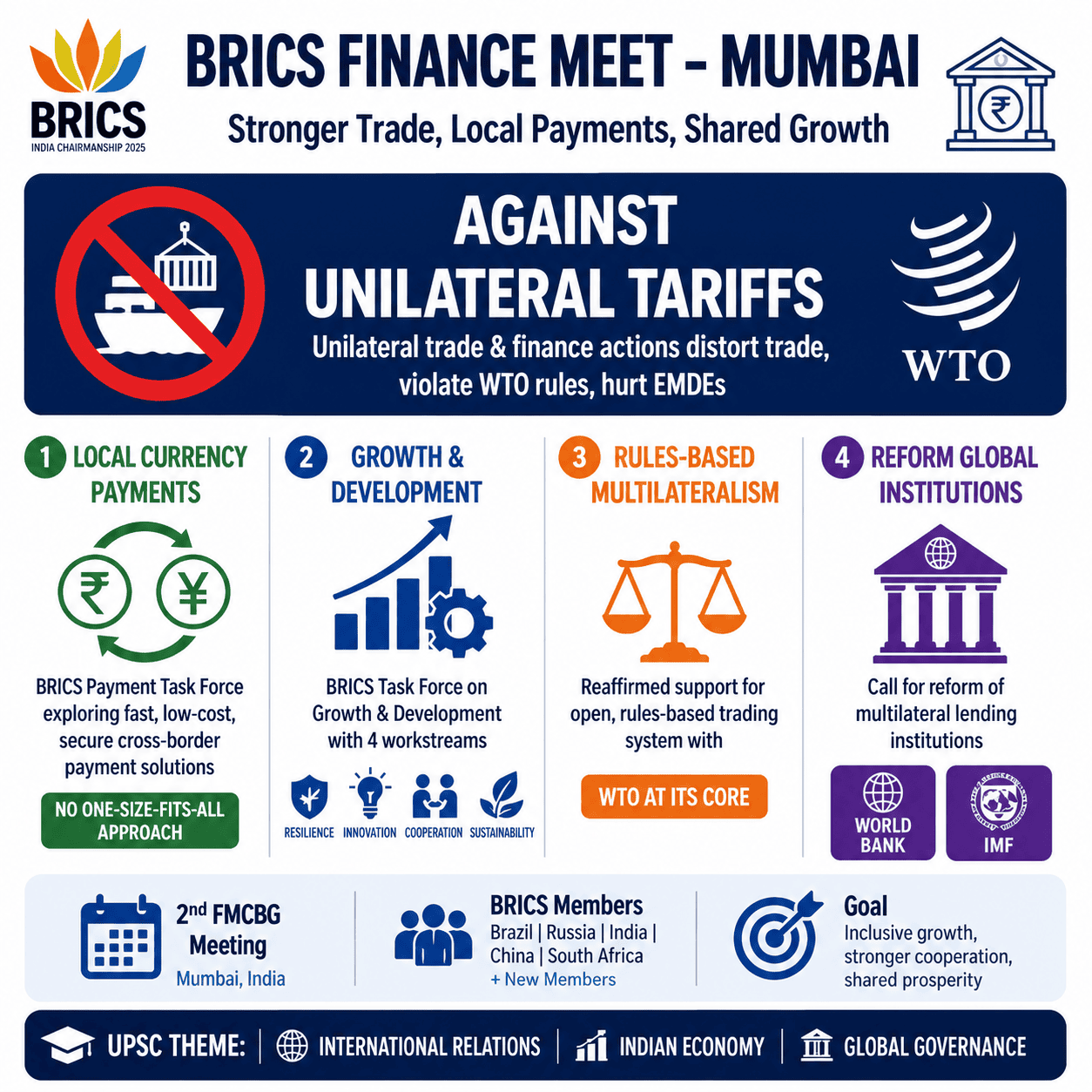
- The BRICS Finance Ministers and Central Bank Governors (FMCBG) voiced concerns over the “unilateral imposition” of tariffs and non-tariff measures that distort trade.
- A joint statement was issued after their second meeting in Mumbai, following an earlier meeting in Jaipur, both held under India's chairmanship.
- The FMCBG called for "practical solutions" to enhance cross-border payments in local currencies, while respecting national priorities.
- They reiterated support for an open, rules-based multilateral trading system with the World Trade Organization (WTO) at its core.
- India established a BRICS Task Force on Growth and Development to address shared challenges among member nations and other emerging economies.
BRICS Finance Meet.jpg
Detailed Insights:
- The FMCBG noted that unilateral trade and finance-related actions are inconsistent with WTO rules and disproportionately affect Emerging Markets and Developing Economies (EMDEs).
- Although not explicitly named, the statement implicitly referred to the U.S., which is known for levying extraordinary tariffs on its trade partners.
- The BRICS Payment Task Force (BPTF) is actively exploring efficient, fast, low-cost, and secure cross-border payment mechanisms.
- Discussions are underway to promote trade settlements and investments using BRICS local currencies, acknowledging that there is no one-size-fits-all approach.
- The BRICS Task Force on Growth and Development is structured with workstreams covering Resilience, Innovation, Cooperation, and Sustainability pillars.
- The joint statement also included calls for the reform of multilateral lending institutions such as the World Bank and the International Monetary Fund (IMF).
Key Concepts Involved:
- BRICS: An acronym for a group of major emerging economies: Brazil, Russia, India, China, and South Africa.
- Unilateral Tariffs: Trade taxes imposed by one country on imports without reciprocal agreements or international consensus.
- Non-Tariff Measures: Trade barriers other than tariffs, such as quotas, import licenses, and subsidies, that restrict trade.
- World Trade Organization (WTO): An intergovernmental organization that regulates and facilitates international trade between nations.

SuperKalam is your personal mentor for UPSC preparation, guiding you at every step of the exam journey.
Download the App


STUDY RESOURCES
CONTACT US
ⓒ Snapstack Technologies Private Limited