GS 3: Science & TechnologyPrelimsGS 3: Achievements of Indians in Science and Technology
The work that won Deepak Dhar the Dirac Medal, Pg8
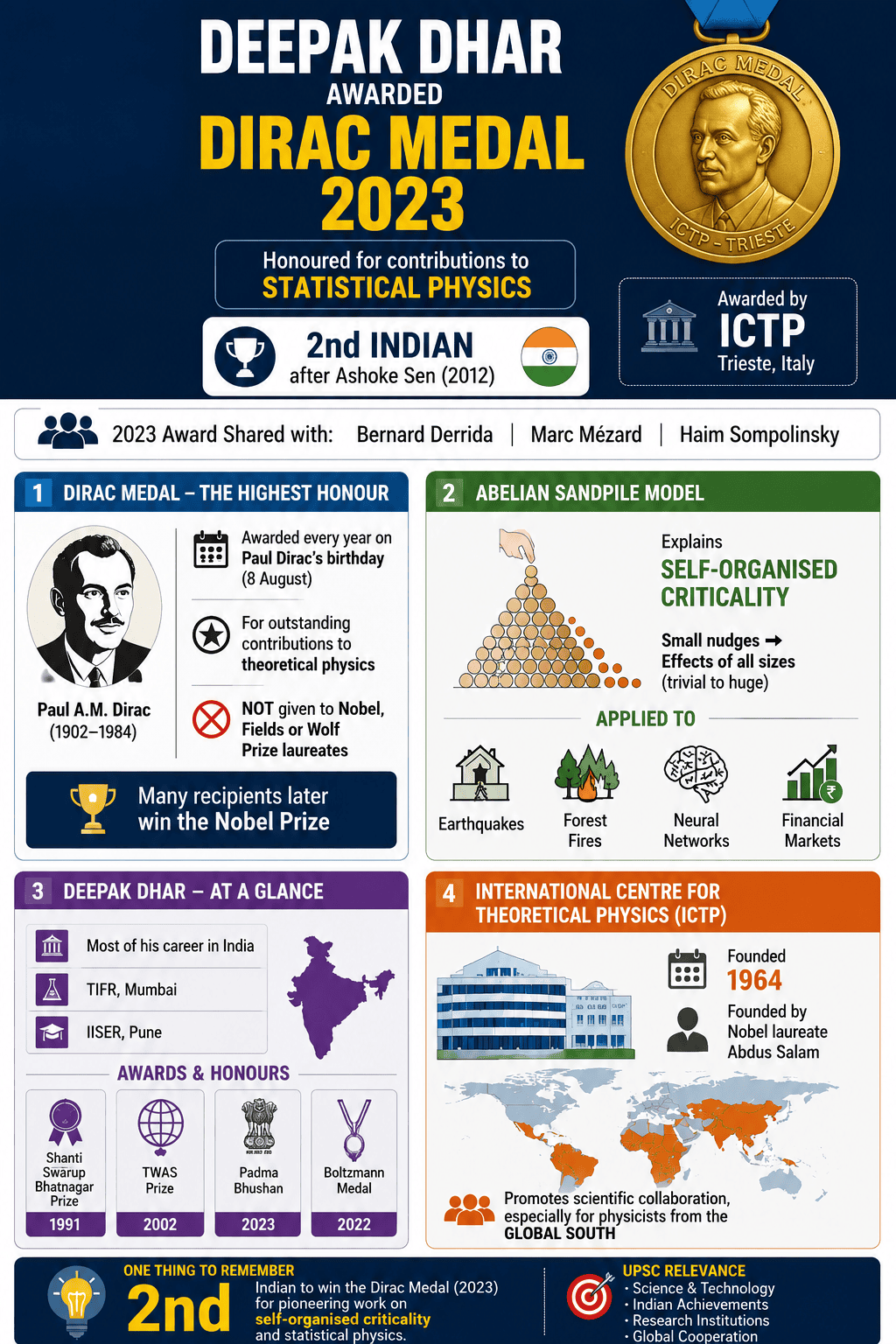
Indian physicist Deepak Dhar wins prestigious Dirac Medal for pioneering contributions to statistical physics, particularly his Abelian sandpile model.
Practice MCQs
862 Students attempted
Key Highlights:
- Theoretical physicist Deepak Dhar was awarded the Dirac Medal for his contributions to statistical physics.
- He shares the 2023 award with Bernard Derrida, Marc Mézard, and Haim Sompolinsky.
- Dhar is the second Indian to receive the Dirac Medal, following Ashoke Sen in 2012.
- The award is presented by the International Centre for Theoretical Physics (ICTP) in Trieste, Italy.
- His most notable work involves the Abelian sandpile model, which explains self-organised criticality.
Dirac.jpg
Detailed Insights:
- The Dirac Medal is awarded annually on Paul A.M. Dirac's birthday for significant contributions to theoretical physics.
- It is explicitly not given to Nobel, Fields, or Wolf Prize laureates, though many recipients later win a Nobel Prize.
- The Abelian sandpile model describes systems where small nudges can trigger effects of varying sizes, from trivial to significant.
- This model is applied to phenomena like earthquakes, forest fires, neural networks, and financial market fluctuations.
- Self-organised criticality refers to systems that naturally evolve into a critical state where small disturbances can have large impacts.
- Deepak Dhar has spent most of his career in India, including at the Tata Institute of Fundamental Research (TIFR) and Indian Institute of Science Education and Research (IISER), Pune.
- He has also received other prestigious awards, including the Shanti Swarup Bhatnagar Prize (1991), TWAS Prize (2002), Padma Bhushan (2023), and the Boltzmann Medal (2022).
- The ICTP was founded in 1964 by Nobel laureate Abdus Salam to foster scientific collaboration, especially for physicists from the Global South.
Scientific/Technical Concepts Involved:
- Abelian sandpile model: A mathematical model describing systems that build instability and release it unpredictably, where the final state is independent of the sequence of events.
- Self-organised criticality: A property of dynamic systems that spontaneously evolve into a critical state, where small perturbations can lead to large-scale events.
- Statistical mechanics: A branch of physics that uses probability theory to study the collective behavior of large ensembles of microscopic entities.

SuperKalam is your personal mentor for UPSC preparation, guiding you at every step of the exam journey.
Download the App


STUDY RESOURCES
CONTACT US
ⓒ Snapstack Technologies Private Limited