GS 2: GovernanceGS 2: International RelationsGS 3: EconomyPrelimsGS 3: Indian Economy, Planning, Mobilization of Resources, Growth, Development and Employment
Someone has to pay for UPI. How do we decide who?, Pg12
India debates who should fund UPI infrastructure amidst zero MDR policy, impacting merchants, consumers, and digital payment ecosystem.
Practice MCQs
862 Students attempted
Key Highlights:
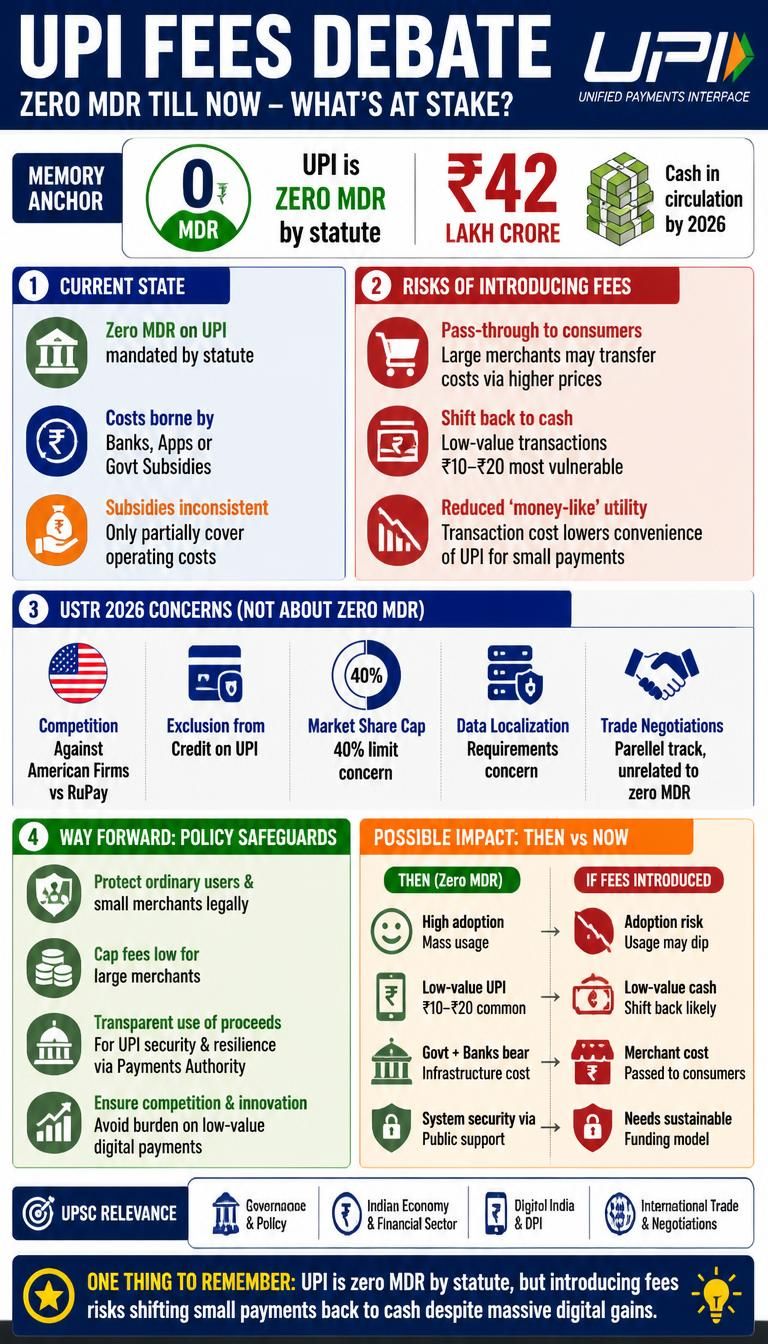
- Unified Payments Interface (UPI) has historically operated with a zero Merchant Discount Rate (MDR), a policy mandated by statute.
- The costs associated with UPI infrastructure have been borne by banks, payment applications, or through government subsidies.
- Government subsidies for UPI have been inconsistent and have only partially covered the estimated operating costs of the system.
- Concerns exist that introducing a fee could lead to large merchants passing costs to consumers and potentially encourage a shift back to cash, especially for low-value transactions of ₹10-₹20.
- The discussion around introducing UPI fees coincides with ongoing trade negotiations with the United States Trade Representative (USTR), although the USTR's objections are not related to zero MDR.
UPI Fee debate.jpg
Detailed Insights:
- MDR is the fee a merchant pays its bank for accepting digital payments, typically a percentage of the transaction value for card transactions.
- The current zero MDR policy, while promoting digital payments, places a financial burden on the exchequer and payment service providers.
- "Pass-through" is an economic concept describing the extent to which merchants transfer increased costs to consumers through higher prices.
- Introducing transaction costs could reduce the "money-like" utility of UPI, potentially shifting low-value transactions back to cash.
- Despite free UPI, cash in circulation continued to increase, reaching approximately ₹42 lakh crore by 2026.
- The USTR's 2026 report raised concerns about competition for American firms against RuPay, exclusion from credit on UPI, market share caps (40%), and data localization requirements.
- Recommendations include legally protecting ordinary users and small merchants from fees, capping fees low for large merchants, and transparently managing proceeds for UPI system security through a payments authority.
Key Concepts Involved:
- UPI (Unified Payments Interface): An instant real-time payment system developed by the National Payments Corporation of India (NPCI), enabling inter-bank peer-to-peer and person-to-merchant transactions via mobile.
- MDR (Merchant Discount Rate): The fee a merchant pays its bank for accepting digital payments, typically a percentage of the transaction value.
- Pass-through: The extent to which a firm passes on an increase in its costs to its customers in the form of higher prices.
- RuPay: An Indian multinational financial services and payment service system, conceived and launched by the National Payments Corporation of India (NPCI), as an alternative to international card networks.

SuperKalam is your personal mentor for UPSC preparation, guiding you at every step of the exam journey.
Download the App


STUDY RESOURCES
CONTACT US
ⓒ Snapstack Technologies Private Limited