GS 3: Science & TechnologyPrelimsGS 3: Indigenization of Technology and New Technology DevelopmentGS 3: IT and Computers
Indian lab designs quantum algorithm to beat computers, Pg13
BITS Pilani team achieves quantum advantage, simulating subatomic particles faster than classical computers, marking India's first active claim on Quantum Advantage Tracker.
Practice MCQs
855 Students attempted
Key Highlights:
- An Indian laboratory at BITS Pilani has designed a quantum algorithm that successfully simulated subatomic particle behavior.
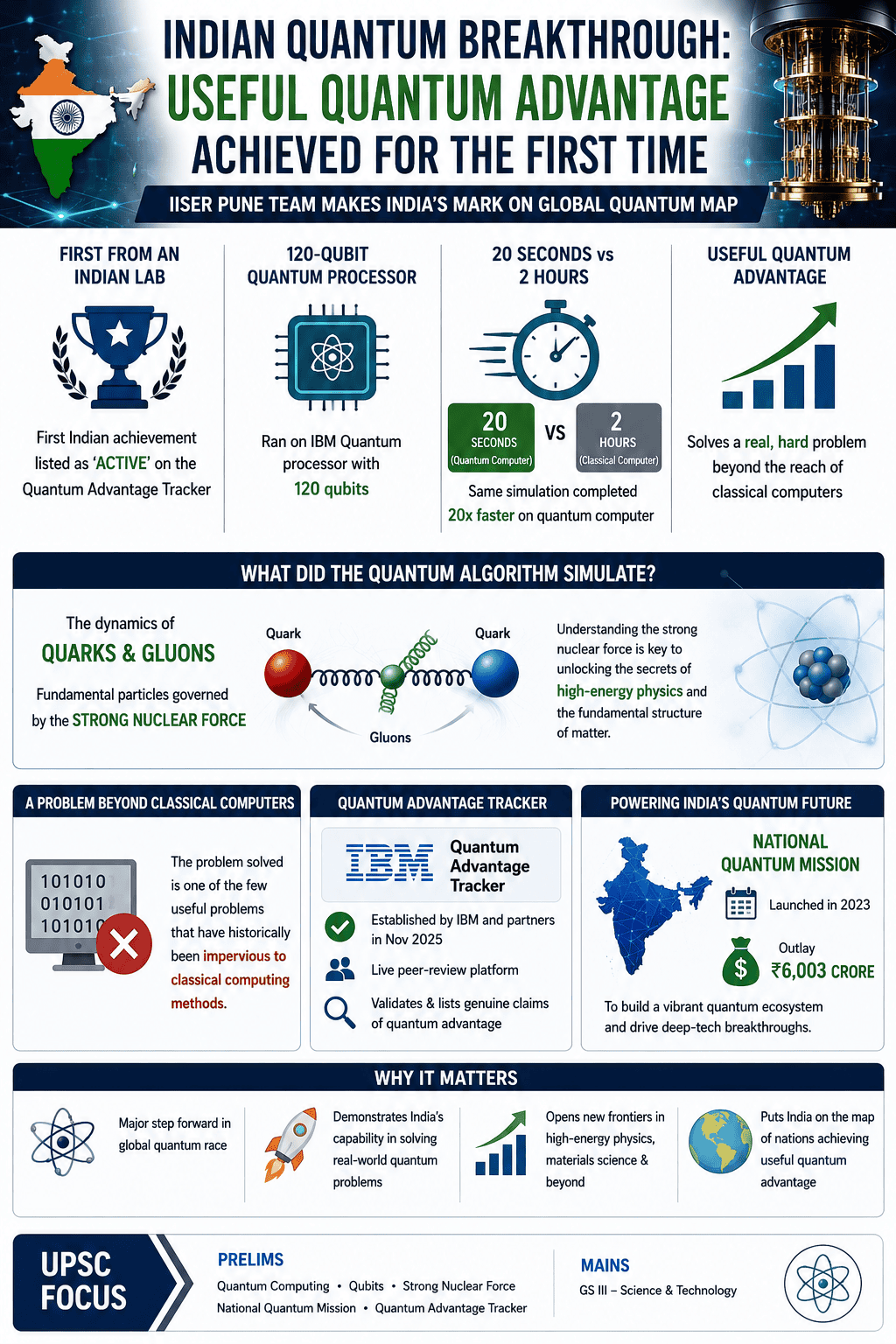
- The algorithm ran on a 120-qubit IBM Quantum processor, completing a simulation in 20 seconds that took a classical computer two hours.
- This achievement demonstrates "useful quantum advantage" and is the first from an Indian lab to be listed as 'active' on the Quantum Advantage Tracker.
- The research focuses on understanding the strong nuclear force and has significant implications for high-energy physics.
- India's National Quantum Mission, launched in 2023 with an outlay of ₹6,003 crore, supports such advancements in quantum technology.
NQM.png
Detailed Insights:
- The quantum algorithm specifically simulated the dynamics of quarks and gluons, which are fundamental particles governed by the strong nuclear force.
- The problem solved by the Indian team is considered one of the few useful problems that have historically been impervious to classical computing methods.
- The Quantum Advantage Tracker, established by IBM and partners in November 2025, serves as a live peer-review platform to validate claims of quantum advantage.
- The algorithm's design is highly scalable, meaning it can be seamlessly applied to quantum computers with a larger number of qubits, such as a 1,000-qubit machine.
- The lead researcher is collaborating with CERN to explore how this quantum approach can enhance simulations in particle physics, where classical methods face limitations.
- While India's National Quantum Mission aims to develop indigenous quantum capabilities, current advanced research often relies on accessing quantum hardware abroad.
Scientific/Technical Concepts Involved:
- Quantum Advantage: The point at which a quantum computer can perform a computational task more efficiently, accurately, or cost-effectively than any known classical computer for a meaningful problem.
- Qubits: The basic unit of quantum information, analogous to a classical bit, but capable of existing in multiple states (0, 1, or both simultaneously) due to superposition.
- Strong Nuclear Force: The most powerful of the four fundamental forces of nature, responsible for binding quarks together within protons and neutrons, and holding atomic nuclei intact.
- IBM Quantum: IBM's comprehensive initiative for quantum computing, encompassing the development of quantum hardware, software (Qiskit), and cloud-based access to quantum processors for research and development.

SuperKalam is your personal mentor for UPSC preparation, guiding you at every step of the exam journey.
Download the App


STUDY RESOURCES
CONTACT US
ⓒ Snapstack Technologies Private Limited