GS 2: PolityGS 2: International RelationsGS 3: EconomyPrelimsGS 2: Bilateral, Regional and Global Groupings and Agreements
India seeks review of US' forced labour investigation, Pg11
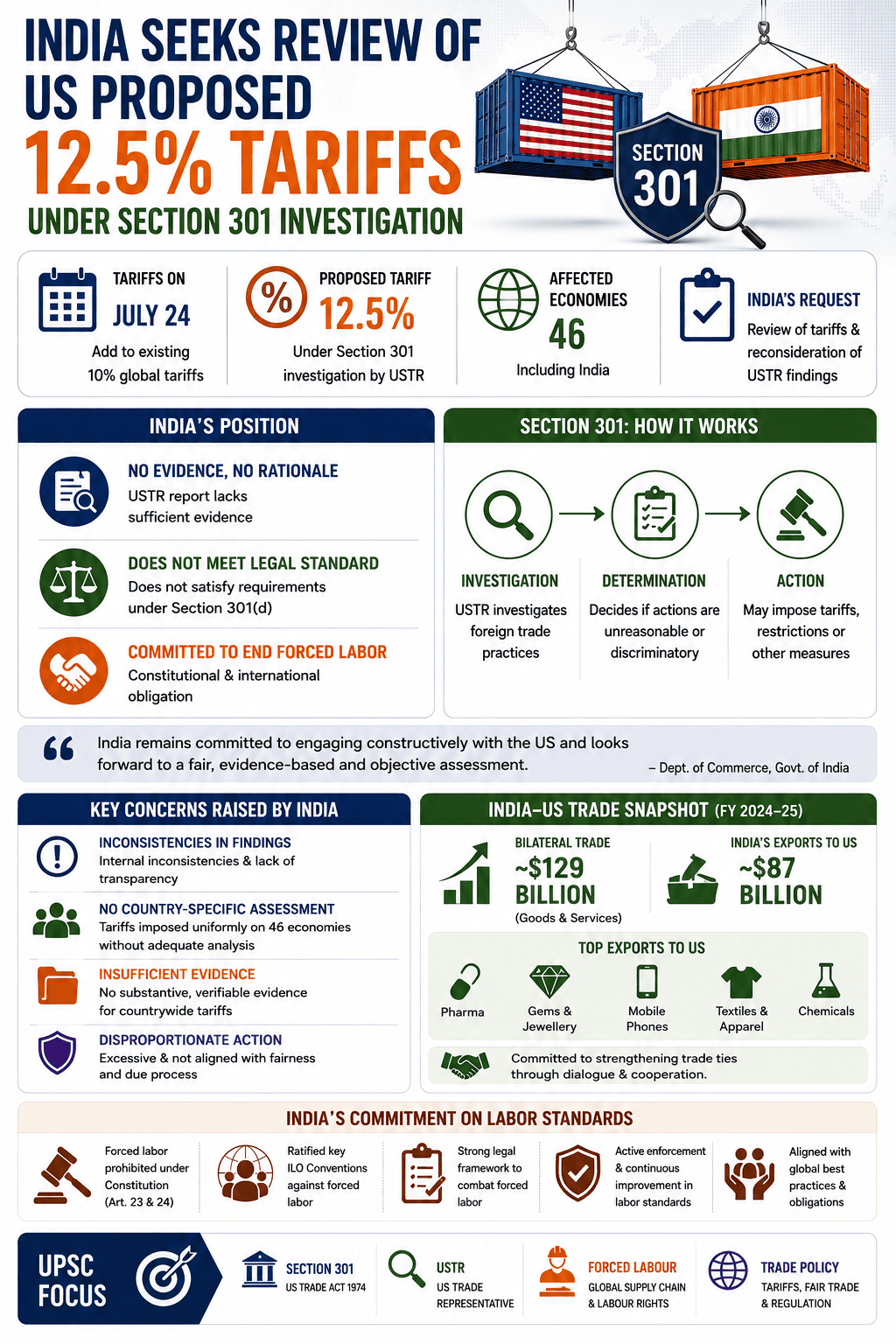
India challenges proposed 12.5% US tariffs under Section 301, citing inconsistencies in forced labor investigation and urging bilateral trade talks.
Practice MCQs
855 Students attempted
Key Highlights:
- India has requested a review of proposed US tariffs of 12.5% under a Section 301 investigation by the United States Trade Representative (USTR), citing inconsistencies in its findings on forced labor concerns.
- The proposed tariffs are scheduled to be imposed by July 24, adding to existing 10% global tariffs.
- India's Department of Commerce stated that the USTR's report lacks sufficient evidence and rationale for imposing countrywide tariffs on 46 economies, including India.
- India emphasized its commitment to eliminating forced labor as a constitutional and international obligation.
USTR.png
Detailed Insights:
- Joint Secretary Brij Mohan Mishra from the Department of Commerce argued that the USTR's determination does not satisfy the legal standards under Section 301(d) of the Trade Act.
- India contends that the report relies on broad data without providing sector- or country-specific evidence linking forced labor to Indian exports or an unfair competitive advantage for India.
- Reliance Industries Limited (RIL), represented by Anil Rajvanshi, highlighted that their petrochemical intermediates use low-risk raw materials and adhere to ESG audits, warning that additional tariffs would significantly increase costs for US downstream users.
- APEDA, through Shrevans Gupta, objected to the USTR's observations regarding alleged forced labor in Indian rice imports, noting that the value of rice imported into India is less than 3% of its exports to the US.
- India advocates for resolving trade issues within the framework of India-US bilateral trade negotiations rather than through unilateral measures like the Section 301 investigation.
- The USTR launched two separate Section 301 investigations in March 2026, covering 60 economies over concerns related to forced labor and excess industrial capacity.
Key Concepts Involved:
- Section 301 of the Trade Act of 1974: A US trade law authorizing the President to take action, including tariffs, against foreign governments engaging in unfair trade practices that burden or restrict US commerce.
- United States Trade Representative (USTR): A US government agency responsible for developing and coordinating US international trade policy, negotiating trade agreements, and acting as the President's chief advisor on trade matters.
- Forced Labor: Any work or service exacted from a person under the menace of any penalty and for which the person has not offered themselves voluntarily, as defined by the ILO Forced Labour Convention, 1930 (No. 29).
- ESG Audits: Structured evaluations of a company's performance across environmental, social, and governance practices, assessing their impact on the planet, people, and long-term governance.
- APEDA (Agricultural and Processed Food Products Export Development Authority): A statutory body under India's Ministry of Commerce and Industry, established to promote the export of agricultural and processed food products from India.

SuperKalam is your personal mentor for UPSC preparation, guiding you at every step of the exam journey.
Download the App


STUDY RESOURCES
CONTACT US
ⓒ Snapstack Technologies Private Limited