GS 3: Internal SecurityGS 2: International RelationsGS 3: EconomyPrelimsGS 2: Bilateral, Regional and Global Groupings and Agreements
India, New Zealand set trade goal, elevate ties, Pg1
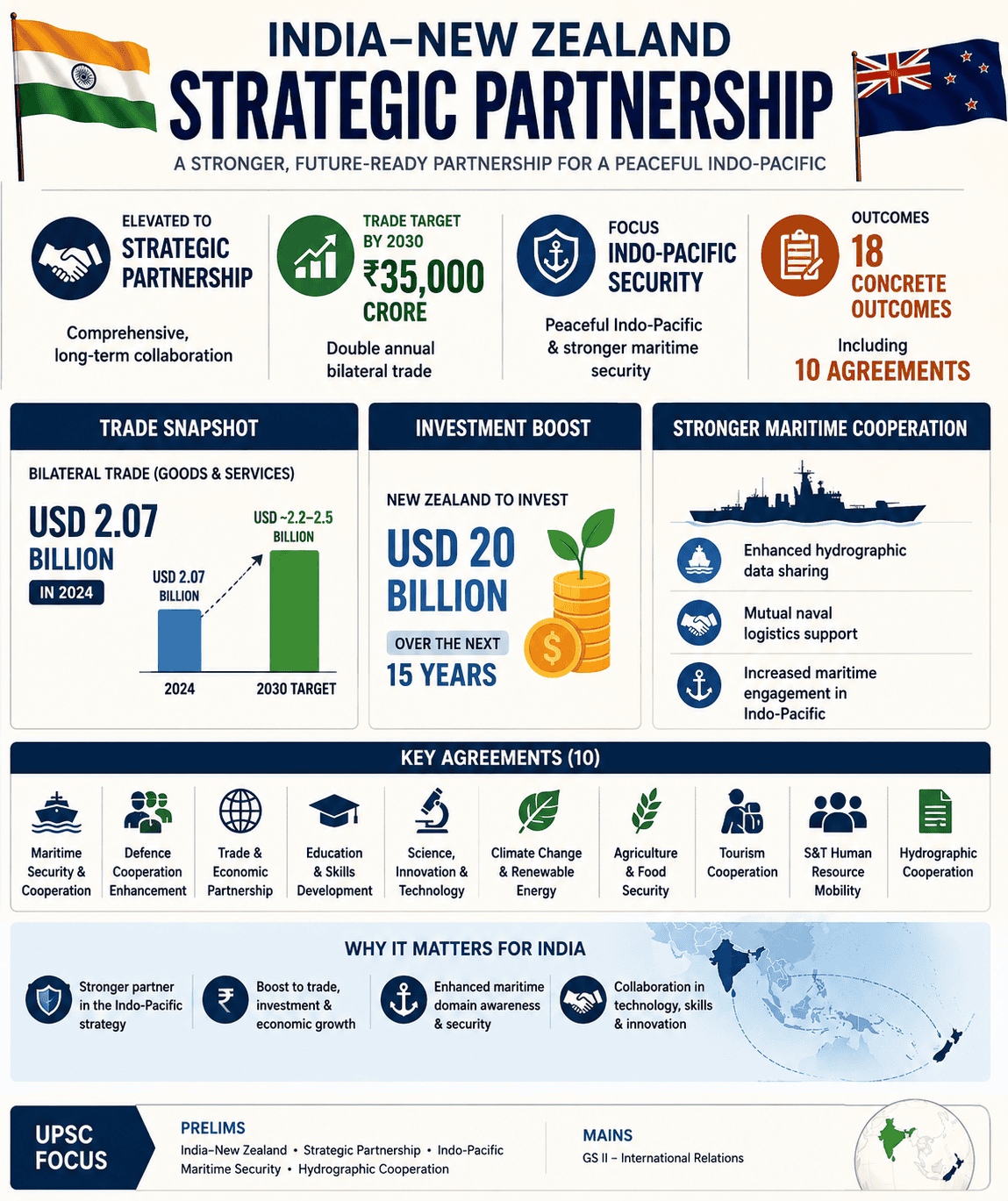
India and New Zealand forge strategic partnership, aiming to double trade to ₹35,000 crore by 2030, enhancing Indo-Pacific maritime cooperation.
Practice MCQs
855 Students attempted
Key Highlights:
- India and New Zealand elevated their bilateral relationship to a strategic partnership.
- The two nations set a target to double annual bilateral trade to ₹35,000 crore by 2030.
- They vowed to work towards a peaceful Indo-Pacific and decided to ramp up maritime security.
- Eighteen concrete outcomes, including ten agreements, were reached during talks between the Prime Ministers.
- New Zealand committed to invest USD 20 billion in India over the next 15 years.
Ind-NZ.png
Detailed Insights:
- The elevation to a strategic partnership signifies a comprehensive, long-term collaboration across various sectors, including security, defense, and economics.
- Current bilateral trade in goods and services between India and New Zealand was approximately USD 2.07 billion in 2024.
- Key agreements include enhanced hydrographic data sharing, mutual naval logistics, and increased maritime engagement in the Indo-Pacific region.
- The joint statement emphasized a shared commitment to a free, open, and prosperous Indo-Pacific, addressing concerns over regional military activities.
- Both countries agreed to establish a maritime security dialogue and a joint working group on counter-terrorism.
- The leaders called for adherence to freedom of navigation and overflight, in accordance with the 1982 United Nations Convention on the Law of the Sea (UNCLOS).
- An India-New Zealand joint action plan on sport was also finalized, focusing on high-performance sports, sports science, and athlete development.
Key Concepts Involved:
- Strategic Partnership: A comprehensive, long-term diplomatic relationship between two or more sovereign states, involving structured cooperation across multiple areas such as security, defense, economics, and politics.
- Indo-Pacific: A geopolitical concept encompassing the interconnected Indian and Pacific Oceans, emphasizing the strategic and economic links between the two regions, crucial for global trade and security.
- United Nations Convention on the Law of the Sea (UNCLOS): An international treaty adopted in 1982 that establishes a legal framework for all marine and maritime activities, defining the rights and responsibilities of nations in their use of the world's oceans.

SuperKalam is your personal mentor for UPSC preparation, guiding you at every step of the exam journey.
Download the App


STUDY RESOURCES
CONTACT US
ⓒ Snapstack Technologies Private Limited