GS 2: PolityGS 2: Social JusticeGS 2: International RelationsGS 1: Modern HistoryPrelims
Why Jamaica’s reparations petition has a solid legal basis, Pg8
Jamaica petitions King Charles III, seeking Privy Council's legal opinion on UK's obligation for slavery reparations, challenging historical injustices with international law.
Practice MCQs
876 Students attempted
Key Highlights:
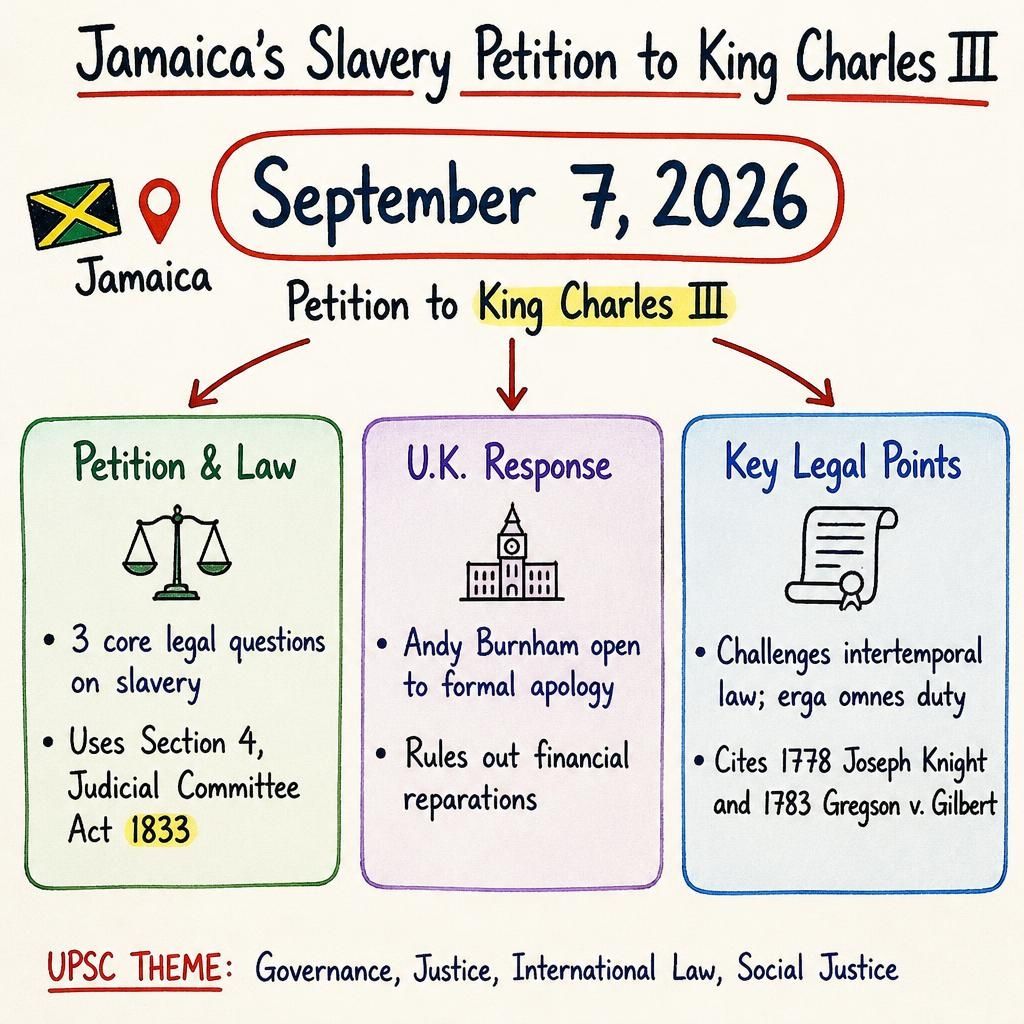
- Jamaica, led by Culture Minister Olivia Grange, filed a petition on September 7, 2026, to King Charles III, who is Jamaica’s Head of State.
- The petition asks King Charles III to refer three core legal questions regarding the lawfulness of slavery to the Judicial Committee of the Privy Council (JCPC).
- These questions concern whether the enslavement of Africans in Jamaica was lawful under English common law, violated international legal principles, and if the U.K. has a legal obligation for reparatory remedies.
- U.K. Prime Minister Andy Burnham stated openness to formally apologising for Britain’s role in the transatlantic slave trade but ruled out financial reparations.
- The petition strategically uses Section 4 of the Judicial Committee Act 1833 to compel a legal review by Britain's highest sitting judges.
Jamaica's Petition.jpg
Detailed Insights:
- The petition challenges the U.K.'s standard defense, the doctrine of intertemporal law, which dictates that past acts must be judged solely by the law of their contemporary era.
- Jamaica asserts that the prohibition of slavery is an erga omnes obligation, a peremptory duty owed to the international community, making it a timeless violation.
- The petition highlights the 1778 Joseph Knight case, where a Scottish court ruled slavery unjust under Scots law despite colonial statutes.
- It also references the 1783 Gregson v. Gilbert case, where the mass killing of enslaved people on the Zong ship was treated purely as a commercial breach of contract.
- The U.K. Parliament passed the Slavery Abolition Act 1833, which compensated former slave owners with £20 million, a debt that was fully repaid only in 2015.
- Jamaica's approach aligns with restorative justice, focusing on addressing the harm done and affirmative obligations to make things right, rather than solely on individual culpability.
Key Concepts Involved:
- Judicial Committee of the Privy Council (JCPC): The highest court of appeal for several Commonwealth countries, including Jamaica.
- Intertemporal Law: A legal principle stating that past acts must be judged by the law applicable at the time they occurred.
- Erga Omnes: Obligations owed by states to the international community as a whole, considered universally binding and non-derogable.
- Restorative Justice: An approach to justice that focuses on repairing harm caused by crime or conflict, involving victims, offenders, and the community.
- Slavery Abolition Act 1833: An Act of the Parliament of the United Kingdom that abolished slavery throughout the British Empire.

SuperKalam is your personal mentor for UPSC preparation, guiding you at every step of the exam journey.
Download the App


STUDY RESOURCES
CONTACT US
ⓒ Snapstack Technologies Private Limited