GS 2: GovernanceGS 3: Science & TechnologyGS 2: International RelationsGS 3: EconomyPrelims
Two Different Bullet Trains, Signal Systems Can't Run In Same Corridor, Pg12
Japanese expert warns India against using two different bullet train technologies and signaling systems on the same high-speed corridor, citing safety concerns and lack of precedent.
Practice MCQs
869 Students attempted
Key Highlights:
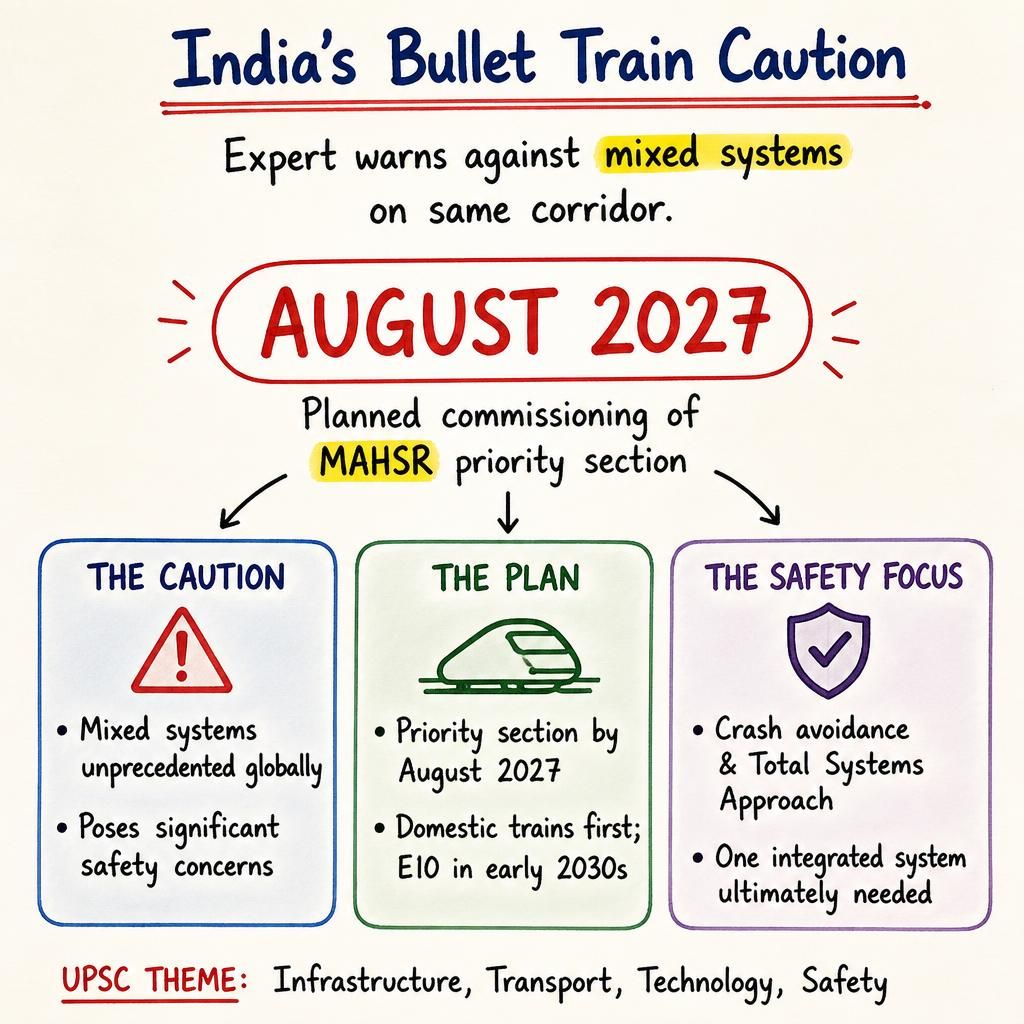
- An expert from the Japan Transport and Tourism Research Institute (JTTRI) has cautioned against using two different types of bullet trains and their respective signaling systems on the same corridor in India.
- Masafumi Shukuri, Chairman of JTTRI, stated that such a mixed system is unprecedented globally and poses significant safety concerns for high-speed rail operations.
- India plans to commission the priority section of the Mumbai-Ahmedabad High-Speed Rail (MAHSR) project by August 2027 using domestically manufactured bullet trains.
- The latest Japanese E10 series Shinkansen, originally intended for the project, is still under development and will not be available for India's initial operations until the early 2030s.
Bullet Train.jpg
Detailed Insights:
- The Mumbai-Ahmedabad High-Speed Rail (MAHSR) project is India's first bullet train corridor, being developed with technical and financial cooperation from Japan.
- The project is implemented by the National High-Speed Rail Corporation Limited (NHSRCL), a joint venture of the Government of India and participating state governments.
- The expert emphasized the paramount importance of "crash avoidance" and a "Total Systems Approach" for ensuring the safety and reliability of high-speed rail.
- India's decision to use domestically made trains for the initial section aligns with the 'Make in India' and 'Aatmanirbhar Bharat' initiatives.
- BEML Limited, in collaboration with Integral Coach Factory (ICF), is manufacturing two prototype Indian bullet train sets (B-28) designed for speeds of 280 kmph.
- The "priority section" between Surat and Vapi/Bilimora in Gujarat is expected to be the first operational segment of the corridor.
- The expert suggested that for safe and reliable operation, one integrated system, encompassing both rolling stock and signaling, will ultimately need to be adopted for the entire corridor.
Scientific/Technical Concepts Involved:
- High-Speed Rail (HSR): A rail transport system designed to operate at speeds significantly higher than conventional rail, typically above 250 kmph.
- Shinkansen: Japan's renowned high-speed rail system, characterized by its advanced technology, safety record, and punctuality.
- Rolling Stock: Refers to all railway vehicles, including locomotives, passenger coaches, and freight wagons, used on a railway line.
- Signaling Systems: The technology and infrastructure used to control railway traffic, ensuring safe train separation and movement.
- Total Systems Approach: A holistic methodology in railway engineering that considers all components—civil works, tracks, rolling stock, signaling, maintenance, and human resources—as an integrated system.

SuperKalam is your personal mentor for UPSC preparation, guiding you at every step of the exam journey.
Download the App


STUDY RESOURCES
CONTACT US
ⓒ Snapstack Technologies Private Limited