GS 2: International RelationsGS 3: Environment & EcologyGS 3: EconomyPrelimsGS 3: Changes in Industrial Policy and Effects on Industrial Growth
How India could benefit from US probe into EU's carbon pricing mechanism, Pg12
US launches probe into EU's Carbon Border Adjustment Mechanism (CBAM), potentially offering India trade flexibility and easing export impact.
Practice MCQs
869 Students attempted
Key Highlights:
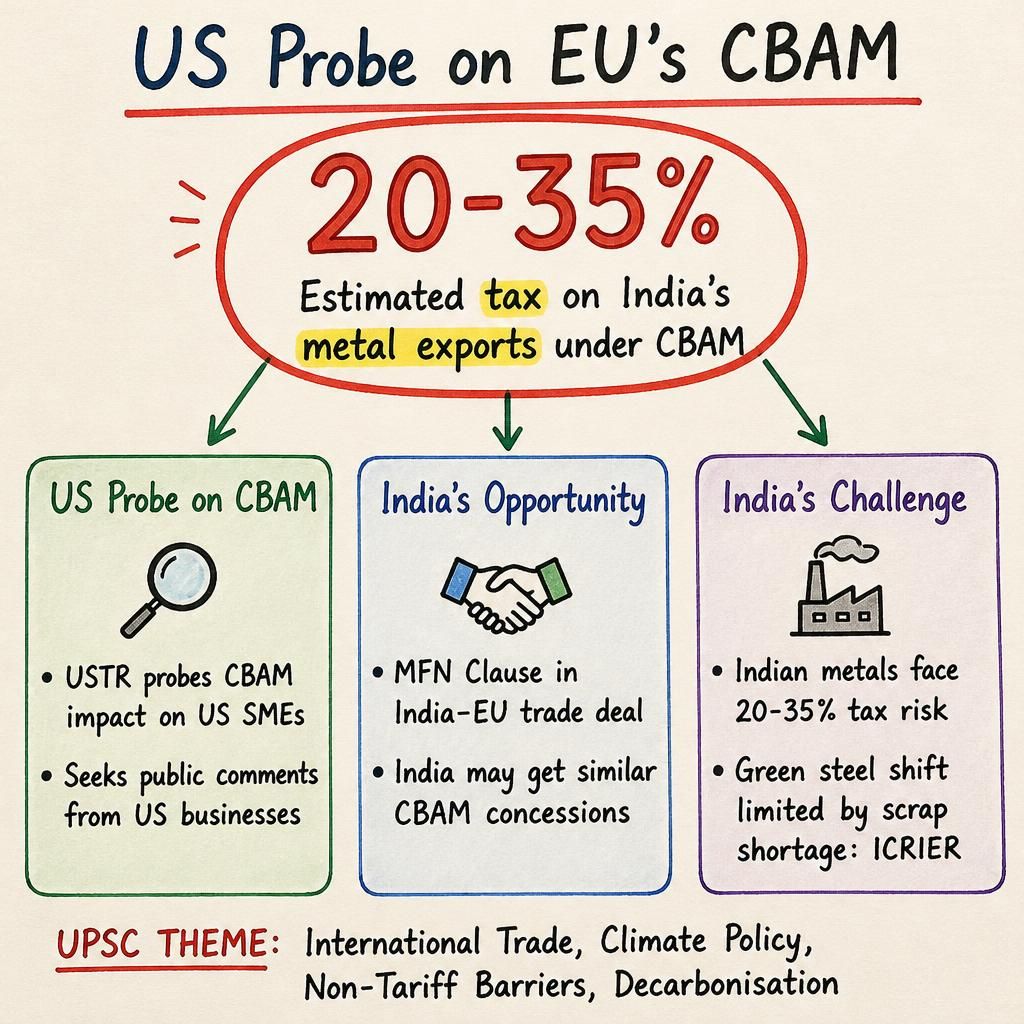
- The United States Trade Representative (USTR) has initiated a probe into the European Union's Carbon Border Adjustment Mechanism (CBAM), seeking public comments from American businesses.
- The CBAM is a carbon pricing mechanism requiring EU importers of specific goods like metals, cement, and fertilisers to declare embedded emissions.
- India could benefit from this US probe due to a 'Forward-Most Favoured Nation' Clause (MFN) secured in its trade deal with the EU.
- This clause could grant India similar concessions that the EU might offer the US regarding CBAM implementation.
- India's metal exports, particularly iron, steel, and aluminium, are estimated to face a 20-35% tax under CBAM.
EU's CBAM.jpg
Detailed Insights:
- The USTR is investigating the CBAM's impact on US small and medium-sized businesses, aiming for increased flexibility in its application.
- The EU's CBAM calculates default emission values with a punitive mark-up to encourage company-level data, which must be verified by an EU-accredited third party.
- India has been engaged in tough negotiations with the EU over CBAM, which is seen as a potential non-tariff barrier.
- The Global Trade Research Initiative (GTRI) highlighted the significant tax burden CBAM would impose on Indian metal exports to the EU.
- Indian steel manufacturers predominantly use the high-emission blast furnace route, making them vulnerable to CBAM regulations.
- India's 'green steel initiative' aims to increase steel production using scrap-based electric arc furnace technology to mitigate CBAM impacts.
- A report by the Indian Council for Research on International Economic Relations (ICRIER) noted India's limited domestic scrap availability, which is a critical bottleneck for decarbonization.
Key Concepts Involved:
- Carbon Border Adjustment Mechanism (CBAM): An EU policy imposing a carbon price on imported goods to equalize the carbon cost paid by EU producers.
- Most Favoured Nation (MFN) Clause: A principle in international trade ensuring that a country treats all its trading partners equally, granting them the same concessions.
- Non-Tariff Barrier: Restrictions on trade other than customs duties, such as quotas, import licenses, or technical regulations like environmental standards.
Previous7/7

SuperKalam is your personal mentor for UPSC preparation, guiding you at every step of the exam journey.
Download the App


STUDY RESOURCES
CONTACT US
ⓒ Snapstack Technologies Private Limited