GS 2: GovernanceGS 1: Indian SocietyGS 3: EconomyPrelimsGS 3: Changes in Industrial Policy and Effects on Industrial Growth
The MSME opportunity lies in clustering them, Pg11
India's 63 million MSMEs, employing 320 million, need strategic clustering and policy reforms to boost job creation and economic output.
Practice MCQs
855 Students attempted
Key Highlights:
- Youth unemployment and underemployment are significant challenges in India, highlighting the need for robust job creation engines.
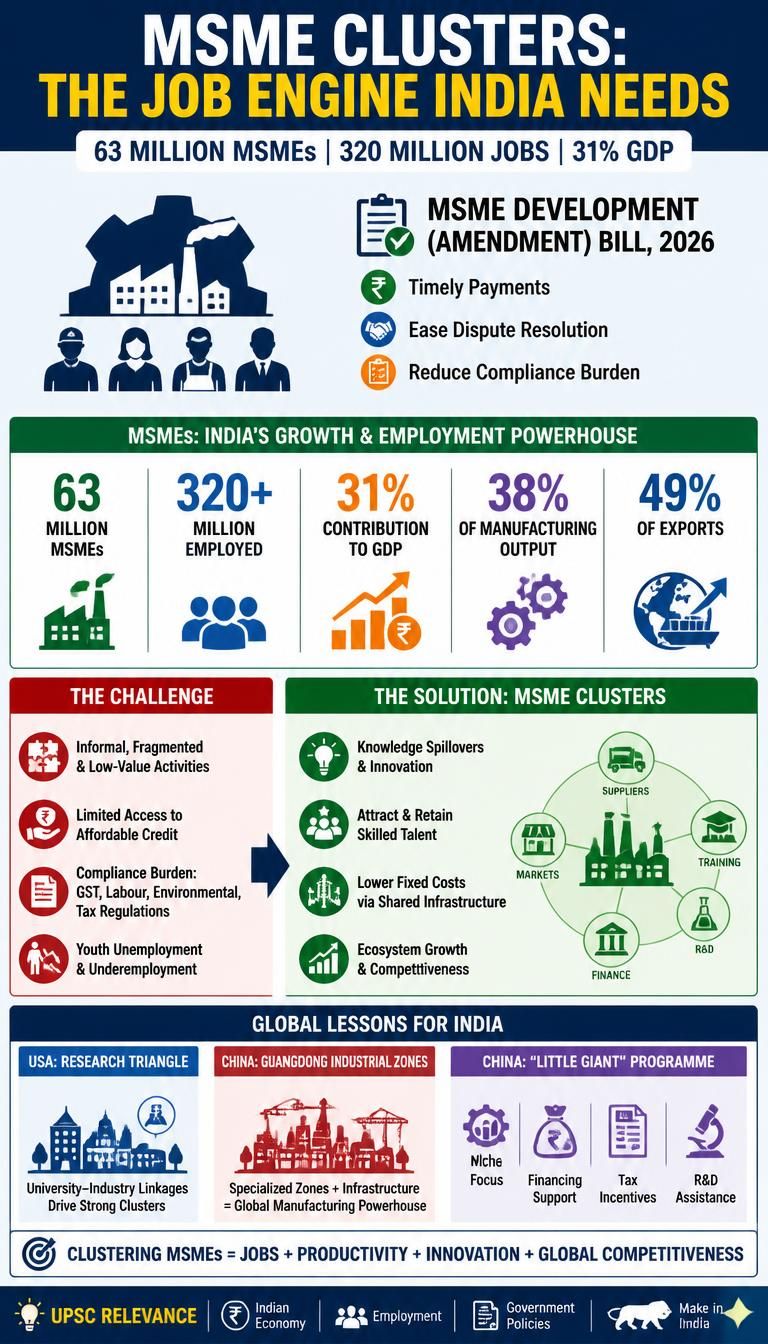
- India's 63 million MSMEs employ over 320 million people, contributing 31% to GDP, 38% to manufacturing output, and 49% to exports.
- The proposed Micro, Small and Medium Enterprises Development (Amendment) Bill, 2026, aims to address delayed payments, ease dispute resolution, and reduce compliance burdens for MSMEs.
- The article advocates for clustering MSMEs as a strategy to foster ecosystem development, drawing lessons from successful models in the US and China.
- Clustering can lead to knowledge spillovers, attract and retain talent, and lower fixed costs through shared infrastructure.
MSME Clusters.jpg
Detailed Insights:
- Despite their significant economic contribution, Indian MSMEs often remain informal, fragmented, and concentrated in low-value activities.
- Smaller firms face major obstacles including limited access to affordable credit and the burden of various compliances like GST, labor, environmental, and tax regulations.
- The US Research Triangle and China's Guangdong industrial zones demonstrate how university-industry linkages and specialized zones foster strong industrial clusters.
- China's "Little Giant" programme supports technically strong small firms in niche areas with financing, tax support, and research and development assistance.
- India should shift from generic industrial estates to specialized, sector-specific clusters, concentrating resources in hubs like Pune for auto components or Sriperumbudur for electronics.
- A dedicated program for "hidden champions" in specialized fields could offer credit lines, faster patent processing, and research and development support.
- Cluster-based lending, which evaluates shared collateral and collective performance, can bridge the MSME credit gap, with SIDBI and cluster-focused NBFCs playing a crucial role.
- Indian universities need to integrate more closely with local industries, mirroring successful models in China and the US for talent supply, lab infrastructure, and innovation.
Key Concepts Involved:
- Micro, Small and Medium Enterprises (MSMEs): Businesses categorized by investment in plant and machinery or turnover, crucial for employment and economic growth.
- Industrial Clusters: Geographic concentrations of interconnected companies, suppliers, and associated institutions in a particular field.
- Knowledge Spillovers: The diffusion of knowledge and ideas among firms and individuals within a geographic area, often facilitated by proximity.
- Credit Gap: The difference between the demand for credit by businesses and the actual supply of credit from financial institutions.

SuperKalam is your personal mentor for UPSC preparation, guiding you at every step of the exam journey.
Download the App


STUDY RESOURCES
CONTACT US
ⓒ Snapstack Technologies Private Limited