GS 2: GovernanceGS 3: Science & TechnologyGS 3: Environment & EcologyGS 3: EconomyPrelims
You compared power consumption of data centres with thermal plants but they also produce electricity, Pg19
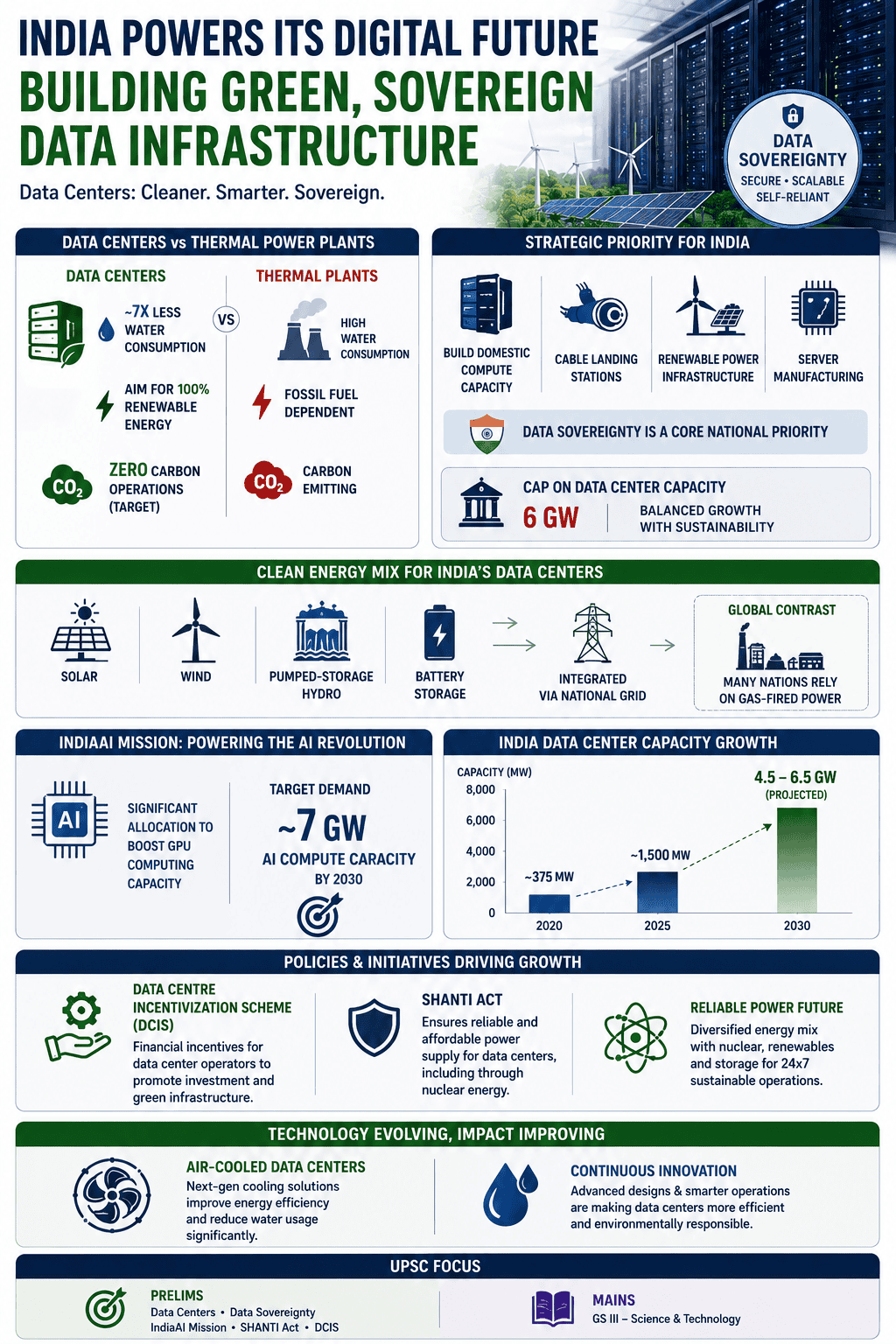
India champions domestic data centers, capping capacity at 6 GW, citing strategic necessity for AI and data sovereignty, powered by renewables.
Practice MCQs
847 Students attempted
Key Highlights:
- Data centers are presented as a more environmentally favorable alternative to thermal power plants, consuming roughly seven times less water and aiming for renewable energy operation, unlike carbon-emitting thermal plants.
- India views building domestic compute capacity, Cable Landing Stations, renewable power infrastructure, and server manufacturing as a strategic priority for Data Sovereignty.
- India's policy caps data center capacity at 6 GW, emphasizing a balanced approach to growth.
- The country's data centers are planned to run on a mix of solar, wind, pumped-storage, and battery storage, integrated through a National Grid, contrasting with the gas-fired power often used in other nations.
Data Centre.png
Detailed Insights:
- The article highlights that evolving technology, such as air-cooled data centers, is continuously improving energy efficiency and reducing water consumption.
- There is a perceived campaign against data center investments in Vizag, despite similar facilities operating without controversy in other major Indian cities like Hyderabad, Chennai, Navi Mumbai, and NCR.
- India's push for indigenous compute capacity is crucial to avoid dependence on foreign entities for advanced AI models like ChatGPT or Gemini, which could pose a significant strategic challenge.
- The IndiaAI Mission includes significant allocations to boost the country's GPU computing capacity, aiming to meet a projected demand of approximately 7 GW of AI compute capacity by 2030.
- India's data center capacity has seen substantial growth, increasing from about 375 MW in 2020 to 1500 MW by 2025, with projections indicating further expansion to 4.5-6.5 GW by 2030.
- The government has introduced initiatives like the Data Centre Incentivization Scheme (DCIS) and the SHANTI Act to promote the sector and ensure reliable power supply, including through nuclear energy.
- India's National Grid is the world's largest operational synchronous grid, facilitating the integration of diverse renewable energy sources to support growing electricity demands, including those from data centers.
Key Concepts Involved:
- Data Sovereignty: A nation's ability to independently control its digital infrastructure, data, communication networks, critical technologies, and AI without undue foreign dependence.
- Compute Capacity: The total processing power available, often measured in Graphics Processing Units (GPUs) or Floating-Point Operations Per Second (FLOPS), essential for complex calculations like AI.
- Cable Landing Stations: Coastline facilities that serve as crucial connection points for undersea fiber-optic cables, linking global internet networks to terrestrial infrastructure.

SuperKalam is your personal mentor for UPSC preparation, guiding you at every step of the exam journey.
Download the App


STUDY RESOURCES
CONTACT US
ⓒ Snapstack Technologies Private Limited