GS 2: GovernanceGS 3: Internal SecurityGS 2: International RelationsPrelimsGS 3: Communication Networks, Media and Social Media Challenges
Terrorism’s data retreat hides emerging global threats, Pg8
Global terrorism's statistical retreat masks dangerous reorganization, with threats concentrating in conflict zones and borderlands, demanding recalibrated counter-terrorism strategies.
Practice MCQs
847 Students attempted
Key Highlights:
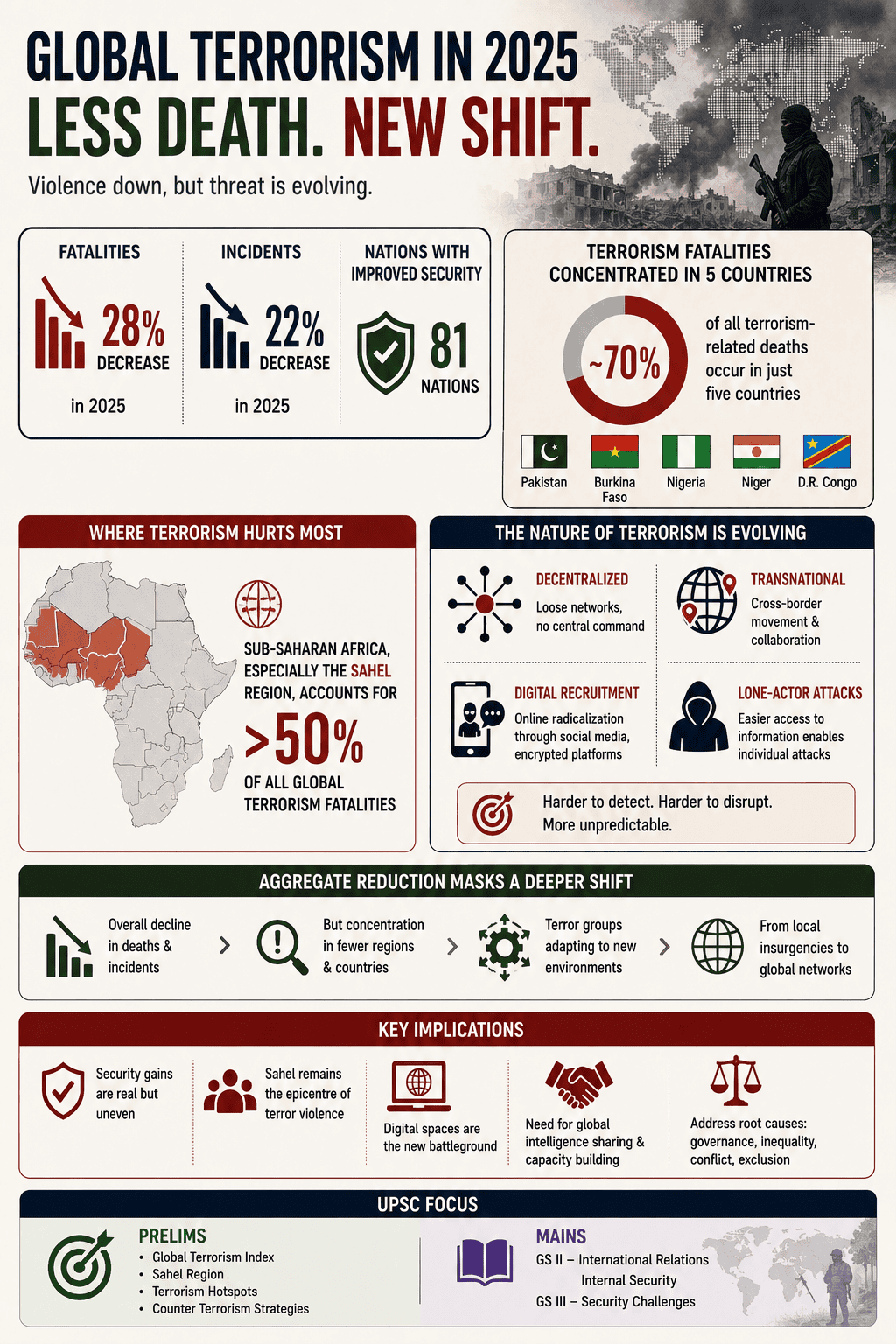
- Global terrorism fatalities decreased by 28% and incidents by 22% in 2025, with 81 nations showing improved security.
- Nearly 70% of all terrorism-related deaths are concentrated in five countries: Pakistan, Burkina Faso, Nigeria, Niger, and the Democratic Republic of the Congo.
- Sub-Saharan Africa, particularly the Sahel region, accounts for over half of all global terrorism fatalities.
- The nature of terrorism is evolving towards decentralized, transnational, and digital recruitment, facilitating lone-actor attacks.
Global Terrorism.png
Detailed Insights:
- The aggregate reduction in violence masks a profound structural mutation in how terror operates and where it thrives globally.
- When violence becomes highly concentrated in specific vulnerable geographies, it risks becoming invisible to the global conscience, fostering complacency.
- There is an overwhelming correlation between political instability and violent extremism, with 99% of terrorism-related deaths occurring in nations already in armed conflict.
- Over 60% of modern terror attacks now take place within 100 kilometers of international borders, which serve as operational sanctuaries.
- Counter-terrorism strategy must shift from reactive responses to addressing the structural ecology of extremist violence, including re-investment in state capacity and border sovereignty.
- The constriction of violent extremism to five dominant networks, including Islamic State and Tehrik-e-Taliban Pakistan (TTP), allows for more focused intelligence efforts.
- Ongoing conflicts in West Asia and persistent geopolitical tensions, such as between India and Pakistan, threaten to reverse recent global gains.
- Terrorist organizations like TTP demonstrate high adaptability, fragmenting and embedding themselves within pre-existing domestic grievances when globally pressured.
Key Concepts Involved:
- Asymmetric Warfare: Conflict between belligerents whose relative military power differs significantly, often involving unconventional tactics.
- Lone-actor attacks: Terrorist acts carried out by individuals without direct command or material support from a larger organization.
- Digital Radicalisation: The process by which individuals are exposed to and adopt extremist ideologies through online platforms and content.
- State Capacity: The ability of a government to effectively implement its policies, maintain order, and provide public services.

SuperKalam is your personal mentor for UPSC preparation, guiding you at every step of the exam journey.
Download the App


STUDY RESOURCES
CONTACT US
ⓒ Snapstack Technologies Private Limited