GS 1: Indian GeographyGS 1: Physical GeographyGS 3: Environment & EcologyPrelimsGS 1: Changes in Critical Geographical Features, Water Bodies, Ice Caps, Flora and Fauna
El Niño strengthens, could develop into strongest since 1950, says US agency, Pg15
US agency warns El Niño could become strongest since 1950, with 81% chance of 'very strong' event, threatening India's monsoon.
Practice MCQs
847 Students attempted
Key Highlights:
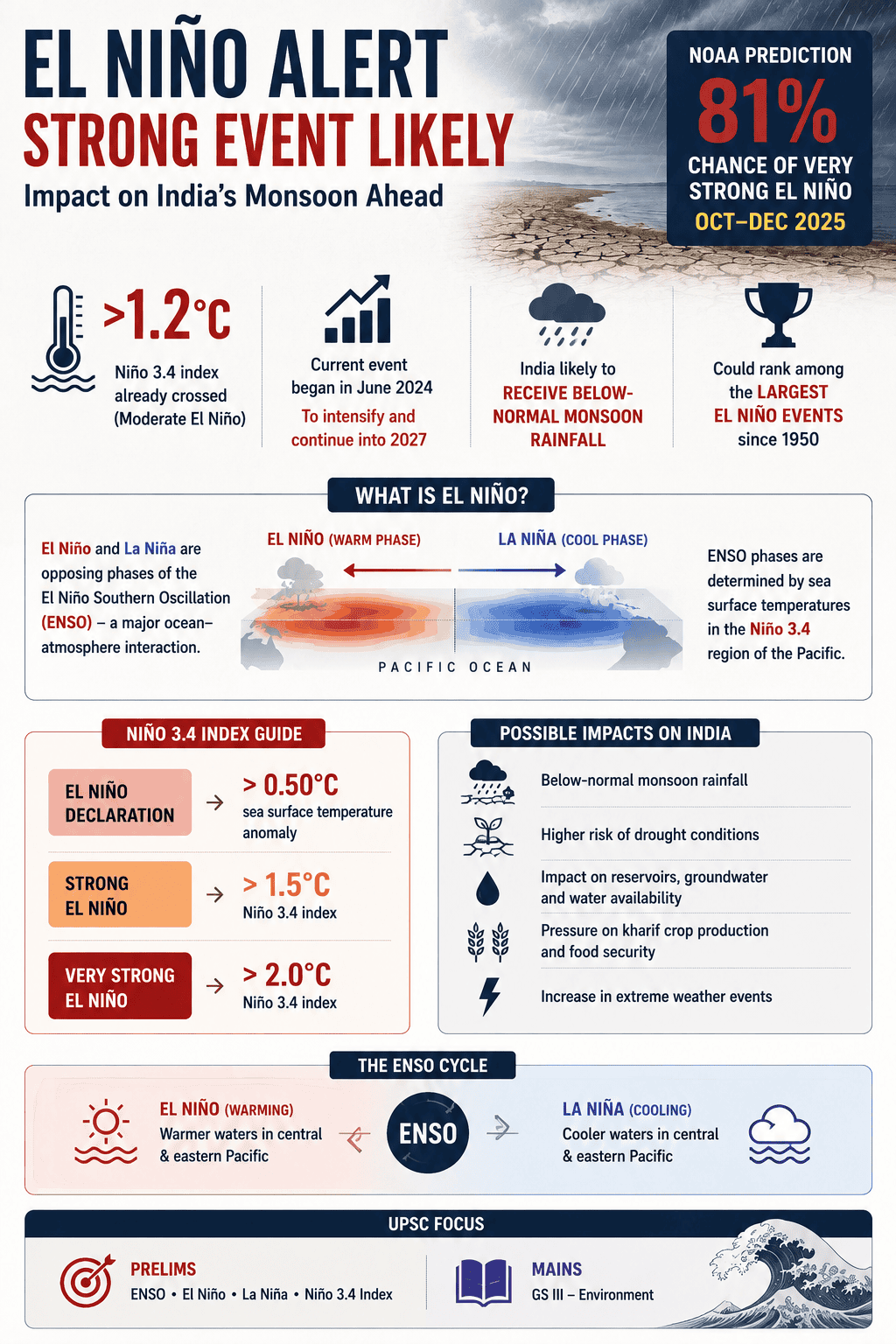
- The National Oceanic and Atmospheric Administration (NOAA) predicts an 81% chance of a very strong El Niño from October to December.
- This El Niño event could rank among the largest recorded since 1950.
- The Niño 3.4 index has already surpassed 1.2°C, indicating a moderate El Niño.
- India is expected to experience below-normal monsoon rainfall this year due to the strengthening El Niño.
- The current El Niño began in June and is projected to intensify and continue into 2027.
El Nino.png
Detailed Insights:
- El Niño and La Niña are opposing phases of the El Niño Southern Oscillation (ENSO), which is a significant ocean-atmosphere interaction.
- ENSO phases are determined by the sea surface temperatures in the Niño 3.4 region of the Pacific Ocean.
- An El Niño is officially declared when the average sea surface temperature anomaly in the Niño 3.4 region exceeds 0.50°C.
- An El Niño is considered strong when the Niño 3.4 index crosses 1.5°C, and very strong when it goes beyond 2°C.
- The 2015-2016 El Niño, known as "Godzilla," was the strongest recent event, with the Niño 3.4 index remaining above 2°C for over four months.
- Other very strong El Niño phases occurred in 1982-83, 1991-92, and 1997-98.
- The rapid strengthening of the current El Niño is attributed to increased subsurface temperatures in the eastern Pacific and weakened trade winds.
- The India Meteorological Department (IMD) has forecast slightly below-normal rainfall across the country until July 22.
- Historically, 60% of El Niño years have resulted in either below-normal or deficient seasonal rainfall in India.
Key Concepts Involved:
- El Niño: A climate pattern characterized by the unusual warming of surface waters in the eastern equatorial Pacific Ocean.
- La Niña: A climate pattern characterized by the unusual cooling of surface waters in the eastern equatorial Pacific Ocean.
- El Niño Southern Oscillation (ENSO): A periodic fluctuation in sea surface temperature and the air pressure of the overlying atmosphere across the equatorial Pacific.
- Niño 3.4 region: A specific area in the equatorial Pacific Ocean (5°N-5°S, 120°-170°W) used to monitor and define El Niño and La Niña events.

SuperKalam is your personal mentor for UPSC preparation, guiding you at every step of the exam journey.
Download the App


STUDY RESOURCES
CONTACT US
ⓒ Snapstack Technologies Private Limited