GS 2: PolityPrelimsGS 2: Indian Constitutional Evolution, Features, Amendments, Basic Structure DoctrineGS 2: Separation of Powers and Dispute Redressal MechanismsGS 2: Structure and Functioning of Executive and Judiciary
Court's Relook At Detention Protects Liberty, Pg10
Supreme Court strengthens individual liberty by clarifying detention vs. arrest, mandating judicial scrutiny from custody onset, reinforcing Article 22 protections against state overreach.
Practice MCQs
869 Students attempted
Key Highlights:
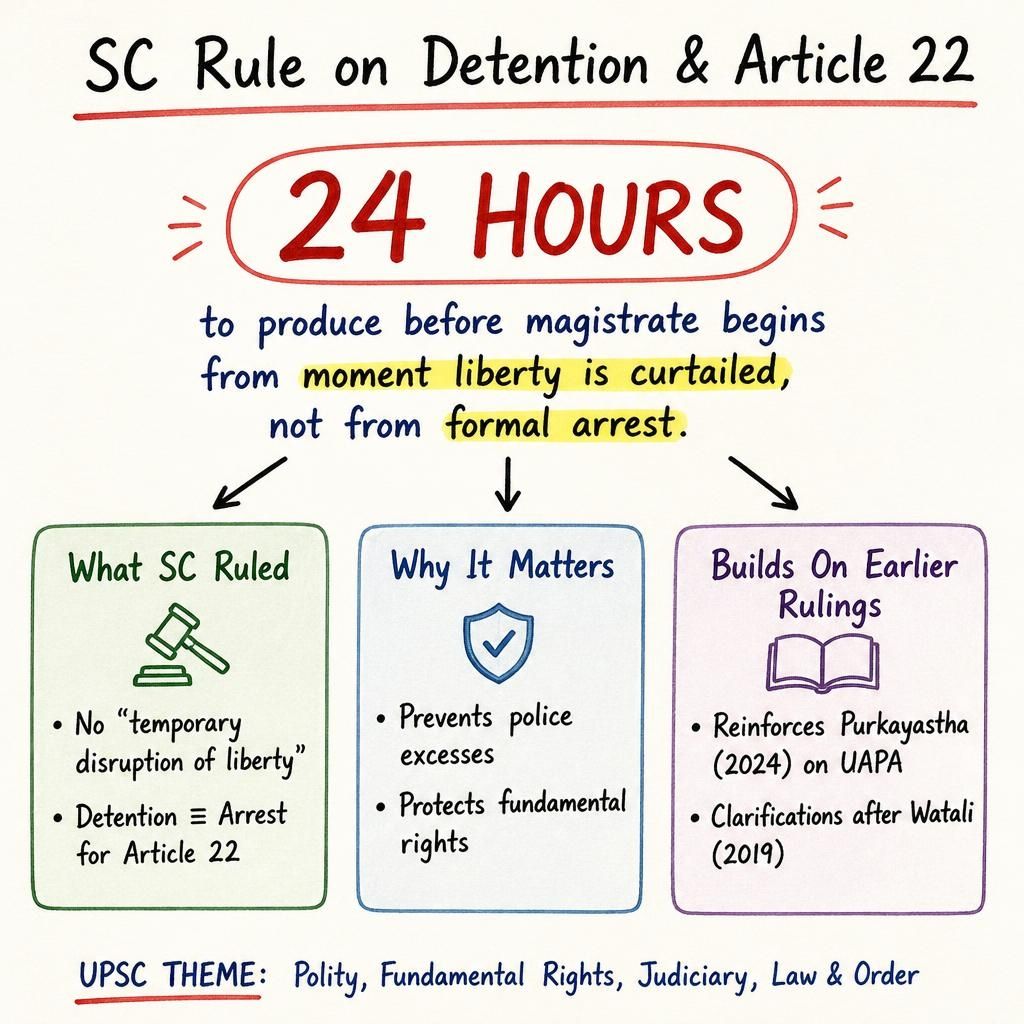
- On November 5, the Supreme Court ruled that the 24-hour period for producing a detained person before a magistrate begins from the moment their liberty is curtailed, not from formal arrest.
- This ruling came in the case of Sujit Das and Others v Union of India, overturning a bail denial by the Tripura High Court in a Narcotic Drugs and Psychotropic Substances (NDPS) Act case.
- The Court emphasized that there is "no such thing called temporary disruption of liberty" and that fundamental rights cannot be easily disregarded, even under special statutes.
- The decision aims to prevent police excesses by dissolving the distinction between "detention" and "arrest" for the purpose of Article 22 constitutional protections.
SC Rule on Detention.jpg
Detailed Insights:
- The Supreme Court bench, comprising Justices Ujjal Bhuyan and A S Chandurkar, highlighted the critical role of the magistrate in scrutinizing every arrest to prevent human rights violations during prolonged detentions.
- This judgment reinforces earlier rulings, such as Prabir Purkayastha v State of Delhi (2024), where an arrest under the Unlawful Activities (Prevention) Act (UAPA) was invalidated due to procedural non-compliance, specifically the failure to provide written grounds of arrest.
- The ruling also builds upon exceptions carved out from the National Investigation Agency v Zahoor Ahmad Shah Watali (2019) judgment, which previously stated that the state's version must be prima facie accepted in UAPA bail cases.
- Subsequent judgments like Union of India v K A Najeeb (2021) and Sheikh Javed Iqbal v State of Uttar Pradesh (2024) have clarified that bail provisions under special laws must consider prolonged trials and that Watali cannot be an absolute precedent to deny bail.
- The Court's decision underscores that procedural compliances under special statutes like the NDPS Act cannot justify delaying the production of a detainee before a magistrate within 24 hours.
Key Concepts Involved:
- Article 22: A fundamental right in the Indian Constitution providing protection against arbitrary arrest and detention, ensuring rights like being informed of arrest grounds and production before a magistrate within 24 hours.
- Narcotic Drugs and Psychotropic Substances (NDPS) Act, 1985: An Indian law prohibiting the production, possession, sale, purchase, transport, storage, and consumption of narcotic drugs and psychotropic substances.
- Unlawful Activities (Prevention) Act (UAPA), 1967: India's primary anti-terror law aimed at preventing unlawful activities and associations threatening the country's sovereignty and integrity.

SuperKalam is your personal mentor for UPSC preparation, guiding you at every step of the exam journey.
Download the App


STUDY RESOURCES
CONTACT US
ⓒ Snapstack Technologies Private Limited