GS 2: PolityGS 2: Social JusticeGS 3: Environment & EcologyPrelimsGS 3: Conservation, Pollution and Degradation
Commercial farming in forest land is not protected by FRA: SC, Pg10
Supreme Court rules commercial farming in forest land not protected by Forest Rights Act, safeguarding forest integrity and tribal rights.
Practice MCQs
869 Students attempted
Key Highlights:
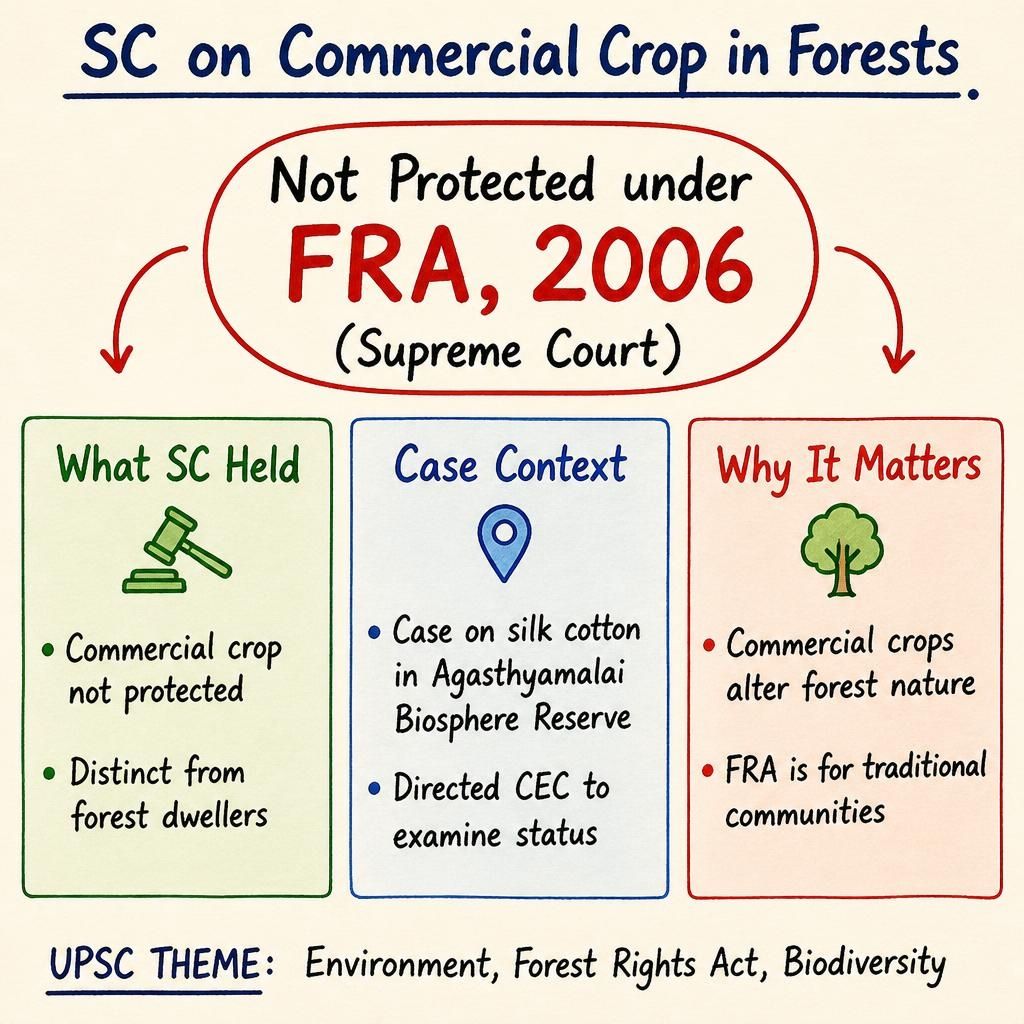
- The Supreme Court ruled that commercial crop cultivation in reserve forest areas is not protected under the Forest Rights Act (FRA), 2006.
- The court distinguished between commercial cultivators and traditional forest dwellers who depend on forests for their livelihood.
- This ruling came during a case concerning extensive silk cotton cultivation within the reserve forests of the Agasthyamalai Biosphere Reserve in Tamil Nadu.
- The Bench, comprising Justices Vikram Nath and Sandeep Mehta, directed the Central Empowered Committee (CEC) to examine if silk cotton qualifies as a 'minor forest produce'.
- The Court expressed a prima facie view that permitting commercial crops would alter the fundamental nature of forests.
SC on FRA Act.jpg
Detailed Insights:
- The Forest Rights Act, 2006, aims to recognize and vest forest rights and occupation in Forest-Dwelling Scheduled Tribes (FDSTs) and Other Traditional Forest Dwellers (OTFDs).
- The Act protects the rights of communities who have lived in forests for generations and depend on them for sustenance.
- The Supreme Court emphasized that planned commercial cultivation contradicts the concept of naturally occurring minor forest produce.
- The Agasthyamalai Biosphere Reserve, located in the Western Ghats across Kerala and Tamil Nadu, is a UNESCO-recognized site known for its rich biodiversity and endemic species.
- The Central Empowered Committee (CEC) is a statutory body constituted by the Supreme Court to monitor compliance with environmental laws and provide expert recommendations on forest and wildlife matters.
- The ruling reinforces the principle that the FRA is a social welfare statute for traditional communities, not a tool for commercial exploitation of forest lands.
Key Concepts Involved:
- Forest Rights Act (FRA), 2006: A law recognizing the rights of forest-dwelling communities over forest land and resources, aiming to rectify historical injustices.
- Forest-Dwelling Scheduled Tribes (FDSTs) & Other Traditional Forest Dwellers (OTFDs): Communities residing in forests for generations, dependent on them for livelihood, whose rights are protected under FRA.
- Minor Forest Produce (MFP): All non-timber forest products of plant origin, including bamboo, honey, medicinal plants, and leaves, crucial for forest dwellers' livelihoods.
- Central Empowered Committee (CEC): A Supreme Court-mandated body that monitors environmental compliance and advises on forest and wildlife conservation issues.

SuperKalam is your personal mentor for UPSC preparation, guiding you at every step of the exam journey.
Download the App


STUDY RESOURCES
CONTACT US
ⓒ Snapstack Technologies Private Limited