GS 2: Social JusticeGS 2: International RelationsGS 3: Environment & EcologyPrelimsGS 3: Conservation, Pollution and Degradation
At COP31, ‘Overshoot’ Narrative Cannot Replace Climate Action, Pg II
COP31 faces criticism as 'overshoot' narrative threatens to derail genuine climate action, shifting burden onto Global South while developed nations shirk obligations.
Practice MCQs
869 Students attempted
Key Highlights:
- The 31st Conference of the Parties (COP31) to the UNFCCC commenced in Antalya, Turkiye, amidst a year marked by extreme weather and an energy crisis.
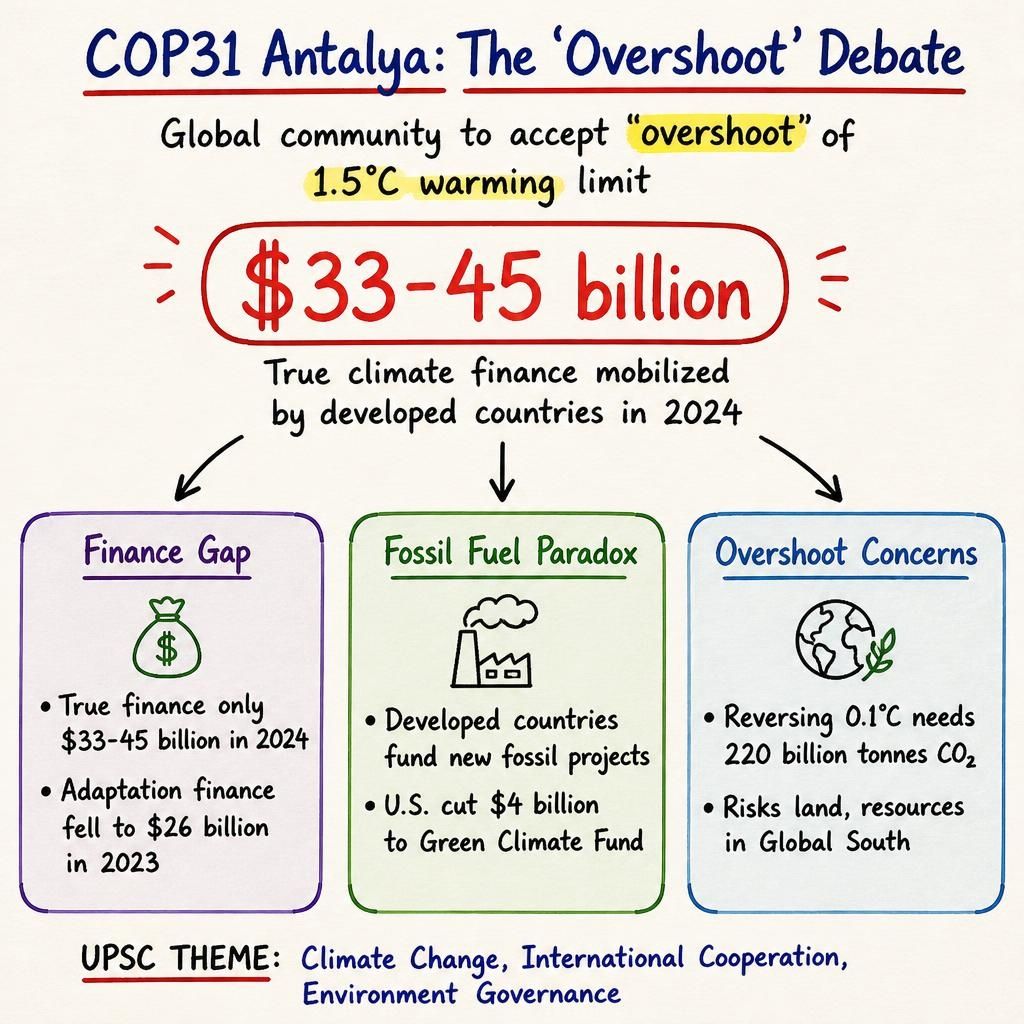
- The global community is preparing to officially accept an "overshoot" of the 1.5 degrees Celsius global warming limit.
- The article criticizes the "overshoot" narrative as a political buzzword that may allow developed nations to delay concrete climate action and shift responsibility.
- Developed countries are failing to meet climate finance obligations and continue significant investments in fossil fuel projects.
- A UNEP report on "Limiting Overshoot" highlights the immense scale of carbon removal required, raising concerns about equity and land use in the Global South.
COP 31 Antalya.jpg
Detailed Insights:
- The term "overshoot" in climate context refers to temporarily exceeding the 1.5 degrees Celsius warming target and returning to it by the end of the century.
- This narrative is seen as potentially diverting attention from immediate, deep emission cuts, similar to how "net-zero" was perceived at COP26.
- Developed nations, including the U.S., Norway, UK, Germany, Netherlands, and Australia, continue to approve and invest heavily in new fossil fuel projects.
- Climate finance commitments remain largely unmet, with developed countries mobilizing an estimated true value of only $33-45 billion in 2024.
- The U.S. has rescinded $4 billion in pledges to the Green Climate Fund, and the U.K. has significantly reduced its contribution.
- Adaptation finance fell to $26 billion in 2023, far below the estimated annual need of $310-365 billion by 2035.
- Unilateral trade measures like the EU’s Carbon Border Adjustment Mechanism (CBAM) are criticized for penalizing industrial development in the Global South.
- The UNEP report indicates that reversing just 0.1 degrees of warming would require removing 220 billion tonnes of CO2, equivalent to five years of current global emissions.
- Current carbon removal methods are insufficient, with direct air capture being expensive and potentially ineffective in fully reversing warming.
- The "overshoot" narrative raises concerns about the Global South's land and resources being used for carbon sinks without clear responsibility or compensation.
- The article calls for immediate, deep, and sustained mitigation by developed countries, grant-based public finance as per Article 9.1 of the Paris Agreement, and technology transfer.
- The Climate Finance Work Programme agreed at Belém is expected to provide clear political guidance on implementing financial obligations.
Key Concepts Involved:
- 1.5 degrees Celsius target: The ambitious goal set by the Paris Agreement to limit global warming to 1.5°C above pre-industrial levels.
- Overshoot (climate context): A scenario where global average temperature temporarily exceeds the 1.5 degrees Celsius target before being brought back down by the end of the century.
- Carbon Border Adjustment Mechanism (CBAM): An EU policy designed to put a fair price on the carbon emitted during the production of carbon-intensive goods entering the EU.
- Article 9.1 of the Paris Agreement: Mandates developed countries to provide financial resources to assist developing countries with respect to both mitigation and adaptation.

SuperKalam is your personal mentor for UPSC preparation, guiding you at every step of the exam journey.
Download the App


STUDY RESOURCES
CONTACT US
ⓒ Snapstack Technologies Private Limited