GS 2: PolityGS 2: International RelationsGS 3: Disaster ManagementGS 3: Environment & EcologyPrelims
A Case For Nepal: Suing Major Carbon Emitters For Floods, Pg6
Nepal flood victims urged to sue major carbon emitters for climate damages, citing international precedents like RWE and Shell cases for transboundary accountability.
Practice MCQs
869 Students attempted
Key Highlights:
- Catastrophic floods in Nepal in August 2026, overwhelmingly attributed to climate change, resulted in thousands of deaths.
- A growing debate suggests exploring climate litigation to hold major carbon emitters accountable for such climate-related damages.
- Establishing direct legal causation between an individual emitter's greenhouse gas (GHG) emissions and specific local impacts like floods remains challenging.
- The German Lliyua vs RWE case (May 2025) established that large emitters can be held responsible for climate risks in distant countries.
- The Dutch Court of Appeal in Milieudefensie et al vs Royal Dutch Shell (November 2024) affirmed companies' duty to limit GHG emissions based on general duty of care.
- Four Indonesian islanders have sued Swiss building material giant Holcim (Asmania vs Holcim) seeking GHG reduction and compensation for damages.
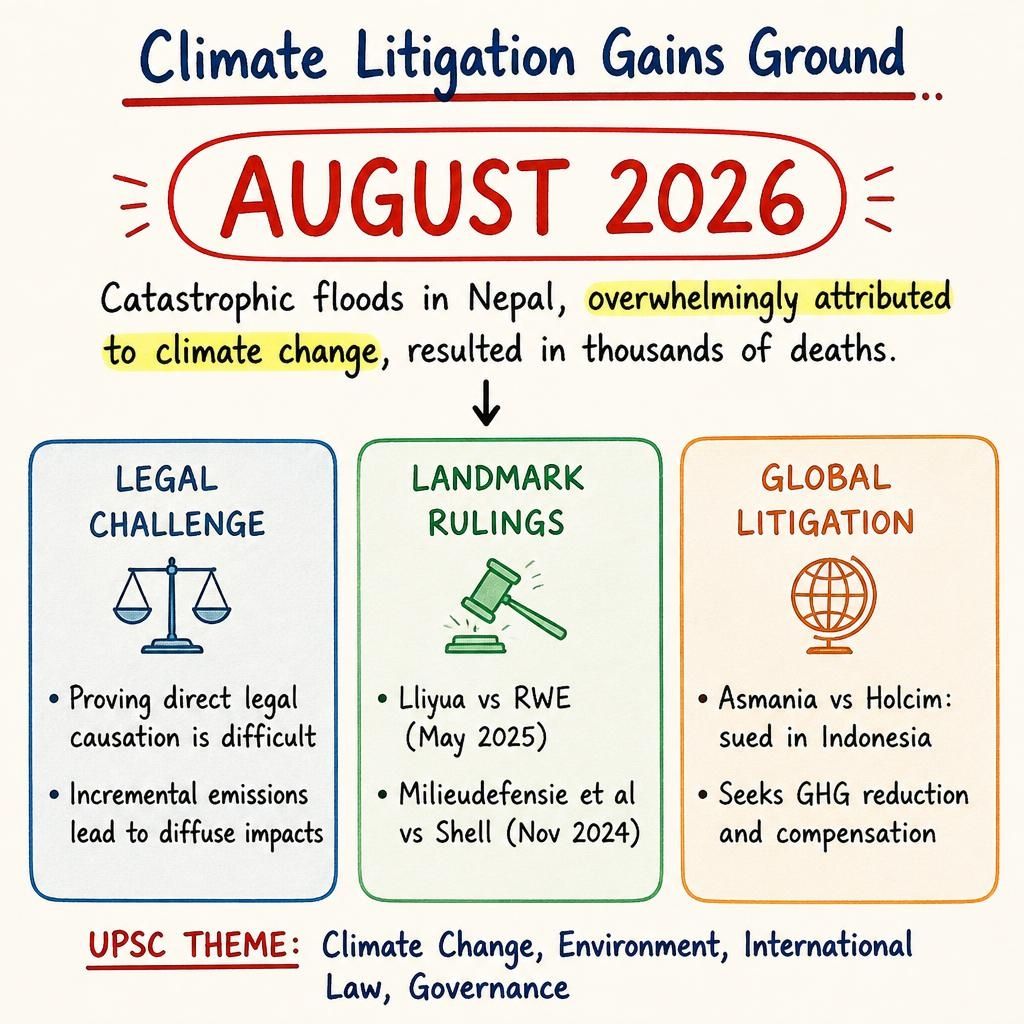
Climate Litigation.jpg
Detailed Insights:
- The Nepal floods are another example of severe climate change impacts in South Asia, following the 2022 Pakistan floods.
- Climate litigation in Europe and the U.S. has seen plaintiffs claim risks to life, health, and property against states and corporations.
- Legal reasoning often struggles with the concept that individual emitters make incremental contributions to global GHGs, leading to diffuse impacts.
- Identifying specific victim groups, such as those in Nepal's Trishuli and Bhote Koshi river basins exposed to Glacial Lake Outburst Floods (GLOFs), is crucial for legal standing.
- Glaciers in the Tibetan Autonomous Region are retreating rapidly, increasing the risk of GLOFs in adjacent areas like Nepal.
- The Higher Court of Appeal in Hamm in the Lliyua case accepted that past individual climate harms can proportionally contribute to climate risks.
- This ruling indicated that long distance and global scale do not automatically shield a corporation from liability for climate harms.
- The Dutch Court of Appeal in the Shell case emphasized a company's obligation to limit GHG emissions under Dutch tort law and human rights standards.
- These landmark cases signify a growing judicial awareness of the responsibilities of large emitters in addressing climate change threats.
Key Concepts Involved:
- Climate Litigation: Legal actions initiated to hold governments or corporations accountable for their contributions to climate change or its impacts.
- Causation (Climate Law): The legal principle of establishing a direct and sufficiently proximate link between a defendant's greenhouse gas emissions and specific climate-related damages.
- Glacial Lake Outburst Floods (GLOFs): Sudden and rapid releases of large volumes of water from glacial lakes, often triggered by glacier melt or dam failure.

SuperKalam is your personal mentor for UPSC preparation, guiding you at every step of the exam journey.
Download the App


STUDY RESOURCES
CONTACT US
ⓒ Snapstack Technologies Private Limited