GS 2: GovernanceGS 2: Social JusticeGS 3: EconomyPrelimsGS 2: Government policies and interventions for development in various sectors
India Has To Act On Its ‘Sugar’ Problem, Pg7
FSSAI mandates red warning labels on packaged foods; India must implement comprehensive policies, including a tiered sugar tax, to combat alarming child obesity and diabetes rates.
Practice MCQs
855 Students attempted
Key Highlights:
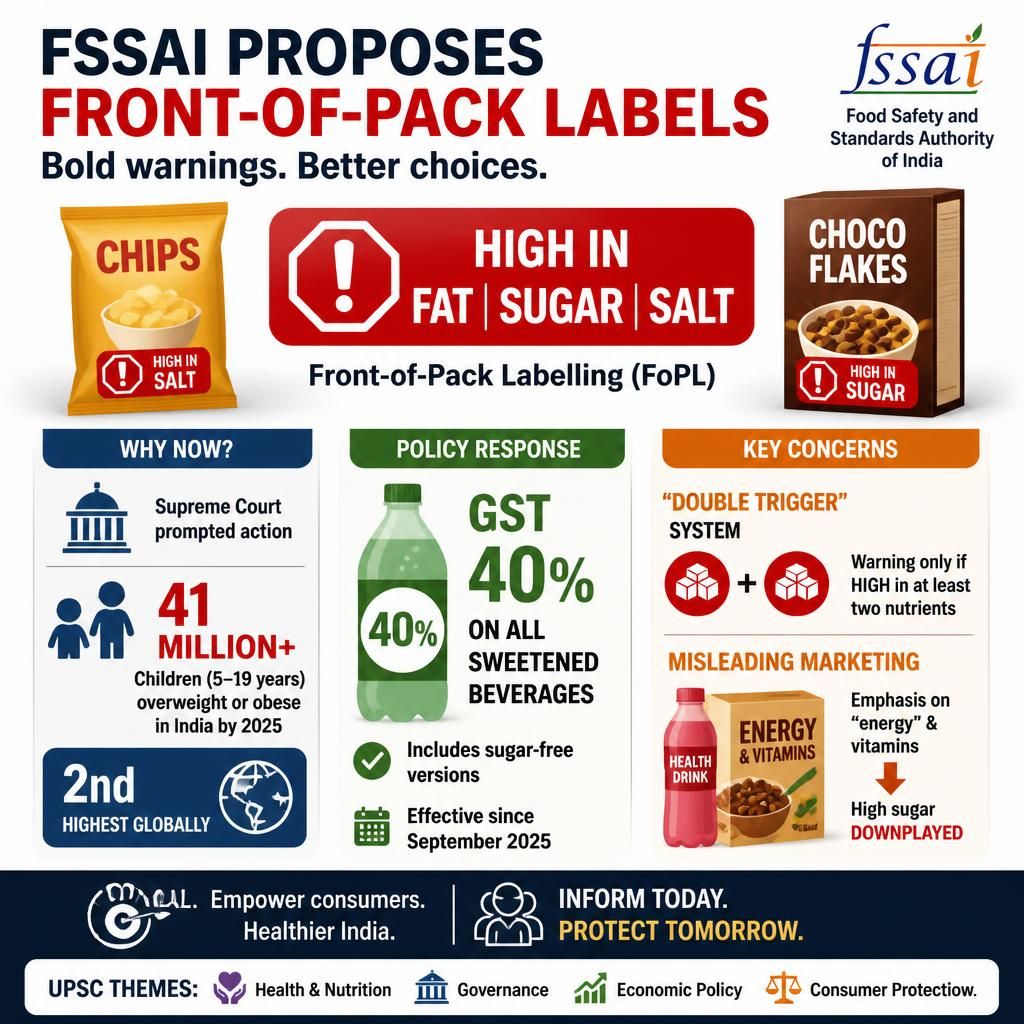
- The Food Safety and Standards Authority of India (FSSAI) has proposed Front-of-Pack Labelling (FoPL) with bold red warnings for packaged foods high in fat, salt, or sugar.
- This move was prompted by the Supreme Court due to escalating public health concerns related to diet.
- India ranks second globally in childhood overweight and obesity, with over 41 million children aged 5-19 classified as overweight or obese by 2025, according to the World Obesity Atlas 2026.
- Since September 2025, India's Goods and Services Tax (GST) regime applies a flat 40% tax to all sweetened beverages, including sugar-free versions.
FSSAI Labels.jpg
Detailed Insights:
- The proposed FoPL aims to empower consumers, especially children, to make healthier food choices by providing clear, at-a-glance information about unhealthy ingredients.
- Critics have raised concerns that the FSSAI's initial FoPL proposal includes a "double trigger" system, requiring a product to be high in at least two unhealthy nutrients (fat, sugar, or salt) to receive a warning, potentially allowing some harmful products to escape labelling.
- Aggressive marketing of "health drinks" and breakfast cereals often misleads parents by emphasizing "energy" and vitamins while downplaying high sugar content.
- Enforcement of existing recommendations by the FSSAI and Central Board of Secondary Education (CBSE) regarding healthy food options in school canteens has been inadequate, as optional guidelines are frequently ignored.
- The FoPL primarily targets packaged foods, leaving a significant portion of the unorganised food sector, such as street stalls and sweet shops, unregulated regarding nutritional declarations.
- The UK's Soft Drinks Industry Levy successfully encouraged manufacturers to reformulate products by implementing a tiered tax system based on sugar content, leading to reduced sugar consumption.
- India's current flat 40% GST on sugary drinks does not provide an incentive for manufacturers to reduce sugar content, unlike the UK's tiered approach.
- A calibrated sugar tax, with revenue potentially allocated to subsidize healthy food, could mitigate the disproportionate health burden of diet-related diseases on lower-income populations.
Key Concepts Involved:
- FSSAI (Food Safety and Standards Authority of India): An autonomous statutory body established under the Food Safety and Standards Act, 2006, responsible for regulating food safety and standards in India.
- Front-of-Pack Labelling (FoPL): A system of prominent, easy-to-understand labels displayed on the front of food packaging to quickly inform consumers about the nutritional profile of a product.
- HFSS (High in Fat, Sugar, and Salt): A classification used for food products that contain elevated levels of fat, sugar, and salt, which are often linked to adverse health outcomes.
- Goods and Services Tax (GST): A comprehensive indirect tax levied on the supply of goods and services in India, replacing various central and state indirect taxes.

SuperKalam is your personal mentor for UPSC preparation, guiding you at every step of the exam journey.
Download the App


STUDY RESOURCES
CONTACT US
ⓒ Snapstack Technologies Private Limited