GS 2: GovernanceGS 3: Science & TechnologyGS 3: Environment & EcologyGS 3: EconomyGS 3: Changes in Industrial Policy and Effects on Industrial Growth
A Common Blueprint for India’s Industrial Heat Electrification, Pg9
India requires a strategic blueprint for industrial heat electrification, crucial for decarbonizing manufacturing, boosting energy security, and strengthening MSME competitiveness.
Practice MCQs
847 Students attempted
Key Highlights:
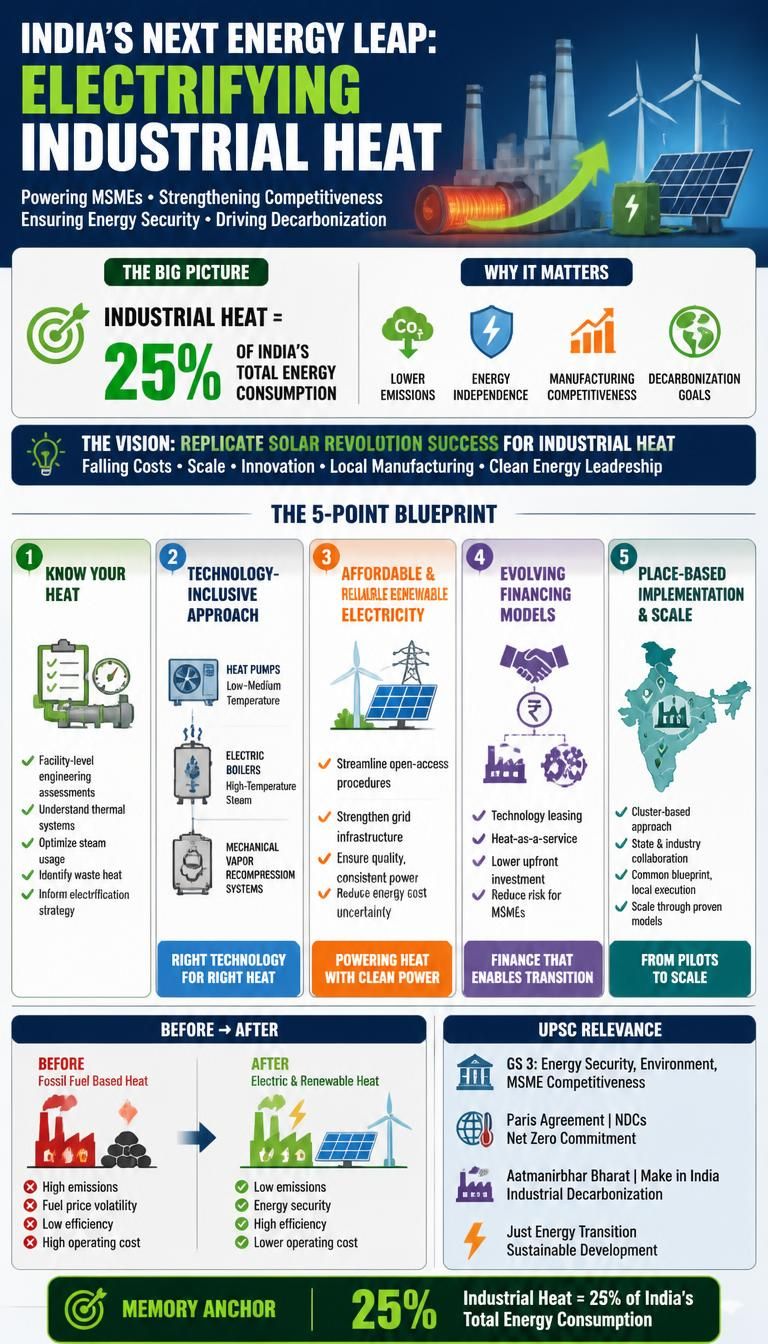
- India is focusing on electrifying industrial heat, particularly for Micro, Small, and Medium Enterprises (MSMEs), to enhance manufacturing competitiveness, energy security, and decarbonization.
- This transition aims to replicate the success of India's solar photovoltaic revolution, which significantly reduced solar tariffs over the past decade.
- A common blueprint is needed to transform industrial heat electrification into a scalable strategy, supported by a coordinated national framework and place-based implementation.
- Industrial heat accounts for approximately 25% of India's total energy consumption, making its electrification crucial for emission reduction and energy independence.
Heat.jpg
Detailed Insights:
- Facility-level engineering assessments are crucial to understand thermal systems, optimize steam usage, identify waste heat, and inform electrification strategies.
- A technology-inclusive approach is necessary, utilizing solutions like heat pumps for low-to-medium temperatures, electric boilers for high-temperature steam, and mechanical vapor recompression systems.
- Affordable and reliable renewable electricity supply is fundamental, requiring reforms to streamline open-access procedures and strengthen grid infrastructure.
- Evolving financing models, such as technology leasing and heat-as-a-service, are essential to reduce investment risks, especially for MSMEs.
- Developing a skilled workforce through tailored vocational and industry training programs is vital for the engineering transition required at shop floors.
- Demonstration projects across various sectors and temperatures are needed to generate engineering evidence, validate business models, and reduce investment uncertainty.
Key Concepts Involved:
- Micro, Small, and Medium Enterprises (MSMEs): Businesses classified in India based on investment in plant & machinery/equipment and annual turnover, playing a significant role in employment, GDP, and exports.
- Pinch Analysis: A methodology used to minimize energy consumption in chemical processes by optimizing heat recovery systems and identifying thermodynamically feasible energy targets.
- Thermal Energy Storage (TES): A technology that stores thermal energy (heat or cold) for later reuse, helping to balance energy demand, integrate renewable sources, and improve energy efficiency.

SuperKalam is your personal mentor for UPSC preparation, guiding you at every step of the exam journey.
Download the App


STUDY RESOURCES
CONTACT US
ⓒ Snapstack Technologies Private Limited