GS 2: International RelationsGS 3: EconomyPrelimsGS 2: Bilateral, Regional and Global Groupings and AgreementsGS 2: Important International Institutions, Agencies and Fora
India questions e-comm interim pathway at WTO, Pg15
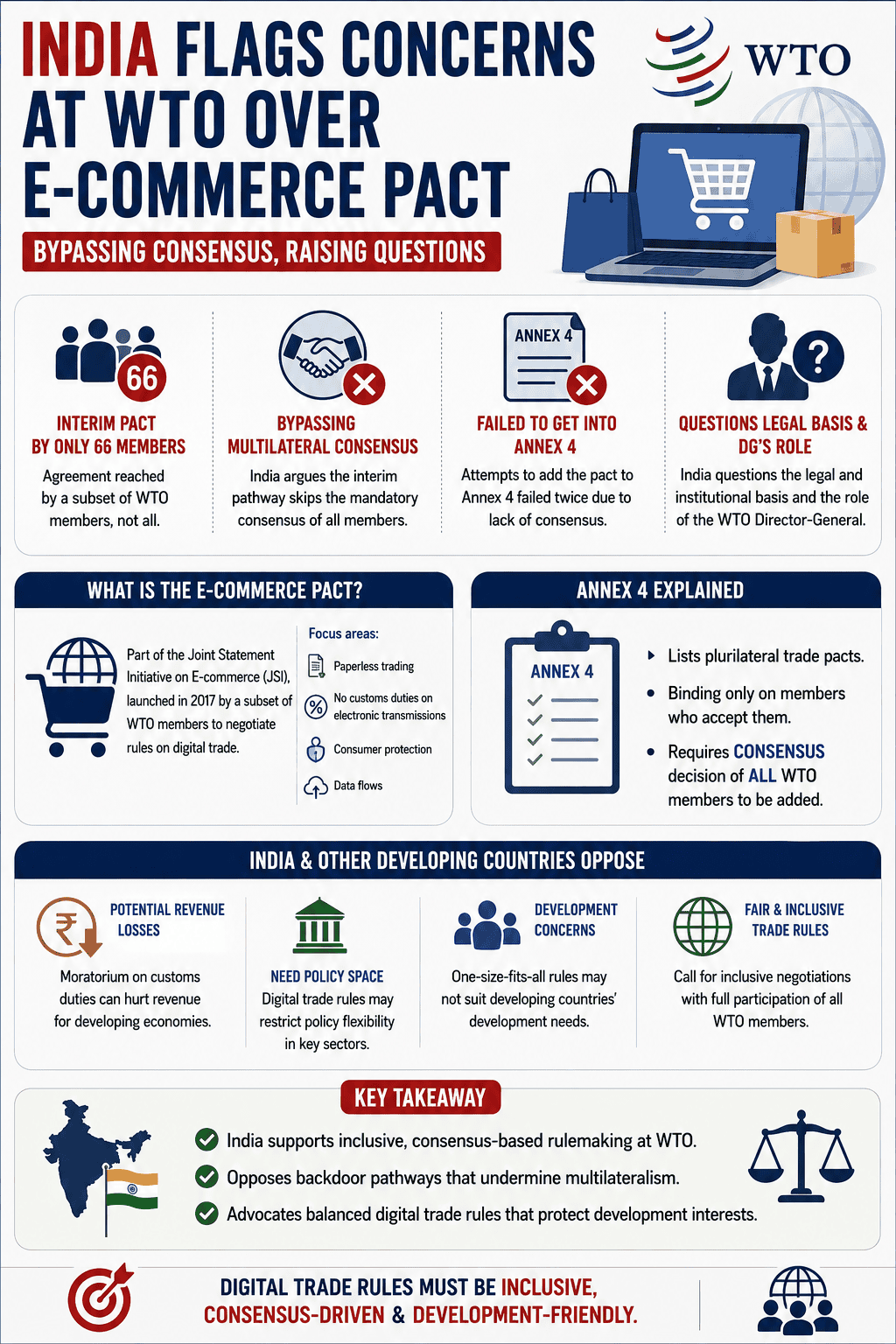
India challenges interim e-commerce agreement at WTO, citing lack of consensus among 66 member nations for Annex 4 inclusion.
Practice MCQs
840 Students attempted
Key Highlights:
- India has raised concerns at the World Trade Organization (WTO) regarding an interim arrangement for an e-commerce agreement.
- This agreement was reached by only 66 member countries, not the entire WTO membership.
- India argues that this interim pathway bypasses the necessary multilateral consensus for such agreements.
- Attempts to incorporate the pact into Annex 4 of the WTO agreements failed twice due to a lack of consensus among all members.
- India has questioned the legal and institutional basis for the interim arrangements and the role of the WTO Director-General in facilitating them.
WTO.png
Detailed Insights:
- The e-commerce agreement in question is part of the Joint Statement Initiative on E-commerce (JSI), launched in 2017 by a subset of WTO members to negotiate rules on digital trade.
- Annex 4 of the WTO Agreements lists plurilateral trade pacts that are binding only on the members who have accepted them, unlike multilateral agreements which apply to all WTO members.
- For an agreement to be added to Annex 4, it requires a consensus decision from all WTO member countries, a condition that was not met for the e-commerce pact.
- India, along with other developing countries like South Africa, has consistently opposed the JSI and the e-commerce moratorium, citing concerns over potential revenue losses for developing economies and the need to preserve policy space.
- India contends that such plurilateral initiatives, without the consensus of the entire membership, undermine the WTO's multilateral framework and the single undertaking principle.
- The General Council is the highest day-to-day decision-making body of the WTO, responsible for overseeing the implementation of agreements and the work of subsidiary bodies.
- The JSI aims to establish global baseline rules on e-commerce, including provisions on banning customs duties on electronic transmissions and facilitating paperless transactions.
- India has also questioned the legitimacy of using WTO Secretariat resources and the organization's dispute settlement mechanism for an agreement that lacks full WTO consensus.
Key Concepts Involved:
- World Trade Organization (WTO): An intergovernmental organization that regulates and facilitates international trade.
- General Council: The highest decision-making body of the WTO between Ministerial Conferences, composed of representatives from all member countries.
- Plurilateral Agreements: Trade agreements within the WTO framework that are binding only on the subset of members who choose to join them.
- Multilateral Agreements: Trade agreements within the WTO framework that are binding on all member countries.
- Annex 4 of WTO Agreements: A specific part of the WTO legal framework that lists plurilateral trade agreements.
- Joint Statement Initiative (JSI) on E-commerce: A negotiating forum within the WTO where a group of members discuss rules for digital trade.
Previous15/15

SuperKalam is your personal mentor for UPSC preparation, guiding you at every step of the exam journey.
Download the App


STUDY RESOURCES
CONTACT US
ⓒ Snapstack Technologies Private Limited