GS 1: Physical GeographyGS 3: Environment & EcologyPrelimsGS 3: Disaster and Disaster ManagementGS 2: Important International Institutions, Agencies and Fora
Worst of El Niño yet to come, peak likely in December, says UN body, Pg6
UN body warns El Niño to peak in December, causing global above-average temperatures, increased droughts, and floods, impacting India's monsoon and Europe's summer.
Practice MCQs
855 Students attempted
Key Highlights:
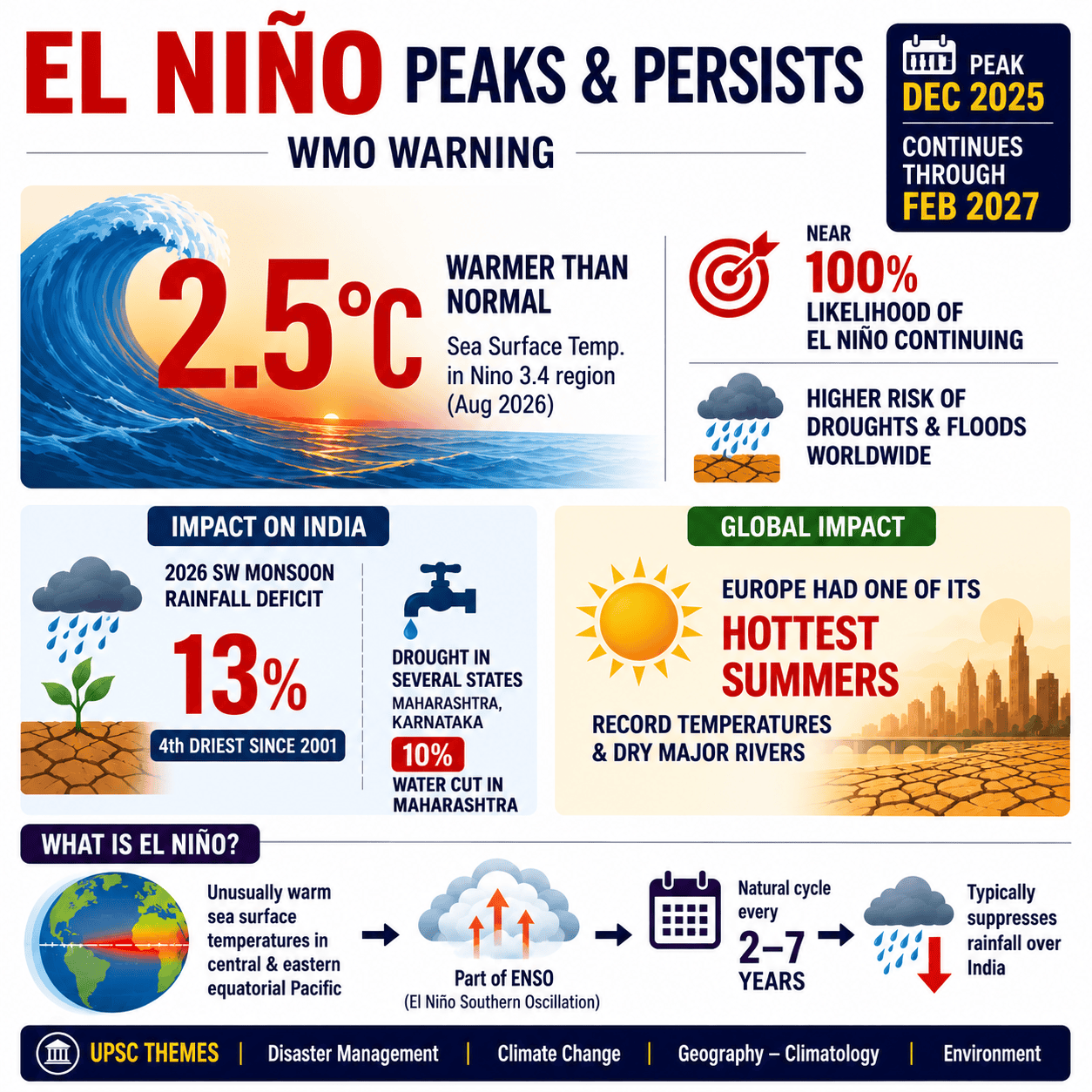
- The World Meteorological Organization (WMO) has warned that the ongoing El Niño is set to peak in December.
- This El Niño event is expected to lead to above-average global temperatures and persist through February 2027, potentially being one of the strongest since 1950.
- It increases the risk of droughts and floods worldwide due to altered rainfall patterns.
- India's 2026 southwest monsoon recorded a 13% rainfall deficit, making it the fourth driest since 2001, with El Niño impacting the latter half of the season.
- Several Indian states, including Maharashtra and Karnataka, have declared drought, with Maharashtra imposing a 10% water cut.
- Europe experienced one of its hottest summers, leading to record temperatures and dry major rivers.
El Nino.jpg
Detailed Insights:
- The WMO forecasts a near-100% likelihood of El Niño continuing through February 2027, indicating its significant and prolonged influence.
- El Niño is characterized by unusually warm sea surface temperatures in the central and eastern equatorial Pacific Ocean.
- The Nino 3.4 region, a key indicator, showed sea surface temperatures 2.5°C above normal in August.
- The El Niño Southern Oscillation (ENSO) is a natural ocean-atmospheric phenomenon that recurs every two to seven years.
- The 2026 monsoon's deficit highlights India's vulnerability to El Niño conditions, which typically suppress rainfall over the subcontinent.
- The global warming effect of El Niño compounds existing climate change impacts, as seen in Europe's record summer heat.
- Historically, strong El Niño events have been associated with weaker or spatially uneven rainfall over India.
Key Concepts Involved:
- El Niño: A climate pattern characterized by unusually warm ocean temperatures in the central and eastern equatorial Pacific Ocean.
- La Niña: The opposite phase of El Niño, marked by unusually cold ocean temperatures in the same region.
- El Niño Southern Oscillation (ENSO): A naturally occurring climate pattern involving fluctuating ocean temperatures and atmospheric pressure in the tropical Pacific, with warm (El Niño), neutral, and cool (La Niña) phases.
- Nino 3.4 region: A specific area in the equatorial Pacific (5°N-5°S, 170°W-120°W) used to monitor sea surface temperature anomalies for declaring El Niño or La Niña events.

SuperKalam is your personal mentor for UPSC preparation, guiding you at every step of the exam journey.
Download the App


STUDY RESOURCES
CONTACT US
ⓒ Snapstack Technologies Private Limited