GS 2: International RelationsGS 3: Environment & EcologyGS 3: EconomyPrelimsGS 3: Buffer Stocks and Food Security
Why Edible Oils Are Worst Affected By Food Inflation, Pg9
Global edible oil prices surge due to war, El Niño, and aggressive biofuel mandates diverting food to fuel, impacting India's imports.
Practice MCQs
855 Students attempted
Key Highlights:
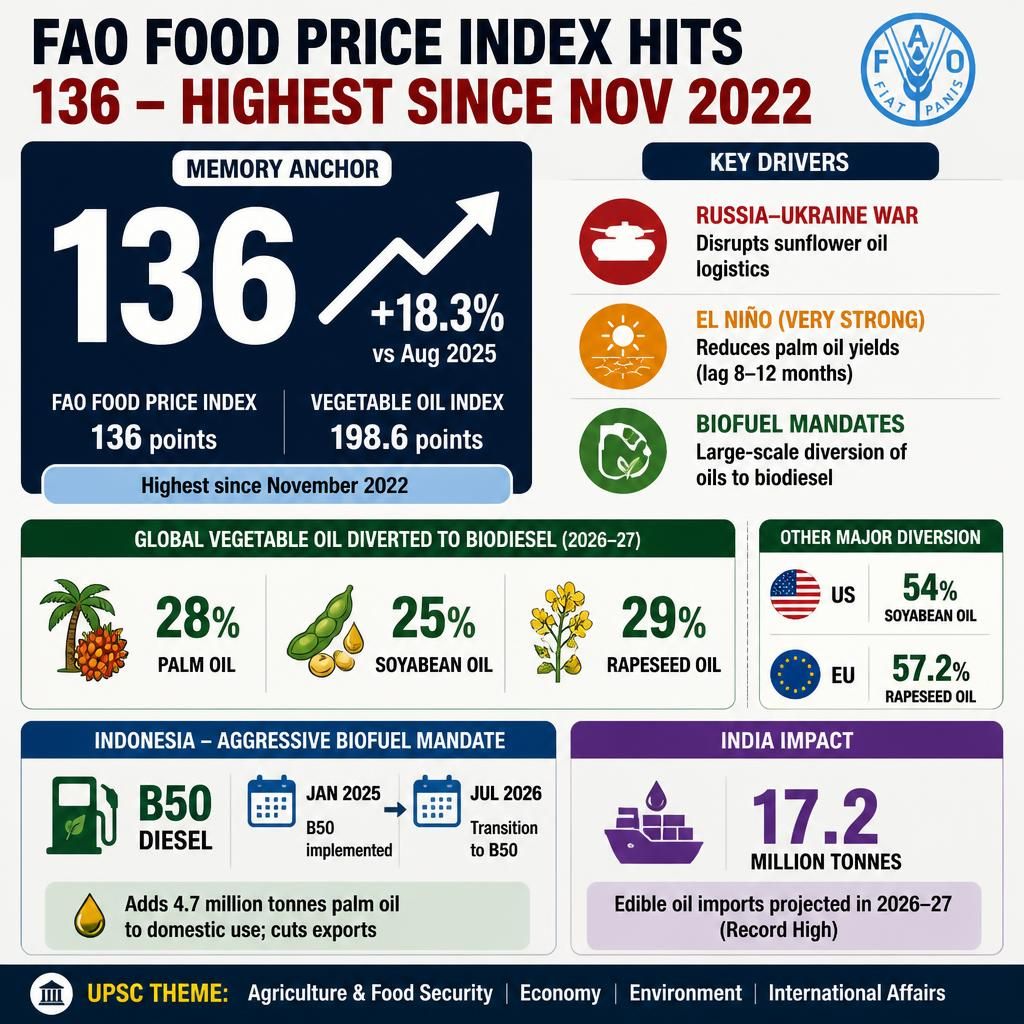
- The United Nations’ Food and Agriculture Organization’s (FAO) benchmark food price index reached 136 points in September, the highest since November 2022.
- The FAO index for vegetable oils was even higher at 198.6 points, an 18.3% increase over September 2025, driven by war, El Niño, and national biofuel mandates.
- Global prices of edible oils, including palm, soyabean, and rapeseed, are significantly impacted by their diversion for biofuel production.
- Approximately 25% of global soyabean oil, 28% of palm oil, and 29% of rapeseed oil production is used as feedstock for biodiesel.
- Indonesia has implemented an aggressive biofuel mandate, reaching B50 diesel (50% FAME content) from January 2025, with a transition to B50 in July 2026.
- The ongoing conflict between Russia and Ukraine continues to disrupt sunflower oil logistics, despite increased production.
- India's edible oil imports are projected to rise to a record 17.2 million tonnes in 2026-27 due to lower domestic production and global supply constraints.
FAO Food Price Index.jpg
Detailed Insights:
- The FAO vegetable oil index peaked at 251.8 points in March 2022 following Russia's invasion of Ukraine, before falling and then flaring up again.
- Fatty Acid Methyl Esters (FAME), or biodiesel, is produced from vegetable oils via transesterification and can substitute or blend with regular diesel.
- National biofuel mandates require oil marketing companies to blend specified percentages of biofuels into fossil fuels like petrol, diesel, and aviation turbine fuel.
- Indonesia's B50 mandate alone is expected to absorb an additional 4.7 million tonnes of its palm oil domestically, reducing exports.
- Malaysia has a less ambitious biofuel program, with B10 diesel mandatory since September 2019 and a phased rollout of B15 beginning in June 2026.
- The US is projected to divert 54% of its soyabean oil and the EU 57.2% of its rapeseed oil towards biofuels in 2026-27.
- El Niño, currently in a "very strong" phase, is anticipated to reduce palm oil yields with a lag of 8-12 months due to water stress.
- Logistical constraints, such as strikes on port infrastructure in the Black Sea, hinder the export of sunflower oil from Russia and Ukraine.
- Elevated global petroleum prices incentivize the "food-to-fuel" diversion of vegetable oils, further impacting food inflation.
- India's domestic edible oil production is estimated to dip to 9.2 million tonnes in 2026-27 from 9.7 million tonnes in 2025-26.
Scientific/Technical Concepts Involved:
- Fatty Acid Methyl Esters (FAME): A type of biodiesel produced from vegetable oils, used as a fuel or fuel additive.
- Transesterification: A chemical process that converts triglycerides in vegetable oils into FAME by reacting them with methanol.
- Biofuel Mandates: Government policies requiring a minimum percentage of biofuels to be blended with conventional fossil fuels.
- El Niño: A climate pattern characterized by unusual warming of surface waters in the equatorial Pacific Ocean, affecting global weather.

SuperKalam is your personal mentor for UPSC preparation, guiding you at every step of the exam journey.
Download the App


STUDY RESOURCES
CONTACT US
ⓒ Snapstack Technologies Private Limited