GS 2: GovernanceGS 3: EconomyPrelimsGS 3: Government BudgetingGS 3: Indian Economy, Planning, Mobilization of Resources, Growth, Development and Employment
Service Sector to Working Capital: Key Gains From GST Process Reform, Pg13
GST Council reforms boost service sector exports and unlock working capital through input tax credit refunds, benefiting various industries and e-commerce.
Practice MCQs
855 Students attempted
Key Highlights:
- The GST Council recommended process reforms impacting the service sector and working capital for businesses.
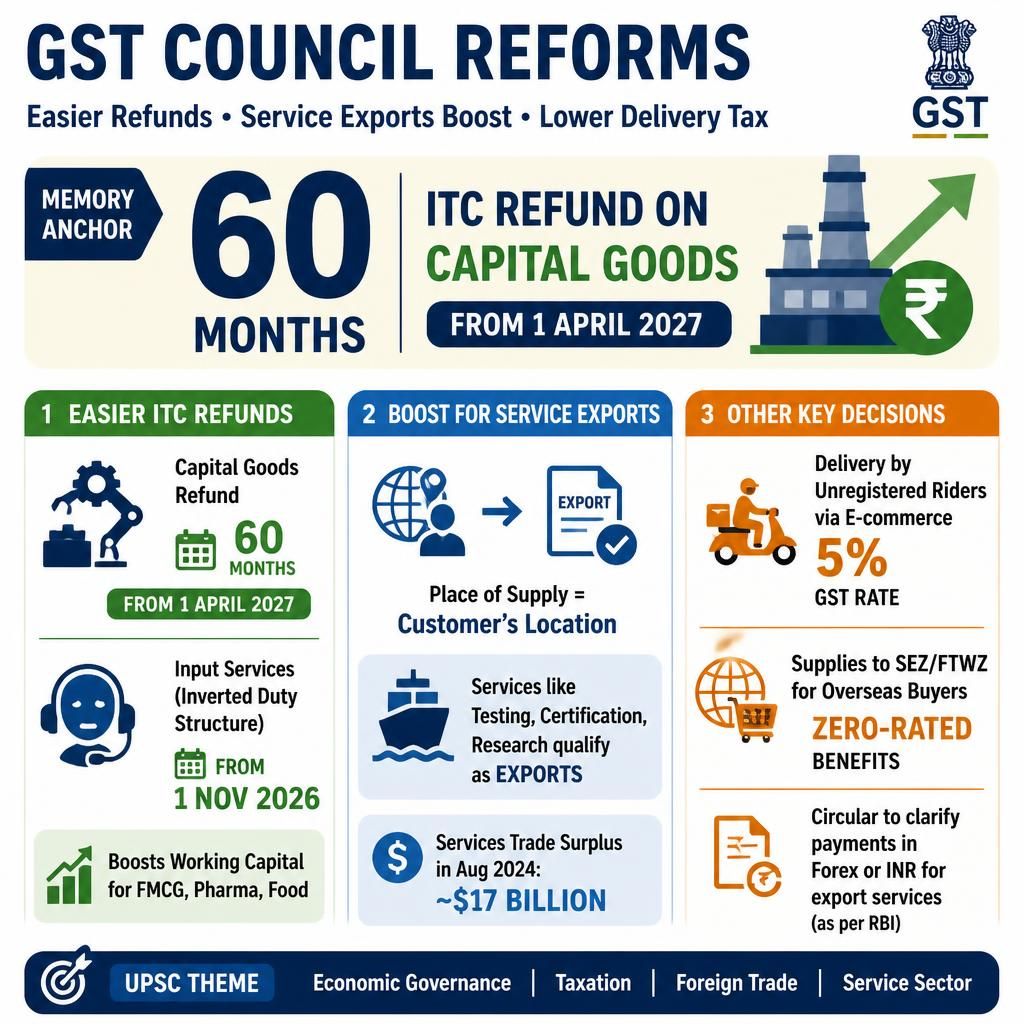
- Amendments to Section 54(3) of the Central Goods and Services Tax Act will allow refunds of accumulated Input Tax Credit (ITC) on capital goods and input services under inverted duty structure and zero-rated supplies.
- Relief was provided for service exports by aligning tax treatment with ground practice, benefiting Indian firms billing through overseas branches.
- The GST Council clarified that the GST rate on delivery services by unregistered riders through e-commerce platforms will be 5%.
- Supplies of goods to Special Economic Zones (SEZ) or Free Trade Warehousing Zones (FTWZ) for overseas buyers will qualify for zero-rating benefits.
GST Council Reforms.jpg
Detailed Insights:
- The ITC refund on capital goods, such as plant and machinery, will be spread over 60 months and effective from April 1, 2027.
- The ITC refund for input services under inverted duty structure will be available from November 1, 2026.
- These changes are expected to free up working capital for major sectors including FMCG, pharma, and food.
- The 'place of supply' rule for services like testing, certification, and research will now follow the customer's location, qualifying them as exports.
- This reform is significant for India's services sector, a key contributor to foreign exchange with a surplus of almost $17 billion in August.
- A circular will be issued to clarify issues related to receiving payments in foreign exchange or Indian rupees for exports, as permitted by the Reserve Bank of India.
Key Concepts Involved:
- Goods and Services Tax (GST): An indirect tax levied on the supply of goods and services in India.
- Input Tax Credit (ITC): The tax a business pays on purchases that it can deduct from the tax it collects on sales.
- Inverted Duty Structure: A situation where the tax on inputs is higher than the tax on finished goods.
- Zero-rated supplies: Exports and supplies to SEZs, where the GST rate is effectively zero, and ITC can be claimed.
Previous9/9

SuperKalam is your personal mentor for UPSC preparation, guiding you at every step of the exam journey.
Download the App


STUDY RESOURCES
CONTACT US
ⓒ Snapstack Technologies Private Limited