GS 2: GovernanceGS 1: Indian GeographyGS 3: Disaster Management
Two warnings, zero action: Why Wayanad tunnel tragedy is a ‘man-made disaster’, Pg 6
The Kerala government has suspended work on the ₹2,134.5-crore Wayanad twin-tunnel project following a fatal landslide at the construction site caused by the unscientific accumulation of excavated excavation debris despite multiple administrative warnings.
Practice MCQs
833 Students attempted
Key Highlights:
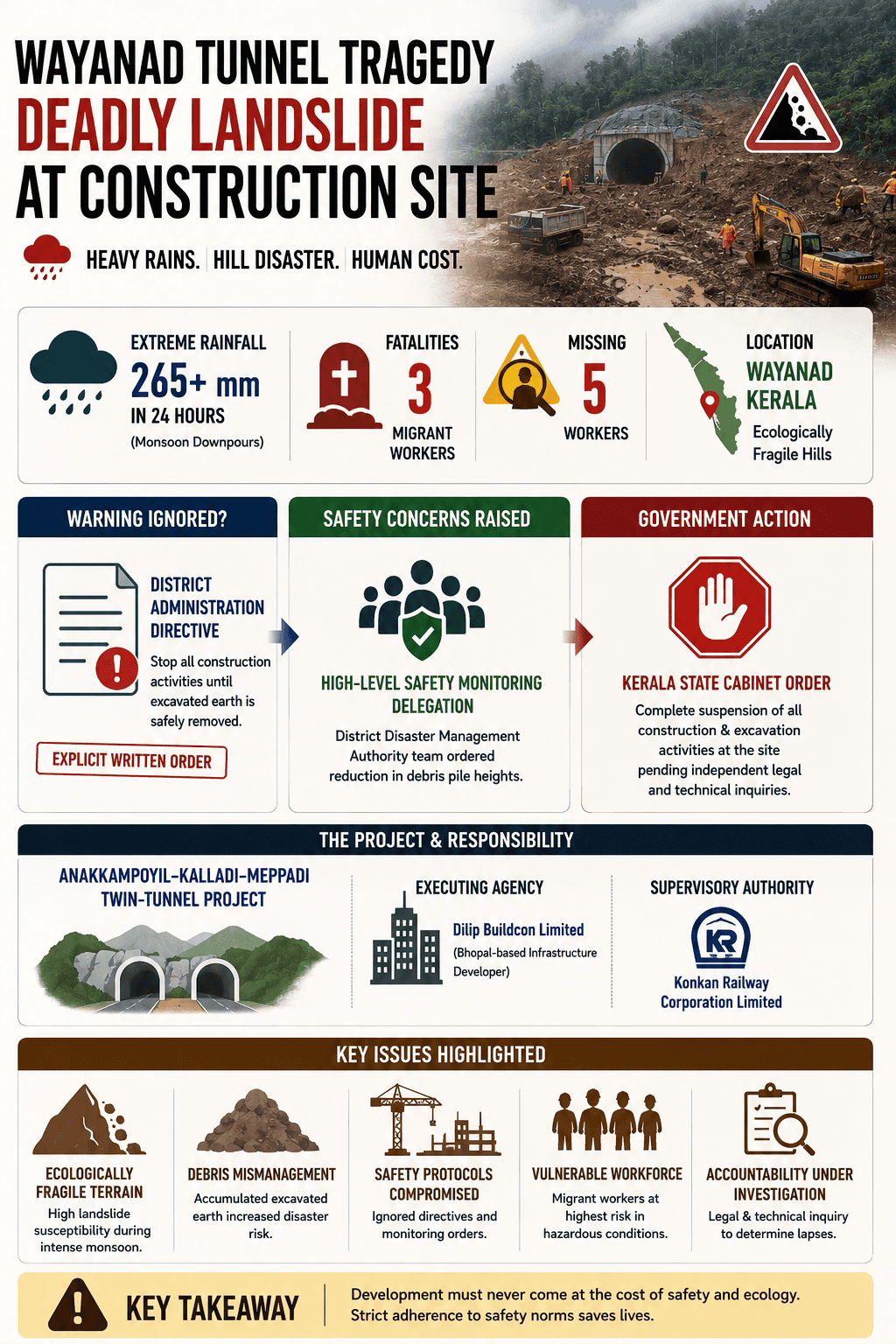
- A catastrophic landslide struck the under-construction Anakkampoyil-Kalladi-Meppadi twin-tunnel project site in the ecologically fragile hill district of Wayanad, Kerala.
- The disaster resulted in three recorded fatalities among migrant workers and left five others missing amid heavy monsoon downpours exceeding 265 mm within 24 hours.
- The Wayanad District Administration had issued an explicit written directive to stop construction activities until accumulated excavated earth was safely removed.
- A high-level safety monitoring delegation comprising members from the District Disaster Management Authority had ordered a reduction in debris pile heights.
- Bhopal-based infrastructure developer Dilip Buildcon Limited was executing the tunnel contract under the supervision of the Konkan Railway Corporation Limited.
- The Kerala State Cabinet officially ordered the complete suspension of all construction and excavation activities at the site pending independent legal and technical inquiries.
Wayanad.png
Detailed Insights:
- The disaster has been classified by state executives as a man-made calamity resulting from slope instability caused by dumping over one lakh cubic meters of loose excavated soil.
- The engineering protections used by the contractor, including basic tarpaulin covers and retaining structures, failed to withstand severe water seepage during the monsoon.
- This structural failure highlights the long-standing ecological risks of large-scale infrastructure deployment across landslide-prone corridors of the Western Ghats.
- The Supreme Court of India had cleared the 8.17 km twin-tube project by dismissing environmental petitions, provided strict safety guidelines were followed during execution.
- Activists are demanding the revocation of clearances given by the State Environment Impact Assessment Authority due to structural threats like soil piping.
- The infrastructure project was conceived to establish an alternative all-weather bypass route to avoid the highly congested and landslide-vulnerable Thamarassery Ghat road.
Key Concepts Involved:
- Soil Piping: An underground geological erosion process where percolating water creates internal pipe-like tunnels through loose soil layers, severely compromising slope stability.
- Ecologically Sensitive Zone: Fragile geographical areas surrounding protected wilderness frontiers designated to cushion human industrial pressures and preserve biodiversity balances.
- Centrally Empowered Committee: A specialized monitoring body appointed by the apex judiciary to examine environmental compliances and institutional violations across infrastructure zones.

SuperKalam is your personal mentor for UPSC preparation, guiding you at every step of the exam journey.
Download the App


STUDY RESOURCES
CONTACT US
ⓒ Snapstack Technologies Private Limited