GS 2: GovernanceGS 3: Environment & EcologyPrelimsGS 3: Conservation, Pollution and DegradationGS 2: Government policies and interventions for development in various sectors
54% Of Delhi's Industrial Units Monitored Breach Emission, Pg4
Over half of Delhi's monitored industrial units breach emission limits, with nearly 50% of monitoring systems offline, severely impacting air quality.
Practice MCQs
855 Students attempted
Key Highlights:
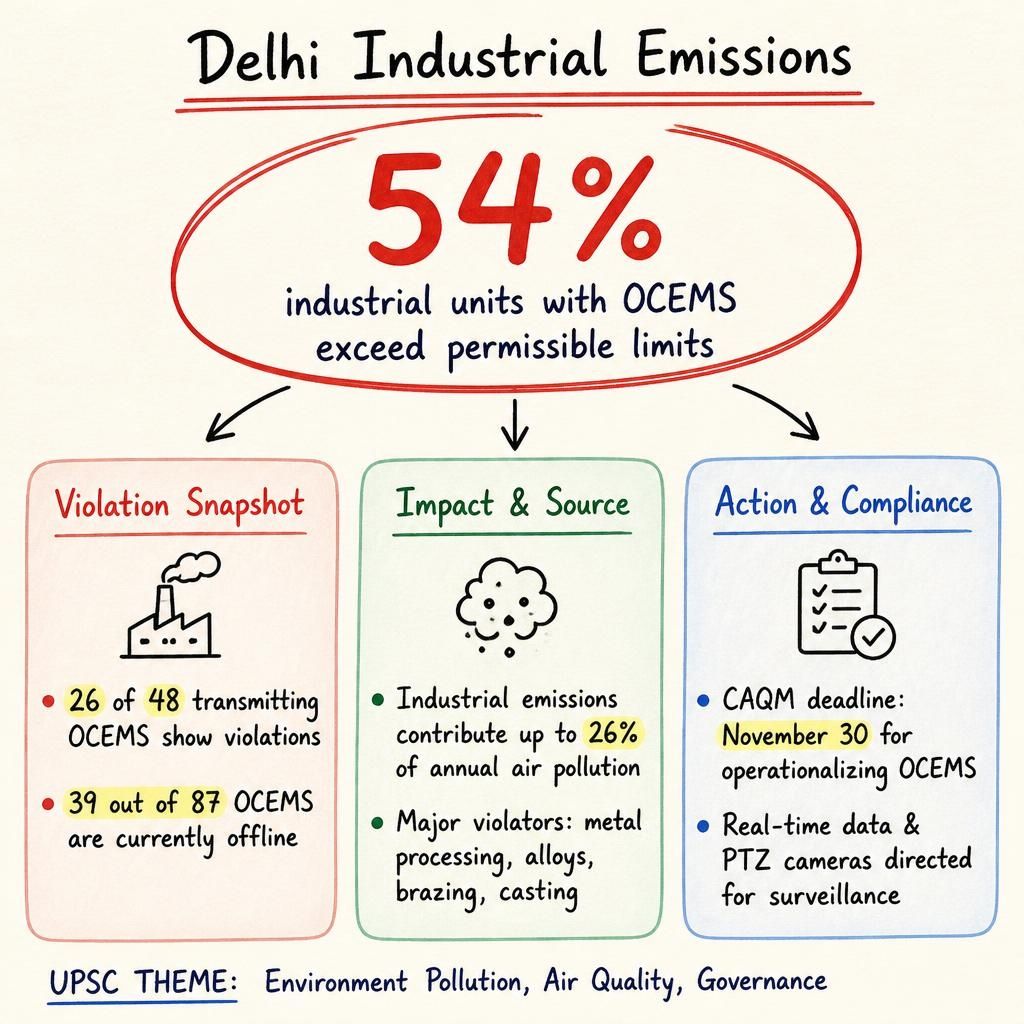
- Over 54% of Delhi's industrial units with online monitoring systems are exceeding permissible emission limits.
- Nearly half (39 out of 87) of the installed Online Continuous Emission Monitoring Systems (OCEMS) in Delhi's industrial areas are currently offline.
- Data from the Delhi Pollution Control Committee (DPCC) indicates that 26 of the 48 transmitting OCEMS show emission violations.
- Industrial emissions contribute up to 26% of Delhi's annual air pollution load, as per a 2018 TERI-ARAI source apportionment study.
- The Commission for Air Quality Management in National Capital Region and Adjoining Areas (CAQM) has set a November 30 deadline for industries to operationalize their OCEMS.
- Metal processing, alloy manufacturing, brazing, and casting industries are identified as major violators.
Delhi Emissions.jpg
Detailed Insights:
- Delhi has 30,672 industrial units, but only 87 of the 128 highly-polluting units mandated to install OCEMS have done so.
- Industries have cited financial difficulties and supply chain disruptions due to the West Asia conflict as reasons for delays in OCEMS installation.
- Industrial emissions significantly contribute to both direct particulate matter and the formation of secondary particulate matter, especially during winter.
- The CAQM has directed industries to ensure real-time data transmission from OCEMS and pan-tilt-zoom cameras for better surveillance.
- In comparison, Haryana has achieved nearly 100% OCEMS coverage, while Uttar Pradesh has 648 units and Rajasthan has 150 units with such systems.
- Industrial hotspots with a high proportion of violations include Bawana, Wazirpur, Mayapuri, Badli, and New Mandoli.
Key Concepts Involved:
- Online Continuous Emission Monitoring Systems (OCEMS): Real-time systems used to continuously monitor and record industrial emissions for regulatory compliance.
- Air Quality Index (AQI): A numerical scale used to communicate daily air quality levels to the public, indicating how clean or polluted the air is.
- Commission for Air Quality Management in National Capital Region and Adjoining Areas (CAQM): A statutory body established to coordinate and implement measures for air quality improvement in the NCR.
- Delhi Pollution Control Committee (DPCC): The principal regulatory authority responsible for enforcing environmental laws and rules within the National Capital Territory of Delhi.

SuperKalam is your personal mentor for UPSC preparation, guiding you at every step of the exam journey.
Download the App


STUDY RESOURCES
CONTACT US
ⓒ Snapstack Technologies Private Limited