GS 2: GovernanceGS 3: Environment & EcologyGS 3: EconomyPrelimsGS 3: Changes in Industrial Policy and Effects on Industrial Growth
India’s cement footprint stands in its way to net-zero emissions, Pg II
India's cement industry poses a significant challenge to achieving net-zero emissions by 2070, necessitating policy interventions and sustainable alternatives.
Practice MCQs
847 Students attempted
Key Highlights:
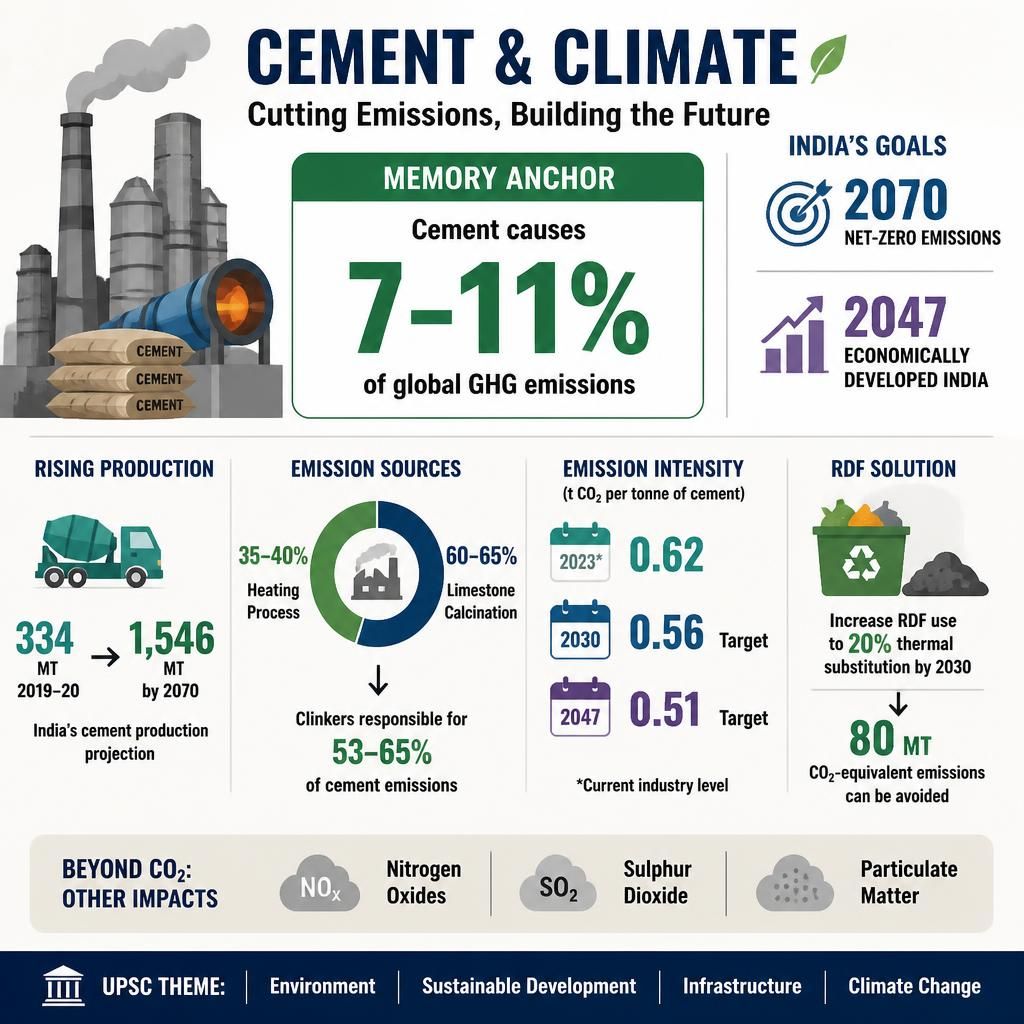
- India aims to achieve net-zero emissions by 2070 and become an economically developed country by 2047.
- The construction sector, particularly cement production, contributes significantly to global greenhouse gas emissions, with cement alone accounting for 7-11%.
- Cement manufacturing involves high-temperature processes and the calcination of limestone, which directly releases carbon dioxide.
- India's cement production is projected to rise from 334 million tonnes in 2019-20 to 1,546 million tonnes by 2070.
- Proposed solutions include increasing the use of Refuse-Derived Fuel (RDF), reducing clinker content, and implementing carbon capture technologies.
Cement and Climate.jpg
Detailed Insights:
- The construction sector's overall footprint contributes 35% to 40% of all greenhouse gas emissions globally.
- Portland cement, developed in the 19th century, became the standard binding agent, replacing traditional materials like lime-based mortars.
- Limestone extraction for cement requires clearing forests and topsoil, impacting ecosystems and carbon sequestration.
- The heating process in cement production accounts for 35% to 40% of its emissions, while the chemical breakdown of limestone (calcination) contributes the rest.
- Clinkers, formed during calcination, are responsible for 53% to 65% of cement-related emissions.
- India's cement industry currently emits 0.62 tonnes of CO2 per tonne of cement, with targets to reduce this to 0.56 tonnes by 2030 and 0.51 tonnes by 2047, as per a roadmap with the Global Cement and Concrete Association and The Energy and Resources Institute (TERI).
- Beyond CO2, cement manufacturing also releases air pollutants like nitrogen oxides, sulphur dioxide, and particulate matter.
- NITI Aayog recommends increasing RDF use from municipal solid waste to achieve a 20% thermal substitution rate by 2030, potentially reducing 80 million tonnes of CO2-equivalent emissions.
- Reducing clinker content by mixing it with industrial waste products like slag and fly ash can significantly lower emissions, with the International Energy Agency (IEA) noting that replacing one tonne of clinker avoids 0.83 tonnes of CO2.
- While Ordinary Portland Cement (OPC) is preferred for its faster strength gain, Portland pozzolana cement and Portland slag cement offer greener alternatives with lower clinker content.
- Traditional construction methods, such as Kath Kuni in Himachal Pradesh or using compressed earth blocks and lime-based binders, offer regional alternatives but face challenges in large-scale modern construction.
Key Concepts Involved:
- Net-zero emissions: Achieving a balance between the amount of greenhouse gases emitted into the atmosphere and the amount removed.
- Hard-to-abate sectors: Industries where decarbonization is particularly challenging due to technical, economic, or operational constraints.
- Calcination: A thermal decomposition process, typically of limestone, that releases carbon dioxide as a byproduct.
- Clinker: The main component of cement, produced by heating limestone and clay in a kiln, responsible for cement's binding properties.
- Refuse-Derived Fuel (RDF): A fuel produced from various types of waste materials, used as an alternative to fossil fuels in industrial processes like cement kilns.

SuperKalam is your personal mentor for UPSC preparation, guiding you at every step of the exam journey.
Download the App


STUDY RESOURCES
CONTACT US
ⓒ Snapstack Technologies Private Limited