EthicsGS 3: Science & TechnologyPrelimsGS 4: Ethics and Human InterfaceGS 3: Space Technology
Eyes On Ice, Pg6
Nobel Prize for IceCube observatory highlights neutrino astronomy, sparking debate over individual awards for collaborative scientific achievements and institutional traditions.
Practice MCQs
847 Students attempted
Key Highlights:
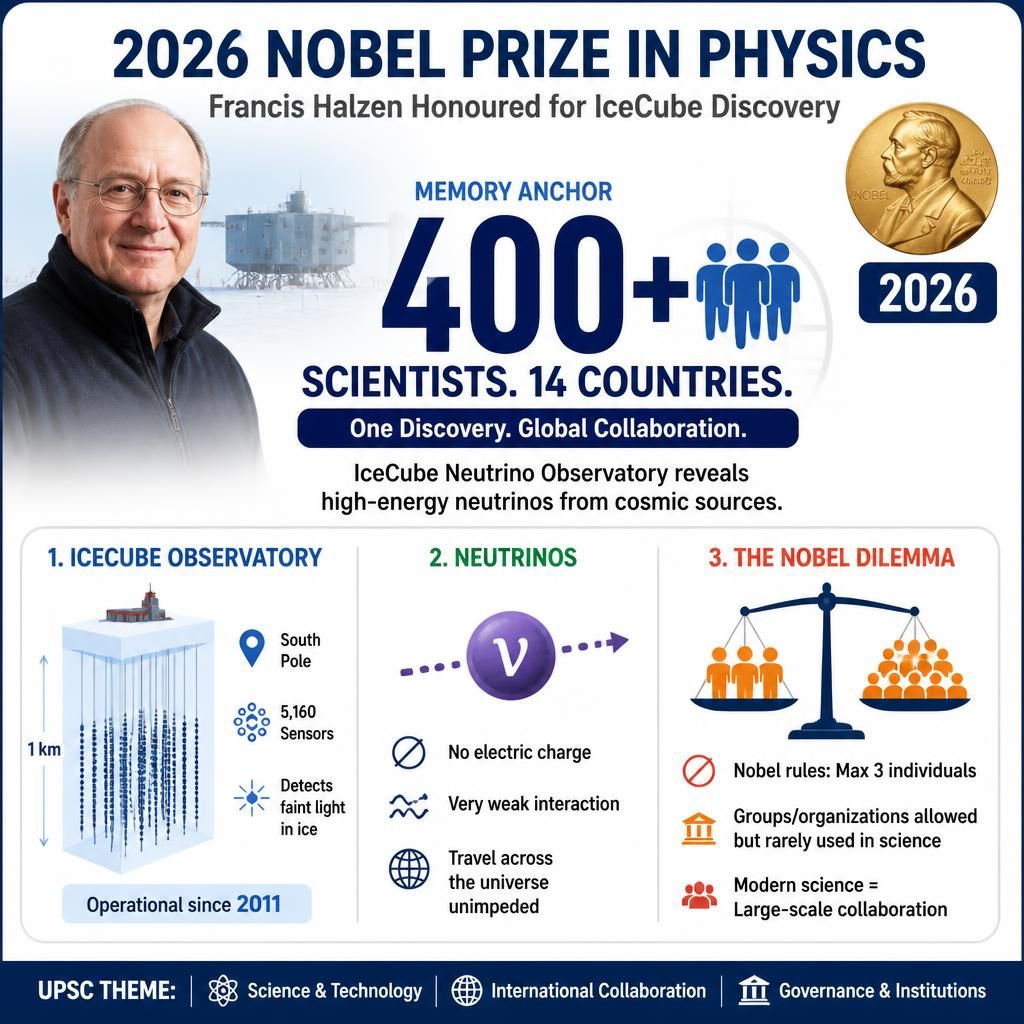
- Francis Halzen was awarded the 2026 Nobel Prize in Physics for his decisive contributions to the IceCube Neutrino Observatory and the discovery of high-energy neutrinos of astrophysical origin.
- The IceCube Neutrino Observatory, located at the South Pole, utilizes thousands of sensors embedded in a cubic kilometer of Antarctic ice to detect elusive subatomic particles called neutrinos.
- This observatory detects faint flashes of light produced when neutrinos interact with atoms in the ice, allowing scientists to reconstruct their energy and direction.
- The detection of high-energy neutrinos by IceCube has transformed astronomy by providing new insights into distant cosmic sources.
- The article critiques the Nobel Foundation's tradition of awarding individuals for scientific achievements that are the result of large-scale international collaborations.
Nobel Prize in Physics.jpg
Detailed Insights:
- The IceCube Neutrino Observatory became fully operational in 2011 and has since been crucial in identifying the origins of high-energy cosmic neutrinos.
- Neutrinos are fundamental particles that carry no electric charge and interact very weakly with matter, enabling them to travel across the universe largely unimpeded.
- The IceCube collaboration involves over 400 experts from 14 countries, highlighting the collective nature of modern scientific research.
- The Nobel Foundation's statutes limit each prize to a maximum of three individuals, which often does not reflect the collaborative reality of major scientific discoveries.
- Although the Nobel Foundation's statutes permit awarding prizes to organizations, this option is rarely exercised, particularly for scientific categories.
- This practice is seen as perpetuating an outdated model of scientific recognition, which can distort the understanding of how contemporary science progresses through extensive cooperation.
Scientific/Technical Concepts Involved:
- Neutrinos: Electrically neutral, nearly massless subatomic particles that interact very weakly with matter, making them difficult to detect but valuable cosmic messengers.
- IceCube Neutrino Observatory: A unique scientific instrument at the South Pole that uses a cubic kilometer of Antarctic ice as a detector for high-energy neutrinos.
- Neutrino Astronomy: A branch of astronomy that studies celestial objects and phenomena by detecting neutrinos, offering a complementary view to traditional light-based astronomy.

SuperKalam is your personal mentor for UPSC preparation, guiding you at every step of the exam journey.
Download the App


STUDY RESOURCES
CONTACT US
ⓒ Snapstack Technologies Private Limited