GS 3: EconomyPrelimsGS 3: Indian Economy, Planning, Mobilization of Resources, Growth, Development and EmploymentGS 2: Statutory, Regulatory and Quasi Judicial BodiesGS 2: Effect of Policies and Politics of Developed and Developing Countries on India's Interests
Dovish In August To Hawkish: How MPC Flipped In 2 Months, Pg19
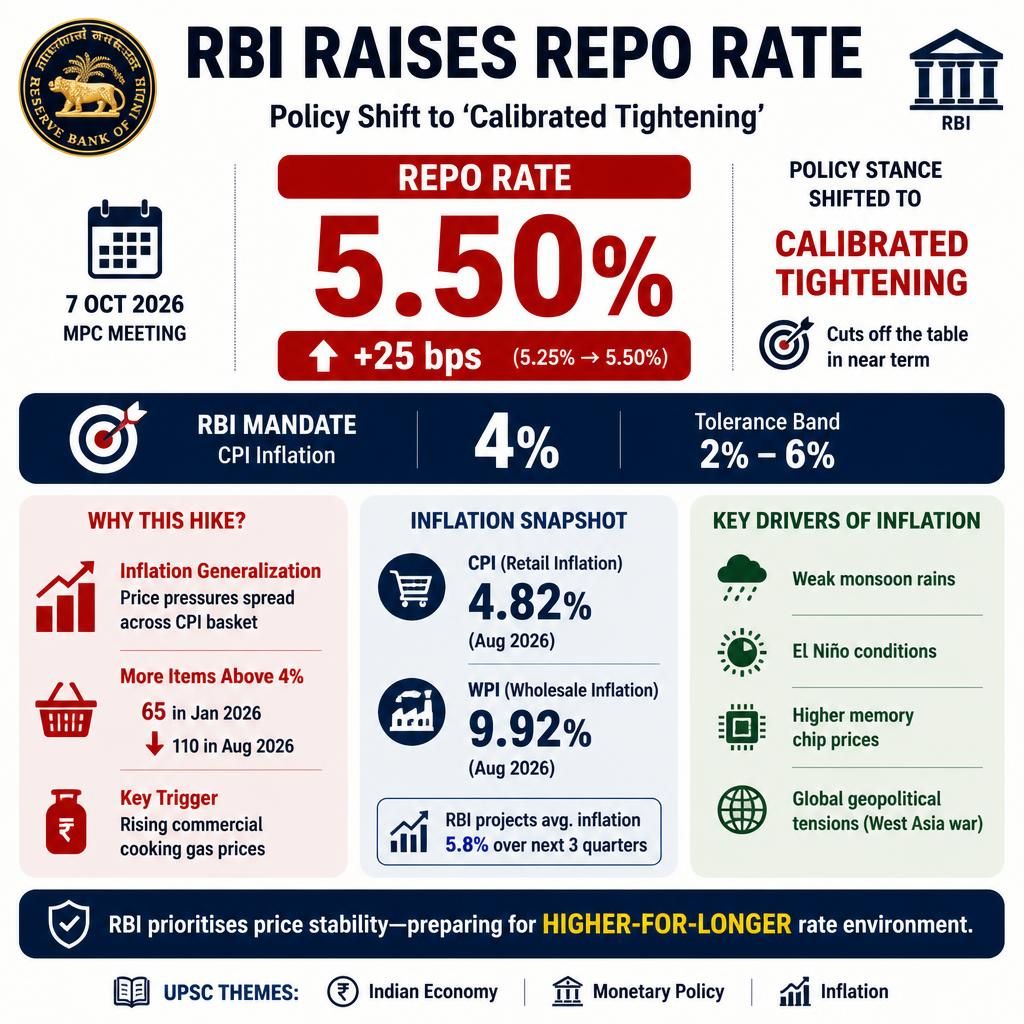
RBI's MPC hiked repo rate by 25 bps to 5.5%, shifting to 'calibrated tightening' from 'neutral' due to spreading inflation, signaling a hawkish turn.
Practice MCQs
847 Students attempted
Key Highlights:
- The Reserve Bank of India's (RBI) Monetary Policy Committee (MPC) increased the policy repo rate by 25 basis points (bps) to 5.5%.
- The MPC shifted its policy stance from 'neutral' to 'calibrated tightening'.
- This change signals that interest rate cuts are "off the table in the near term" and prepares markets for a "higher-for-longer interest rate environment."
- The decision was driven by concerns over the generalization of price pressures and rising Consumer Price Index (CPI) inflation.
- RBI Governor Sanjay Malhotra emphasized the need for policy recalibration due to projected average inflation of 5.8% over the next three quarters.
RBI and Repo Rate.jpg
Detailed Insights:
- The MPC decision was made on Wednesday, October 7, 2026, following its bi-monthly meeting.
- The RBI is mandated to maintain CPI inflation at 4% within a tolerance band of 2-6%.
- Inflation generalization, where price pressures spread across the CPI basket, was a key concern, evidenced by rising commercial cooking gas prices.
- The number of CPI items with inflation above 4% increased from 65 in January to 110 in August.
- Retail inflation (CPI) rose to 4.82% in August, while wholesale inflation (WPI) reached 9.92%.
- The RBI's revised projections indicate continued significant price pressures in the coming quarters.
- Factors contributing to inflationary pressures include weak monsoon rains, El Nino conditions, higher memory chip prices, and global geopolitical events like the West Asia war.
- The shift in stance reflects the MPC's acknowledgment of elevated inflation expectations and broader inflation.
- An increase in the repo rate makes borrowing more expensive for commercial banks, subsequently impacting lending rates for consumers and businesses.
Key Concepts Involved:
- Monetary Policy Committee (MPC): A statutory body in India responsible for fixing the benchmark interest rate to maintain price stability while supporting economic growth.
- Policy Repo Rate: The interest rate at which the Reserve Bank of India lends short-term funds to commercial banks against government securities.
- Basis Points (bps): A unit of measure equal to one one-hundredth (0.01%) of a percentage point, used to express changes in interest rates.
- Inflation Targeting: A monetary policy framework where the central bank publicly announces a target for the inflation rate and uses policy tools to achieve it.
- Calibrated Tightening: A monetary policy stance where the central bank either keeps policy rates constant or increases them, explicitly ruling out rate cuts.
- Consumer Price Index (CPI): A measure that examines the weighted average of prices of a basket of consumer goods and services, used as the primary inflation target in India.
- Wholesale Price Index (WPI): A measure that tracks the average change in the prices of goods at the wholesale level, before they reach consumers.
- El Nino: A climate pattern characterized by the unusual warming of surface waters in the equatorial Pacific Ocean, impacting global weather patterns, including monsoons in India.

SuperKalam is your personal mentor for UPSC preparation, guiding you at every step of the exam journey.
Download the App


STUDY RESOURCES
CONTACT US
ⓒ Snapstack Technologies Private Limited