GS 3: Science & TechnologyPrelimsGS 3: BiotechnologyGS 3: Science and Technology in Everyday Life
Chemistry Nobel for French-Japanese Duo Who Expanded ‘Mirrored’ Molecules Study, Pg1
French and Japanese chemists win Nobel for groundbreaking work on chiral molecules, enabling precise drug and agrochemical development.
Practice MCQs
847 Students attempted
Key Highlights:
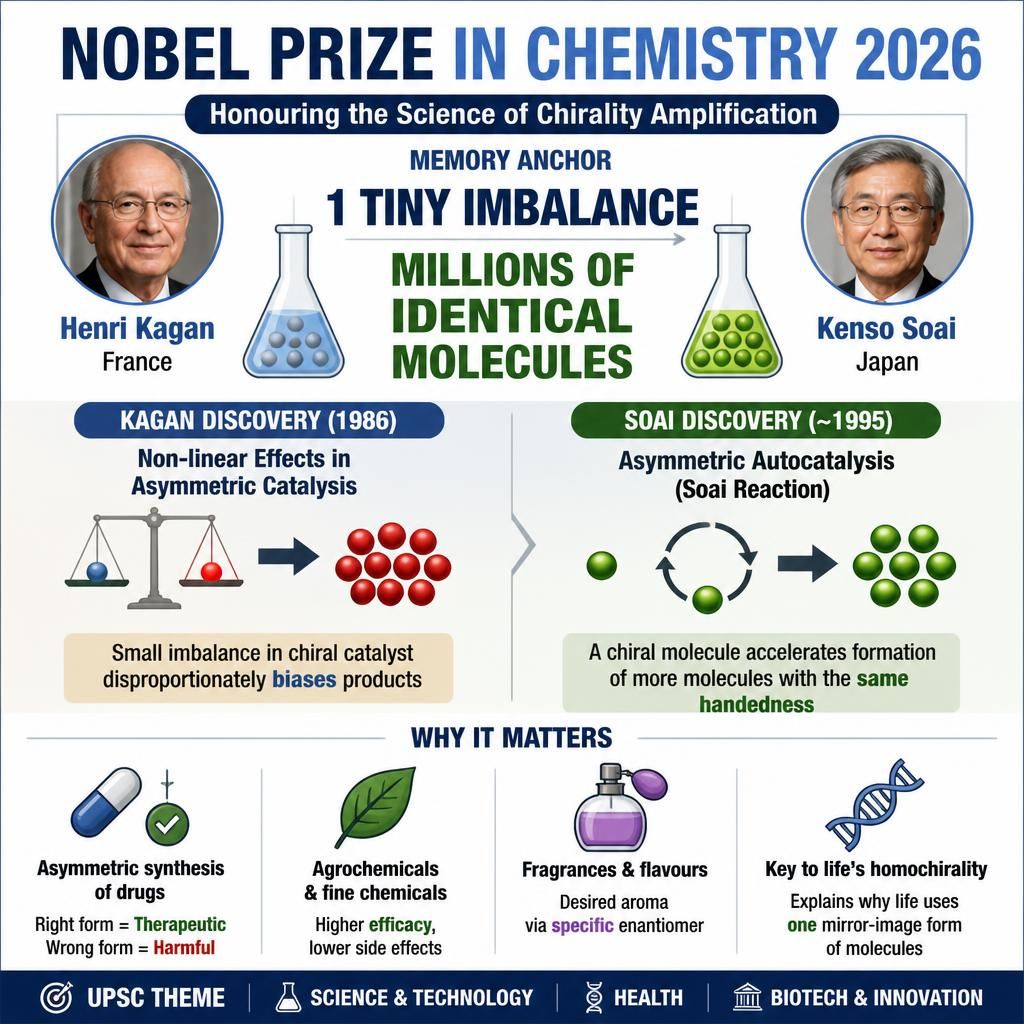
- French chemist Henri Kagan and Japanese chemist Kenso Soai were awarded the Nobel Prize in Chemistry 2026.
- The prize recognizes their groundbreaking work on how chemical reactions can amplify small asymmetries in molecules.
- Their discoveries centered on chiral molecules, which exist in two non-superimposable mirror-image forms.
- Kagan's research focused on non-linear effects in catalysis, while Soai discovered asymmetric autocatalysis.
- Their work is crucial for the asymmetric synthesis of desired forms of drugs, agrochemicals, and fragrances.
Nobel Prize in Chemistry.jpg
Detailed Insights:
- Henri Kagan's 1986 discovery showed that a small imbalance in a chiral catalyst could disproportionately bias the reaction's end products, establishing non-linear effects in asymmetric catalysis.
- Kenso Soai's work, nearly a decade later, demonstrated that a chiral molecule could accelerate the formation of other molecules with its own handedness, a process known as asymmetric autocatalysis or the Soai reaction.
- This research provides a solution to the long-standing chemical mystery of how homochirality emerges and why life predominantly uses one mirror-image form of molecules.
- Chiral molecules are vital in biology, as biological systems like enzymes and receptors are also chiral and interact differently with each mirror-image form of a molecule.
- The ability to control chirality in chemical reactions is paramount for pharmaceuticals, where one enantiomer may be therapeutic while its mirror image could be inactive or harmful, as seen in cases like Thalidomide.
- Their discoveries have significantly advanced asymmetric organic synthesis, enabling the production of single-enantiomer drugs with improved efficacy and reduced side effects.
Scientific/Technical Concepts Involved:
- Chirality: A property of molecules that are non-superimposable on their mirror images, akin to left and right hands.
- Enantiomers: The two mirror-image forms of a chiral molecule that cannot be superimposed on each other.
- Asymmetric Synthesis: Chemical reactions designed to preferentially produce one specific enantiomer over its mirror image.
- Asymmetric Autocatalysis: A process where a chiral product acts as a catalyst to produce more molecules of the same handedness, amplifying a small initial chiral imbalance.
- Non-linear Effects: In asymmetric catalysis, a non-proportional relationship where small changes in catalyst chirality lead to significantly larger changes in product chirality.

SuperKalam is your personal mentor for UPSC preparation, guiding you at every step of the exam journey.
Download the App


STUDY RESOURCES
CONTACT US
ⓒ Snapstack Technologies Private Limited