GS 3: Environment & EcologyPrelimsGS 3: Conservation, Pollution and DegradationGS 1: Changes in Critical Geographical Features, Water Bodies, Ice Caps, Flora and Fauna
Average size of vertebrate populations declined 73% in 52 yrs: WWF, Pg11
WWF's Living Planet Report reveals a shocking 73% decline in average vertebrate populations globally between 1970 and 2022, driven by habitat loss.
Practice MCQs
847 Students attempted
Key Highlights:
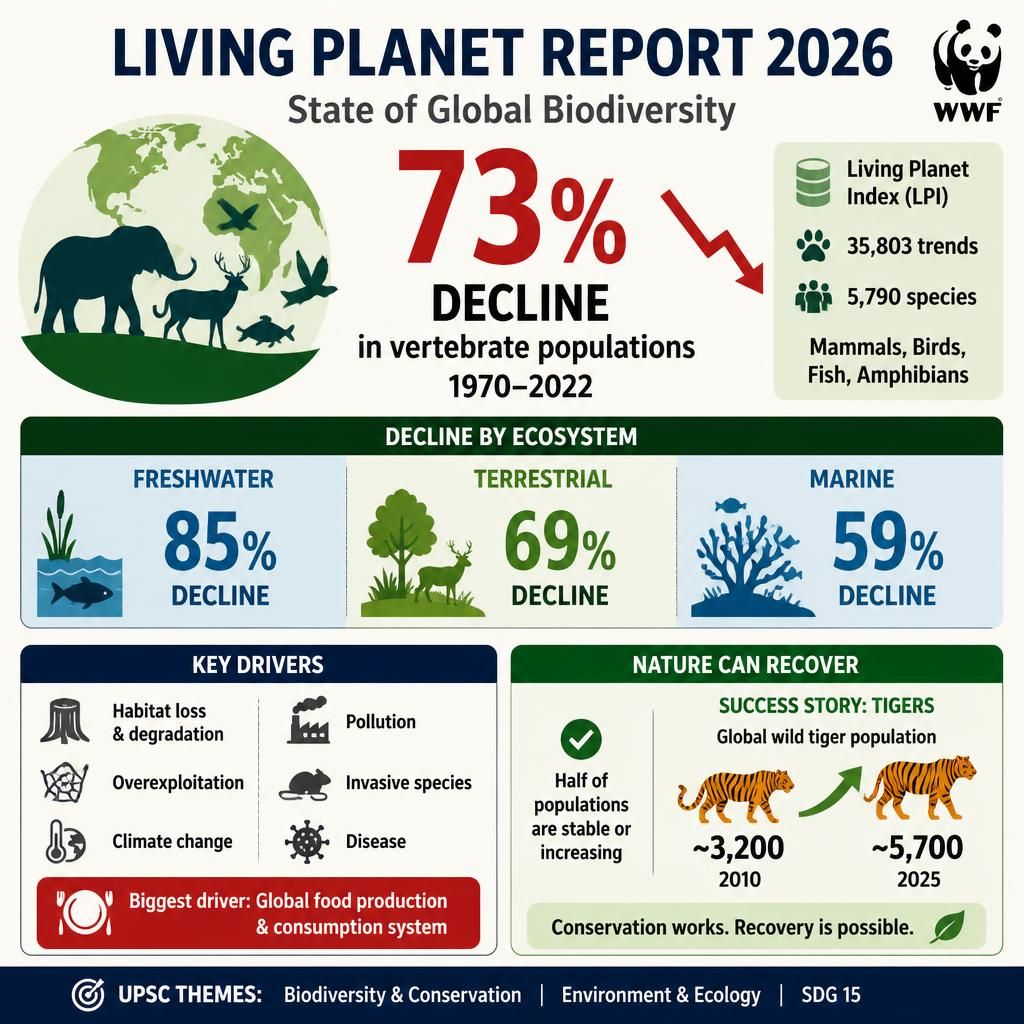
- The World Wide Fund for Nature (WWF) Living Planet Report 2026 indicates an average 73% decline in monitored vertebrate populations globally between 1970 and 2022.
- This decline is measured by the Living Planet Index (LPI), which tracks changes in the relative abundance of mammals, fish, birds, and amphibians.
- Freshwater ecosystems experienced the most significant decline at 85%, followed by terrestrial ecosystems at 69%, and marine ecosystems at 59%.
- Key drivers of this biodiversity loss include habitat degradation, overexploitation, climate change, invasive species, pollution, and disease.
- The report identifies the global food production and consumption system as the single largest contributor to biodiversity loss.
- Despite the overall negative trend, the report notes that half of the populations included in the LPI are stable or increasing, demonstrating nature's capacity for recovery.
- Successful conservation efforts have led to recoveries in populations of species such as tigers, green turtles, bluefin tuna, and southern African elephants.
Living Planet Report.jpg
Detailed Insights:
- The Living Planet Index (LPI), compiled by the Zoological Society of London (ZSL), incorporates 35,803 population trends from 5,790 vertebrate species.
- The LPI assesses average changes in population sizes rather than the absolute number of individual animals or species lost.
- The report emphasizes that biodiversity declines are not irreversible, suggesting that positive transformations in energy, food, and finance systems can trigger recovery.
- WWF-India highlights that sustained conservation actions, collaborative efforts, and long-term commitments are crucial for species recovery, citing the example of tigers in India.
- Global wild tiger populations have shown a notable increase, from approximately 3,200 in 2010 to around 5,700 by 2025.
- Habitat loss and degradation are identified as the most prevalent threats to wildlife populations, followed by overexploitation and climate change.
- The Living Planet Report serves as WWF's flagship biennial assessment, providing a comprehensive overview of the state of nature and the pressures contributing to its decline.
- The LPI has been adopted by the Convention on Biological Diversity (CBD) as a key indicator for monitoring progress towards global biodiversity targets.
- India has demonstrated significant conservation successes, including the recovery of species like the Asiatic lion, greater one-horned rhinoceros, and various deer species.
Key Concepts Involved:
- Living Planet Report: A biennial publication by WWF that assesses the health of the planet and the impact of human activity on wildlife and ecosystems.
- Living Planet Index (LPI): A scientific indicator that measures the state of global biodiversity by tracking average changes in the relative abundance of vertebrate species populations.
- Vertebrates: A subphylum of chordates characterized by the presence of a backbone or spinal column, including mammals, birds, fish, reptiles, and amphibians.
- Biodiversity Loss: The reduction in the variety of life on Earth, encompassing genetic diversity, species diversity, and ecosystem diversity.

SuperKalam is your personal mentor for UPSC preparation, guiding you at every step of the exam journey.
Download the App


STUDY RESOURCES
CONTACT US
ⓒ Snapstack Technologies Private Limited