GS 2: GovernanceGS 3: Science & TechnologyGS 3: Environment & EcologyGS 3: EconomyPrelims
Solar Manufacturing Push: Govt Weighs PLI For Local Polysilicon Production, Pg17
India weighs new PLI scheme for polysilicon production to deepen solar manufacturing value chain, cut imports, and reduce power costs.
Practice MCQs
833 Students attempted
Key Highlights:
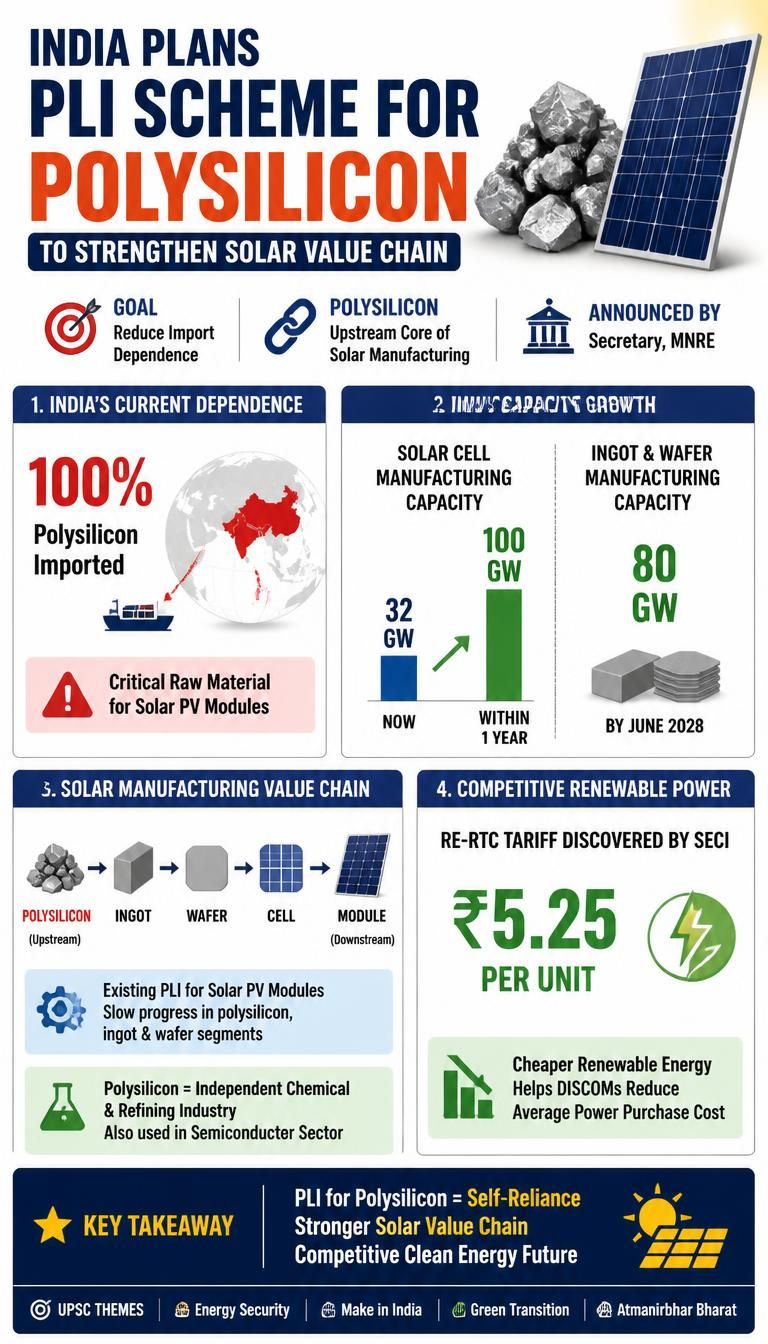
- The Indian government is planning a Production-Linked Incentive (PLI) scheme to boost domestic polysilicon manufacturing.
- India currently relies entirely on imports for polysilicon, a crucial raw material for solar photovoltaic (PV) modules.
- The new scheme aims to deepen India’s solar manufacturing value chain and reduce import dependence.
- Santosh Kumar Sarangi, Secretary at Ministry of New and Renewable Energy (MNRE), announced the initiative.
- India's domestic solar cell manufacturing capacity is projected to reach 100 gigawatts (GW) within a year, up from 32 GW.
PLI.jpg
Detailed Insights:
- Polysilicon represents the upstream segment in the solar manufacturing value chain, processed into ingots, wafers, cells, and finally modules.
- An existing PLI scheme for solar PV modules covers both upstream and downstream segments, but progress in polysilicon, ingot, and wafer production has been slow.
- The government views polysilicon manufacturing as an independent chemical and refining industry, with applications also in the semiconductor sector.
- The electricity tariff for Round-the-Clock Renewable Energy (RE-RTC) is becoming competitive, with a recent tender by Solar Energy Corporation of India Limited (SECI) discovering a tariff of Rs 5.25 per unit.
- Cheaper renewable energy is helping Distribution Companies (DISCOMs) reduce their average power purchase costs, which had previously been increasing rapidly.
- The country's ingot and wafer manufacturing capacity is expected to reach 80 GW by June 2028, addressing a key gap in the domestic value chain.
Scientific/Technical Concepts Involved:
- Polysilicon: A high-purity form of silicon, essential as a raw material for solar cells and semiconductor devices.
- Solar Photovoltaic (PV) Modules: Devices that convert sunlight directly into electricity using semiconductor materials, typically silicon.
- Production-Linked Incentive (PLI) Scheme: A government initiative offering incentives on incremental sales from products manufactured in domestic units.
- Round-the-Clock Renewable Energy (RE-RTC): Renewable energy projects designed to provide continuous power supply, often through a combination of solar, wind, and energy storage.

SuperKalam is your personal mentor for UPSC preparation, guiding you at every step of the exam journey.
Download the App


STUDY RESOURCES
CONTACT US
ⓒ Snapstack Technologies Private Limited