GS 2: GovernanceGS 2: Social JusticeGS 3: EconomyPrelimsGS 3: Indian Economy, Planning, Mobilization of Resources, Growth, Development and Employment
Demonetisation and the Health Costs of Cash Shortages, Pg6
Research reveals India's 2016 demonetisation significantly reduced acute medicine sales, especially in underserved areas, due to cash shortages, underscoring liquidity's critical role in public health access.
Practice MCQs
847 Students attempted
Key Highlights:
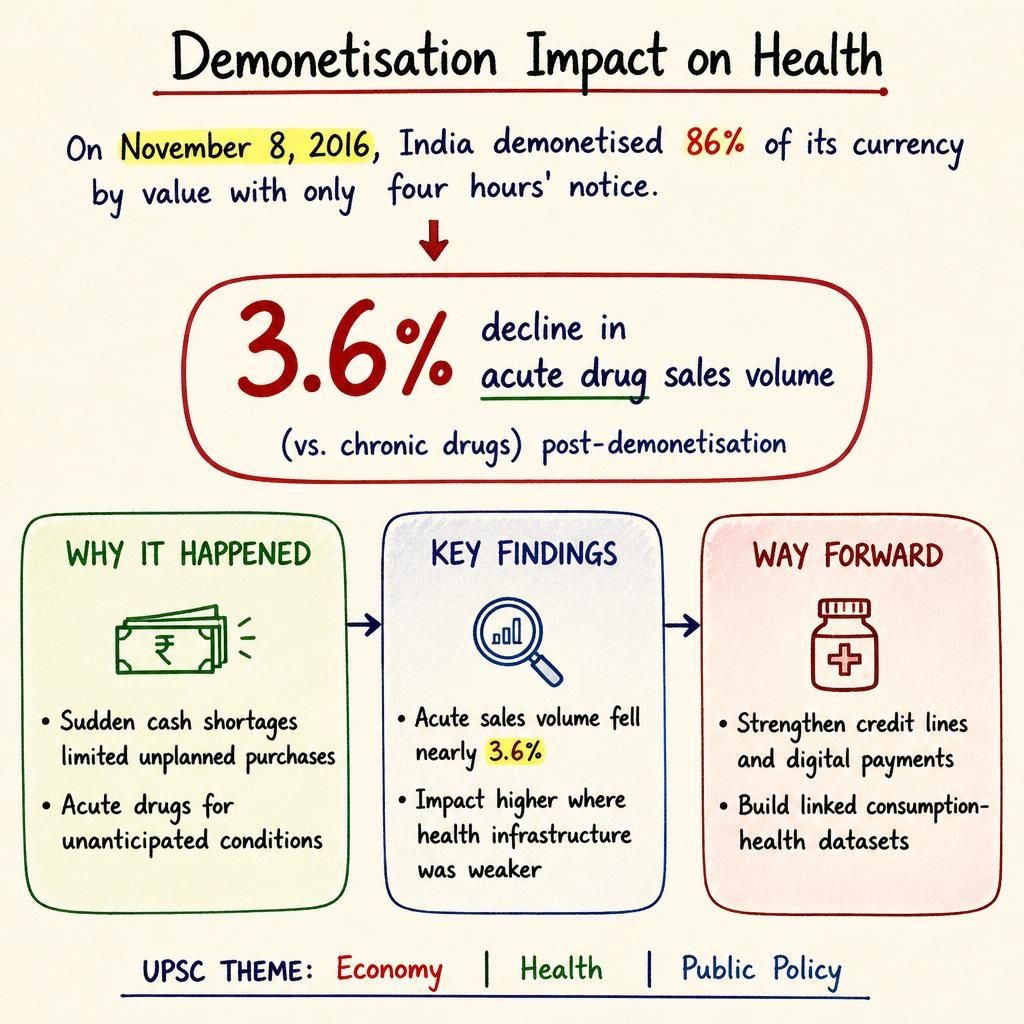
- On November 8, 2016, India demonetised 86% of its currency by value with only four hours' notice.
- The stated objectives included curbing black money, counterfeit currency, and promoting digital payments.
- A study found that sales volume of acute drugs fell by nearly 3.6% and value by 3.1% relative to chronic drugs post-demonetisation.
- This decline was linked to sudden cash shortages making unplanned purchases like acute medicines difficult for households.
- The research utilized the All India Organisation of Chemists and Druggists (AIOCD) database for its analysis.
- The study concludes that liquidity is an economic determinant of health, particularly in economies with high out-of-pocket expenditure.
Demonetisation Impact.jpg
Detailed Insights:
- The Reserve Bank of India reported that approximately 99.3% of the demonetised notes eventually returned to the banking system.
- The research employed a difference-in-differences design to account for dynamic variations across regions, companies, and illness categories.
- Acute drugs, typically bought for unanticipated conditions, were more affected than chronic drugs, which are purchased regularly and allow for price comparison.
- Alternative explanations, such as changes in prescription trends or disease outbreaks, were ruled out using data from the Integrated Disease Surveillance Programme (IDSP).
- The negative impact was more pronounced in areas with weaker public health infrastructure, suggesting that local health centre density mitigated the shock.
- Post-2016, India has expanded initiatives like Jan Aushadhi Kendras, Ayushman Bharat Pradhan Mantri Jan Arogya Yojana (AB-PMJAY), and UPI payments to enhance resilience.
- Future large-scale currency operations should incorporate specific health-sector protocols, such as ensuring credit lines or digital payment facilitation at pharmacies.
- The study emphasizes the critical need for better linked consumption-health datasets to accurately measure welfare impacts and enable precise causal estimation.
Key Concepts Involved:
- Demonetisation: The act of stripping a currency unit of its status as legal tender.
- Out-of-pocket expenditure: Direct payments made by individuals for healthcare services at the point of use.
- Search costs: The time, effort, and money consumers spend to find suitable goods or services.
- UPI (Unified Payments Interface): An instant real-time payment system developed by the National Payments Corporation of India.

SuperKalam is your personal mentor for UPSC preparation, guiding you at every step of the exam journey.
Download the App


STUDY RESOURCES
CONTACT US
ⓒ Snapstack Technologies Private Limited