GS 2: GovernanceGS 3: EconomyPrelimsGS 3: Indian Economy, Planning, Mobilization of Resources, Growth, Development and EmploymentGS 2: Government policies and interventions for development in various sectors
Why Charging For UPI Changes The Math, Pg7
Finance Ministry implements 0.4% MDR on UPI transactions above ₹2,000, sparking debate on digital payment sustainability and economic formalization.
Practice MCQs
840 Students attempted
Key Highlights:
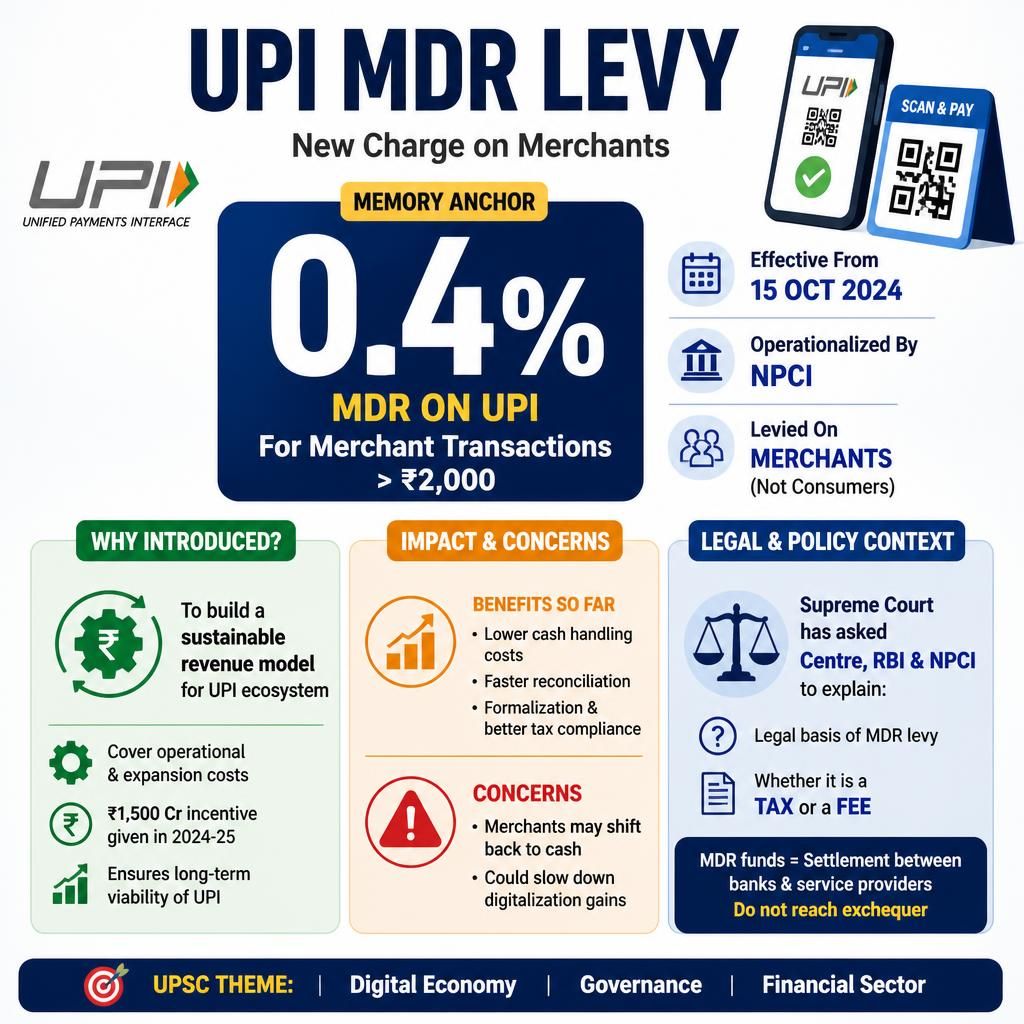
- The Union Finance Ministry has notified a 0.4% Merchant Discount Rate (MDR) on specified merchant transactions above ₹2,000 for Unified Payments Interface (UPI).
- This MDR will be operationalized by the National Payments Corporation of India (NPCI) from October 15.
- Consumers will not be directly charged; the MDR will be levied on merchants.
- The Supreme Court has asked the Centre, RBI, and NPCI to explain the legal basis for this levy, including whether it constitutes a tax or a fee.
- This move marks a significant shift from UPI's previous zero-MDR model for merchants.
UPI MDR.jpg
Detailed Insights:
- The introduction of MDR aims to create a sustainable revenue model for the UPI ecosystem, covering operational and expansion costs.
- UPI has provided significant economic benefits, including reduced cash handling costs for businesses and consumers, faster account reconciliation, and enhanced formalization and tax compliance for the government.
- The government previously incentivized low-value merchant transactions with ₹1,500 crore in 2024-25, recognizing the value of digital payments.
- While the government clarified that MDR funds are a settlement between banks and service providers and do not reach the exchequer, the economic implications remain a subject of debate.
- Concerns exist that MDR could lead some merchants to revert to cash transactions, negating the benefits of digitalization and formalization.
- The zero-MDR policy for UPI and RuPay had fostered a domestic payments ecosystem, potentially at the expense of global card networks like Visa and Mastercard.
- The USTR had previously viewed India's zero-MDR policy as a market-access barrier, suggesting that the new MDR could benefit international players if transactions shift away from UPI.
Key Concepts Involved:
- Unified Payments Interface (UPI): An instant real-time payment system developed by NPCI facilitating inter-bank peer-to-peer and person-to-merchant transactions.
- Merchant Discount Rate (MDR): A fee paid by a merchant to their bank for accepting payments through digital channels.
- National Payments Corporation of India (NPCI): An umbrella organization for operating retail payments and settlement systems in India, promoted by the RBI and IBA.

SuperKalam is your personal mentor for UPSC preparation, guiding you at every step of the exam journey.
Download the App


STUDY RESOURCES
CONTACT US
ⓒ Snapstack Technologies Private Limited