GS 2: GovernanceGS 3: EconomyPrelimsGS 3: Government BudgetingGS 3: Indian Economy, Planning, Mobilization of Resources, Growth, Development and Employment
Higher Yields In US Test India's Macro Resilience, Pg15
Rising US treasury yields and Fed rate hikes test India's macro resilience, despite strong fundamentals, raising borrowing costs and geopolitical risks.
Practice MCQs
840 Students attempted
Key Highlights:
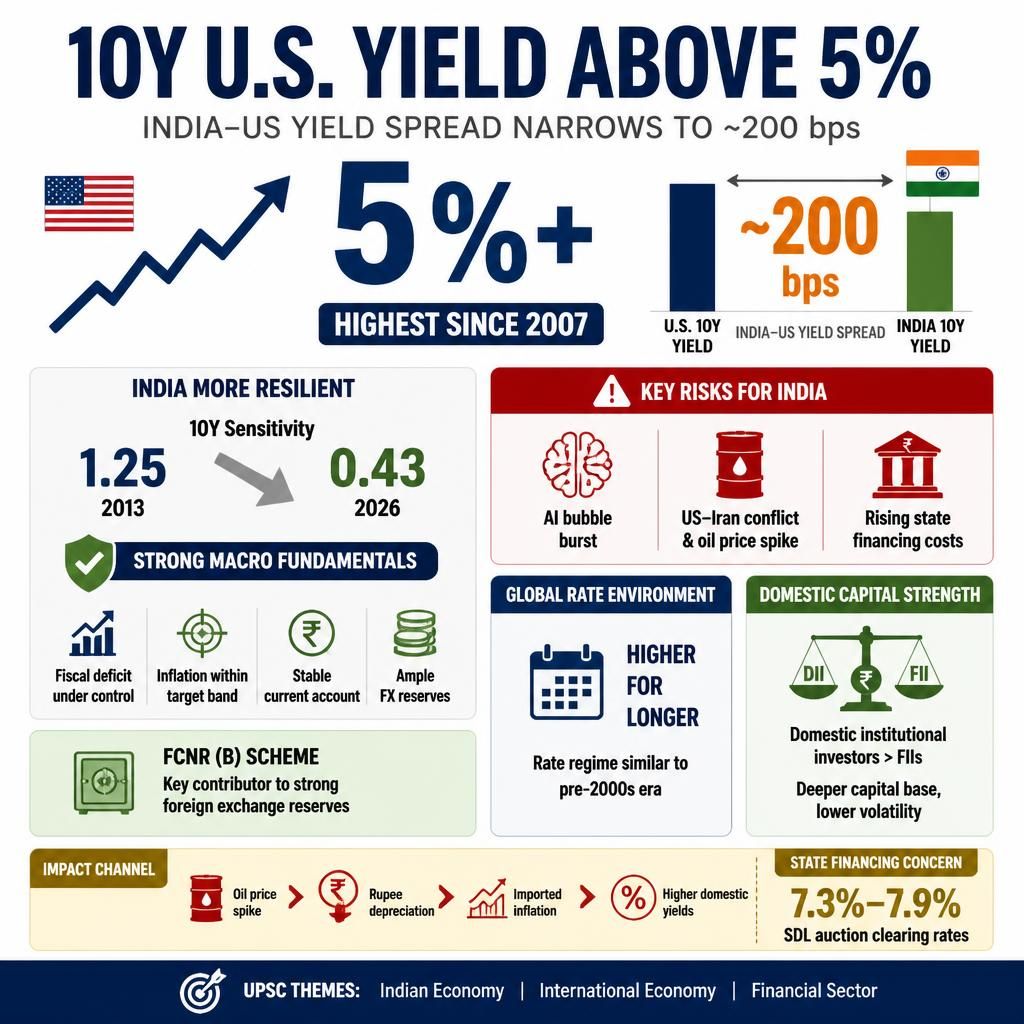
- The 10-year US treasury yields have risen above 5 percent, reaching their highest level since 2007.
- This development has narrowed the India-US yield spread to approximately 200 basis points.
- The US Federal Reserve is continuing its rate hike cycle to manage inflation, impacting global markets.
- India's economy demonstrates increased resilience to external volatility, with its 10-year sensitivity falling from 1.25 in 2013 to 0.43 in 2026.
- Key risks for India include potential AI bubble bursting, the US-Iran geopolitical conflict affecting oil prices, and rising state financing costs.
US Bond Yield.jpg
Detailed Insights:
- Higher US yields increase India's borrowing costs, particularly for long-term issuances, raising fiscal risks.
- The current global environment suggests a "higher for longer" interest rate scenario, reminiscent of pre-2000s market conditions.
- India's macroeconomic fundamentals are robust, characterized by a controlled fiscal deficit, inflation within the target band, a stable current account, and ample foreign exchange reserves.
- The FCNR (B) scheme has contributed significantly to India's strong reserve position.
- Domestic institutional investors have surpassed foreign institutional investors in ownership, deepening India's capital base and reducing capital flow volatility.
- Spikes in Brent crude oil prices due to geopolitical tensions can lead to imported inflation, rupee depreciation, and higher domestic yields.
- State financing through the bond market is a concern, with State Development Loans (SDL) auctions clearing at higher rates between 7.3% and 7.9%.
Key Concepts Involved:
- US Treasury Yields: The return an investor receives on US government bonds, serving as a benchmark for global interest rates.
- Basis Points: A common unit of measure for interest rates and other financial percentages, equal to one-hundredth of a percentage point.
- Fiscal Deficit: The difference between the government's total expenditure and its total revenue, excluding borrowings.
- Current Account: A component of a country's balance of payments, recording its transactions in goods, services, and income with the rest of the world.
- FCNR (B) scheme: A deposit scheme allowing Non-Resident Indians (NRIs) to hold foreign currency deposits in Indian banks, helping to boost foreign exchange reserves.
- State Development Loans (SDL): Bonds issued by state governments in India to finance their fiscal deficits and development projects.
- Brent Crude: A major trading classification of sweet light crude oil that serves as a benchmark price for purchases of oil worldwide.
- AI bubble: A speculative economic bubble characterized by rapid and unsustainable growth in the valuation of companies involved in artificial intelligence.

SuperKalam is your personal mentor for UPSC preparation, guiding you at every step of the exam journey.
Download the App


STUDY RESOURCES
CONTACT US
ⓒ Snapstack Technologies Private Limited