GS 3: Science & TechnologyPrelimsGS 3: Space Technology
Sharpest Pictures Of Sun’s Surface Reveal Previously Unseen Whirlpools, Pg II
World's largest solar telescope captures sharpest images of Sun's surface, revealing violent plasma whirlpools crucial for understanding solar flares and atmospheric heating.
Practice MCQs
833 Students attempted
Key Highlights:
- Scientists have captured the highest-resolution images of the sun's surface, revealing previously unseen small, violent plasma whirlpools.
- The discovery was made using the NSF Daniel K. Inouye Solar Telescope (DKIST) in Hawaii.
- These whirlpools are believed to be an efficient mechanism for transferring energy and magnetic flux within the sun's atmosphere.
- The findings could provide insights into the coronal heating problem and the energy release mechanisms behind solar flares.
- The research was published in Nature on August 5.
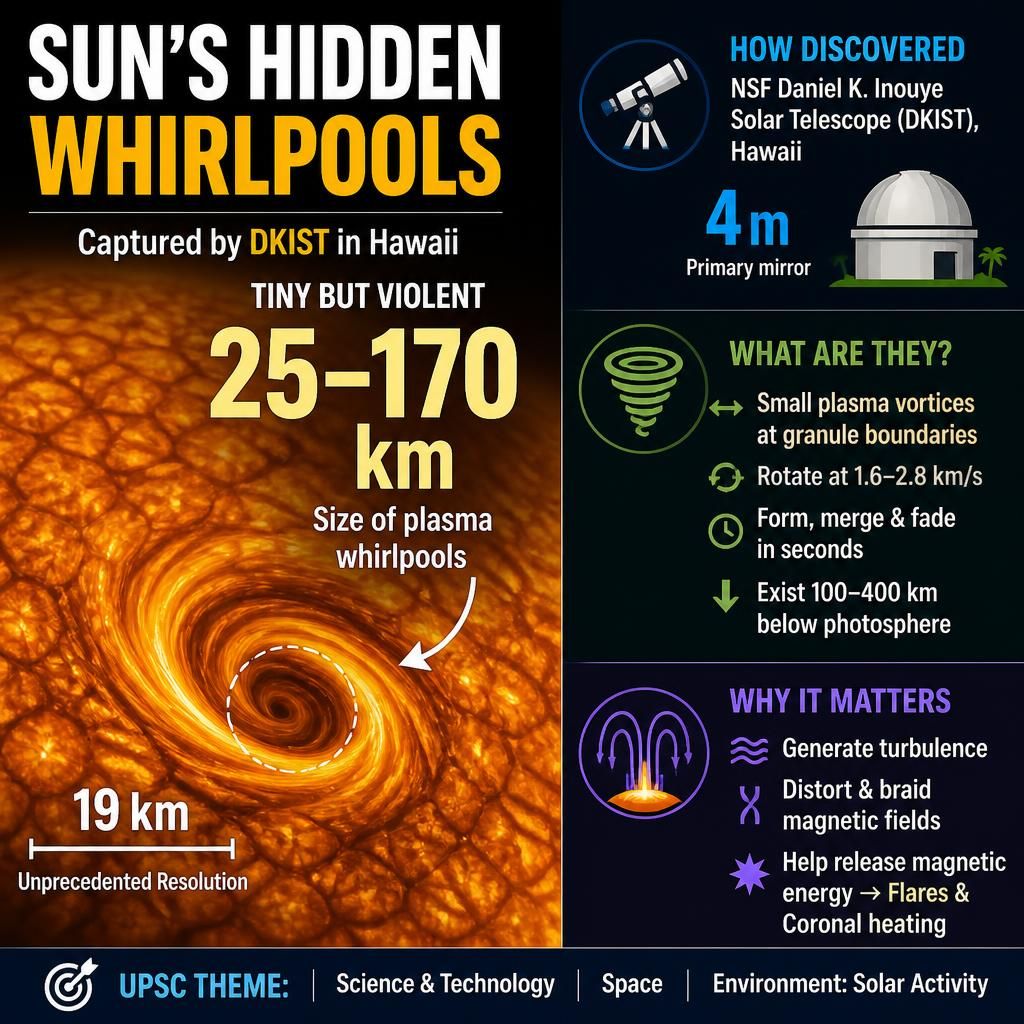
Whirlpools.jpg
Detailed Insights:
- The visible part of the sun, known as the photosphere, is a turbulent environment composed of superheated plasma.
- Previous observations of the sun's surface showed convection cells, or granules, which are large structures up to 2,000 km wide, but their edges appeared blurred.
- The DKIST, with its 4-meter primary mirror, enabled imaging at an unprecedented resolution of 19 km, resolving the previously blurred edges.
- The newly discovered whirlpools are small coils of plasma, ranging from 25-170 km in length, located at the boundaries of the granules.
- These vortices rotate rapidly at speeds of 1.6-2.8 km/s, constantly forming, merging, and dissipating within seconds.
- Magneto-hydrodynamics simulations confirmed the observations and indicated that these whirlpools exist 100-400 km below the photosphere.
- The whirlpools are thought to generate turbulence, distort magnetic fields, and facilitate the braiding of magnetic field lines, which can lead to the release of magnetic energy.
Scientific/Technical Concepts Involved:
- Photosphere: The visible surface layer of the sun, from which light is emitted.
- Convection Cells (Granules): Temporary, beehive-like structures on the sun's surface caused by rising hot plasma and sinking cooler plasma.
- Solar Flares: Sudden, intense bursts of radiation and energy from the sun's surface, often associated with magnetic field reconfigurations.
- Coronal Heating Problem: The long-standing scientific puzzle of why the sun's outer atmosphere, the corona, is millions of degrees hotter than its surface.
- Magneto-hydrodynamics (MHD): The study of the motion of electrically conducting fluids, such as plasma, in the presence of magnetic fields.
- NSF Daniel K. Inouye Solar Telescope (DKIST): The world's largest solar telescope, located in Hawaii, designed for high-resolution observations of the sun.

SuperKalam is your personal mentor for UPSC preparation, guiding you at every step of the exam journey.
Download the App


STUDY RESOURCES
CONTACT US
ⓒ Snapstack Technologies Private Limited