GS 2: GovernanceGS 3: EconomyPrelimsGS 3: Indian Economy, Planning, Mobilization of Resources, Growth, Development and EmploymentGS 2: Important Aspects of Governance, Transparency and Accountability
GDP debate is not about numbers alone. It is about trust deficit, Pg11
Controversial GDP data release fuels trust deficit, questioning MoSPI's methodology and government's economic transparency amidst expert criticism.
Practice MCQs
833 Students attempted
Key Highlights:
- The release of new GDP data for 2026-27 has sparked a debate, with former finance secretary Subhash Garg alleging that the Ministry of Statistics and Programme Implementation (MoSPI) overstated growth.
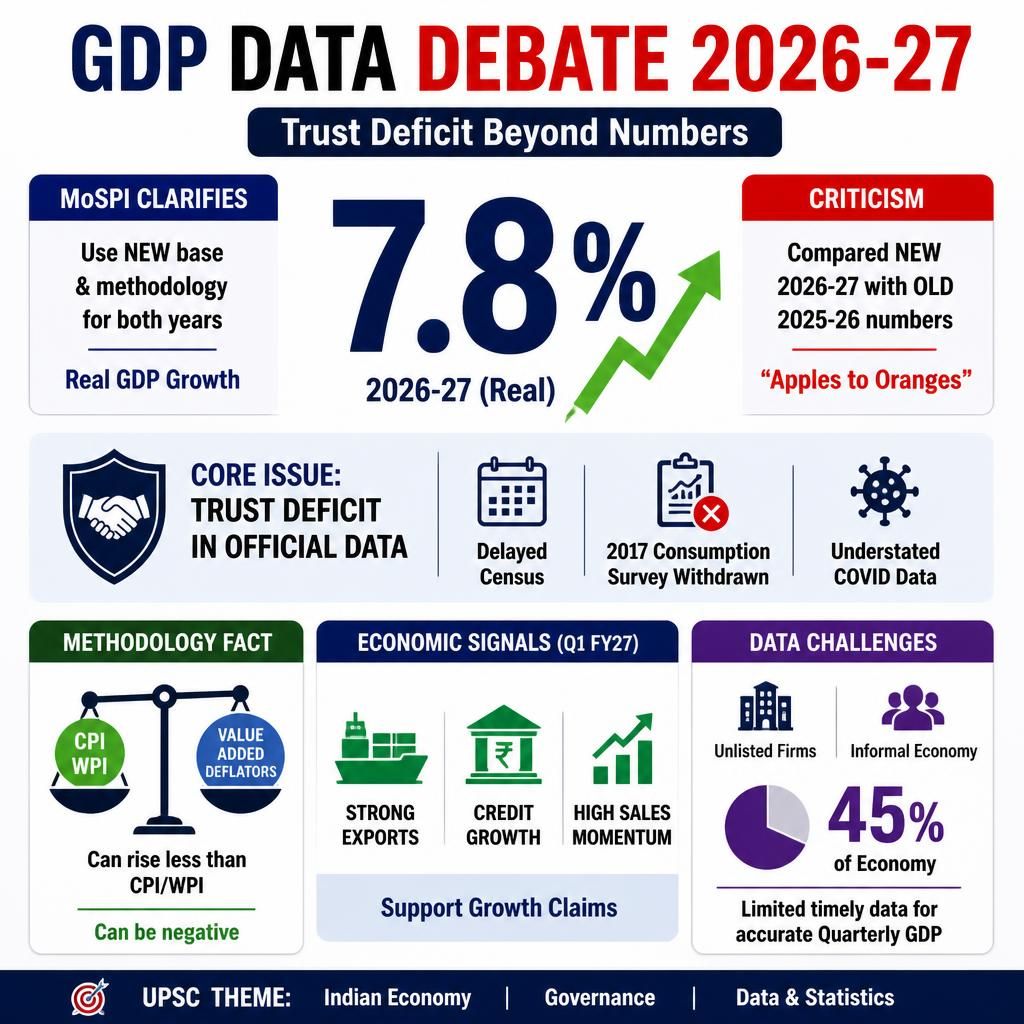
- MoSPI defended its methodology, stating that comparing data using the new base and methodology for both years yields a real growth of 7.8%.
- The controversy highlights a fundamental "trust deficit" in government data, exacerbated by past issues like the 2016-17 GDP figures during demonetisation.
- Critics question the reported economic acceleration amidst an energy shock and call for greater transparency from the government.
GDP Debate.jpg
Detailed Insights:
- Subhash Garg's criticism compares 2026-27 GDP calculated with the new base and methodology to 2025-26 numbers using the old system, which MoSPI terms an "apples to oranges" comparison.
- MoSPI also clarified that value-added deflators can rise less than the Consumer Price Index (CPI) or Wholesale Price Index (WPI), and can occasionally be negative.
- Macroeconomic indicators such as exports, credit, and sales showed strong performance in the first quarter, lending some support to the growth claims.
- The trust deficit extends beyond GDP, encompassing issues like the delayed census, the withdrawn 2017 consumption survey, and understated Covid data.
- Challenges persist in accurately calculating quarterly GDP due to a lack of timely information on unlisted firms and the informal economy, which together account for nearly 45% of the economy.
- The reported economic acceleration is difficult to reconcile with the energy shock, fuel rationing, tepid wage growth, and poor job creation experienced in April and May 2026.
- The Reserve Bank of India (RBI) had previously estimated a slowdown in the first quarter, contrasting with MoSPI's projection of accelerated growth.
- The government is urged to release the complete "Sources and Methods" document detailing GDP calculation and revisions, and to acknowledge any past overestimation of growth.
Key Concepts Involved:
- Gross Domestic Product (GDP): The total monetary value of all finished goods and services produced within a country's borders in a specific time period.
- Base Year: A reference year used for calculating economic indices like GDP, allowing for consistent comparison of economic growth over time.
- GDP Deflator: A measure of the level of prices of all new, domestically produced, final goods and services in an economy.
- Trust Deficit: A lack of confidence or belief in an entity, often referring to public skepticism towards government data or institutions.

SuperKalam is your personal mentor for UPSC preparation, guiding you at every step of the exam journey.
Download the App


STUDY RESOURCES
CONTACT US
ⓒ Snapstack Technologies Private Limited